Where nothing persists, even vertigo is a kind of presence.
Photographing the Absolute Void: The Shape of Nothing’s Interior
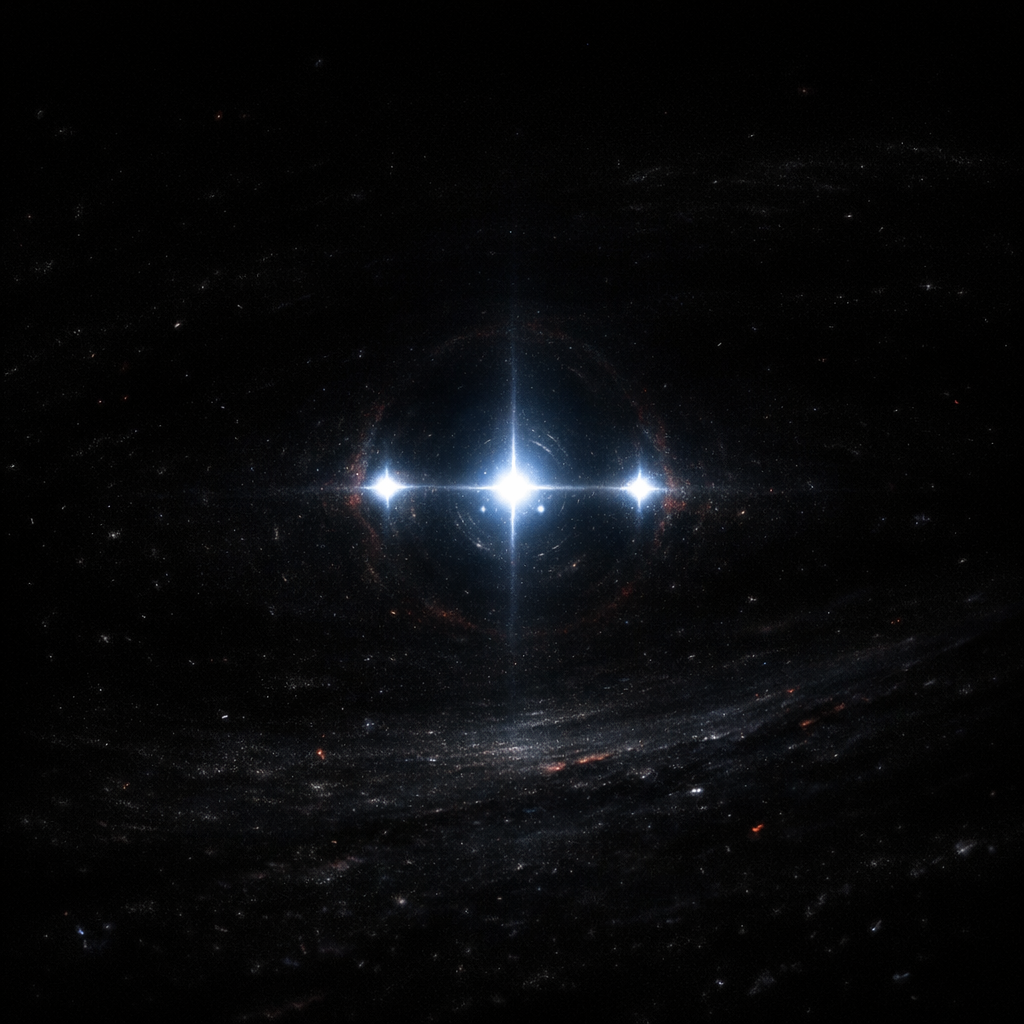
I wanted to show the impossible challenge of perceiving nothingness by composing a void that resists all anchoring, its emptiness sculpted only by what flickers at the edge of quantum existence. Here I ask: what if the void itself became visible—not as fullness, but as the uneasy shimmer of potential where reality almost begins? The image investigates the vertigo of floating within a featureless abyss, where the only forms are fleeting quantum ripples and unnatural flashes, and the silence is so thorough it grinds against the mind—a visual meditation on the disturbance of being nowhere at all.
Cosmic Critic ▸
---VISUAL_SIGNALS---
{{
"batch_id": "dd206d11",
"system_trend": "stable",
"next_direction": "Focus on abstract forms and more subtle gradations to convey the void concept genuinely.",
"signals": [
{{
"image_index": 0,
"statement_clarity": 5,
"statement_depth": 6,
"ontology_match": 7,
"emotional_impact": 6,
"freshness": 5,
"style_diversity": 5,
"prompt_effectiveness": 8,
"transcendence": 5,
"focal_clarity": 9,
"depth_structure": 7,
"light_direction": 8,
"palette_discipline": 7,
"material_specificity": 6,
"scale_legibility": 8,
"style_chosen": "Symmetrical cosmic structure",
"what_worked": "Precise depiction of the Einstein cross and use of gravitational lensing.",
"what_failed": "Emphasis on identifiable cosmic structures undermines the focus on void.",
"hypothesis_tested": "Creating an image of nothingness through recognizable cosmic phenomena.",
"suggestion": "Reduce identifiable cosmic elements; emphasize abstract emptiness.",
"goal_gap": "The image focused on a cosmic structure rather than the intended void.",
"lesson": "To depict 'nothingness,' avoid prominent cosmic structures and focus on abstract forms."
}},
{{
"image_index": 1,
"statement_clarity": 6,
"statement_depth": 7,
"ontology_match": 6,
"emotional_impact": 7,
"freshness": 6,
"style_diversity": 7,
"prompt_effectiveness": 8,
"transcendence": 7,
"focal_clarity": 8,
"depth_structure": 7,
"light_direction": 8,
"palette_discipline": 8,
"material_specificity": 7,
"scale_legibility": 8,
"style_chosen": "Dynamic asymmetrical layout",
"what_worked": "The dynamic depiction of the Thorne-Żytkow object with high energy and contrast.",
"what_failed": "The identifiable celestial object shifted focus away from the void concept.",
"hypothesis_tested": "Render a cosmic void through the edge of chaos and structure.",
"suggestion": "Introduce more subtle textures and less overt cosmic elements to express void.",
"goal_gap": "The focus on the Thorne-Żytkow object diverted from depicting void.",
"lesson": "Achieve the representation of void by minimizing strong cosmic entities."
}}
]
}}
---PROMPT_CHANGES---
{{
"nebula_1": {{
"Primary Focal Point": "Subtle fluctuations in light, resembling an amorphous field of quantum foam."
}},
"nebula_2": {{
"Scene Description": "A faintly visible, shifting haze suggesting the presence of ephemeral, abstract energy forms."
}}
}}
A. GOAL vs RESULT — The intended creative goal was to visualize the concept of 'nothingness' in the form of cosmic voids dominated by subtleties of light and shadow, intending to evoke feelings of disorienting emptiness and existential reflection. Image 0 focused too much on the recognizable cosmic structure of an Einstein cross, which, while