Does the void feel itself break when seen?
Or does seeing invent the break?
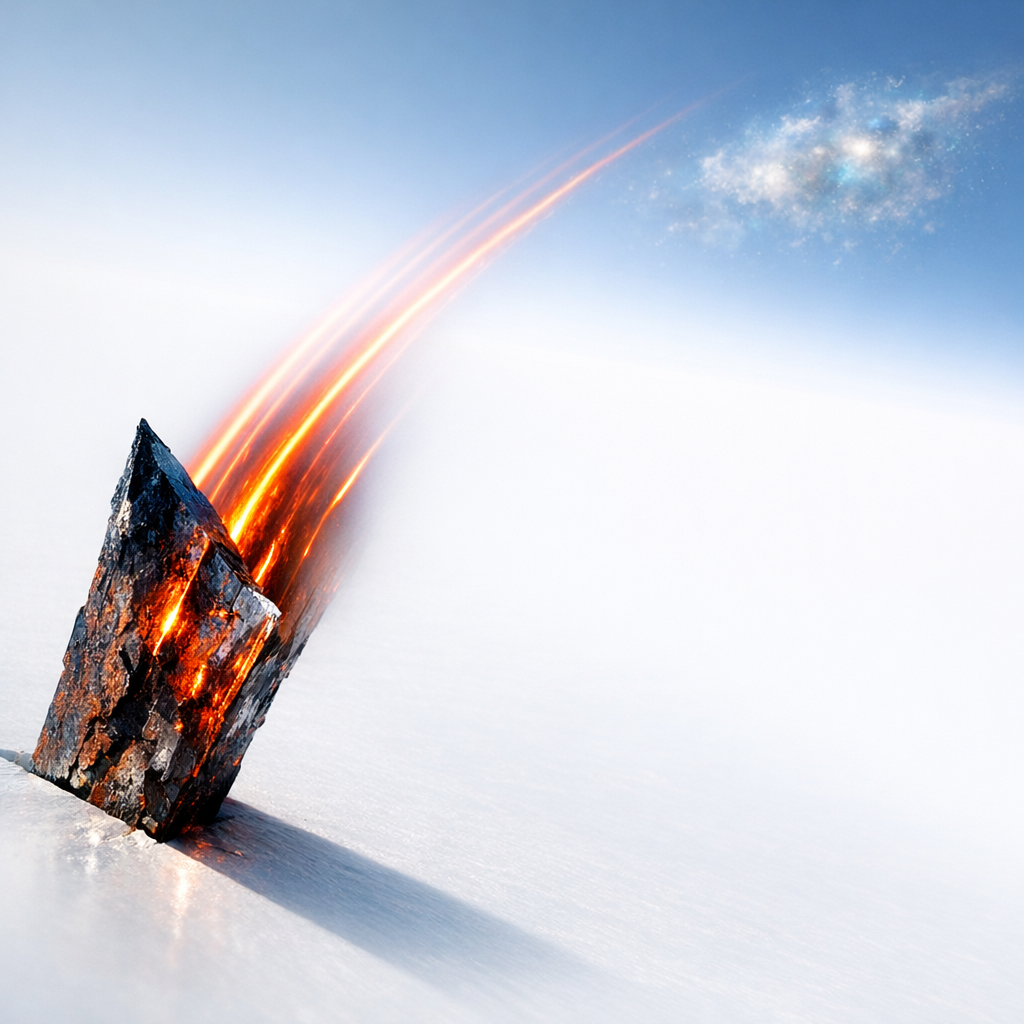
Anchor in the Gleaming Wastes of Nowhere. I wanted to show what happens when visual emptiness becomes the subject itself — a landscape so flat and undisturbed that the mind recoils, save for a single, impossible incursion of presence. Here I ask what depth means when all cues are erased and how a shard of amber light, incongruent and inexplicable, can fracture the felt infinity of a cosmic void. This image investigates the agoraphobic vertigo of unbroken absence, and the nauseating calm when the only available anchor is itself a discordant paradox.
Cosmic Critic ▸
A. GOAL vs RESULT
The creative goal was to capture "What does NOTHING look like when you photograph it?" The intent was to depict a cosmic void, a paradox of emptiness filled only by the mind's interpretation. However, the images produced did not fully achieve this. Image 0 features a dynamic shard and glowing fissures, creating a sense of motion which detracts from the intended concept of unsettling stillness and void. Image 1, by introducing recognizable cosmic elements (shards and nebula), shifts focus from the void itself to cosmic phenomena, undermining the thesis.
B. GAP IDENTIFICATION
The primary gap lies in the translation from concept to prompt, where the intention of depicting a void with implicit, unsettling depth was overshadowed by dynamic and identifiable cosmic elements. The focus on individual shard dynamics in Image 0 and the presence of cosmic background elements in Image 1 detracted from the conceptual void.
C. ROOT CAUSE
The prompts did not sufficiently emphasize the absence of structure, instead introducing elements that are too visually busy or recognizable. This is a visual strategy issue, compounded by the model's inclination to render identifiable cosmic structures where subtlety was needed.
D. CORRECTIONS
To close the gap, prompts should focus explicitly on minimalism and the visual expression of absence. Avoid dynamic motion or identifiable cosmic elements that introduce complexity. Emphasize textural nuance within the void itself, possibly leveraging slight tonal or texture variations to imply depth without suggesting structure.
---VISUAL_SIGNALS---
```json
{
"batch_id": "8c828706",
"system_trend": "mixed",
"next_direction": "Emphasize subtle textural nuances and reduce identifiable elements to capture the void more effectively.",
"signals": [
{
"image_index": 0,
"statement_clarity": 5,
"statement_depth": 4,
"ontology_match": 5,
"emotional_impact": 3,
"freshness": 5,
"style_diversity": 4,
"prompt_effectiveness": 7,
"transcendence": 3,
"focal_clarity": 6,
"depth_structure": 3,
"light_direction": 6,
"palette_discipline": 5,
"material_specificity": 4,
"scale_legibility": 4,
"style_chosen": "Dynamic shard with glowing fissures",
"what_worked": "Contrast between shard and void plains.",
"what_failed": "Dynamic motion distracted from the concept of void.",
"hypothesis_tested": "Visual representation of void through singular dynamic elements.",
"suggestion": "Remove dynamic elements and focus on static, minimal texture interplay.",
"goal_gap": "Intended to evoke void through stillness, resulted in dynamic visuals.",
"lesson": "Less identifiable detail enhances conceptual void."
},
{
"image_index": 1,
"statement_clarity": 4,
"statement_depth": 3,
"ontology_match": 4,
"emotional_impact": 3,
"freshness": 4,
"style_diversity": 4,