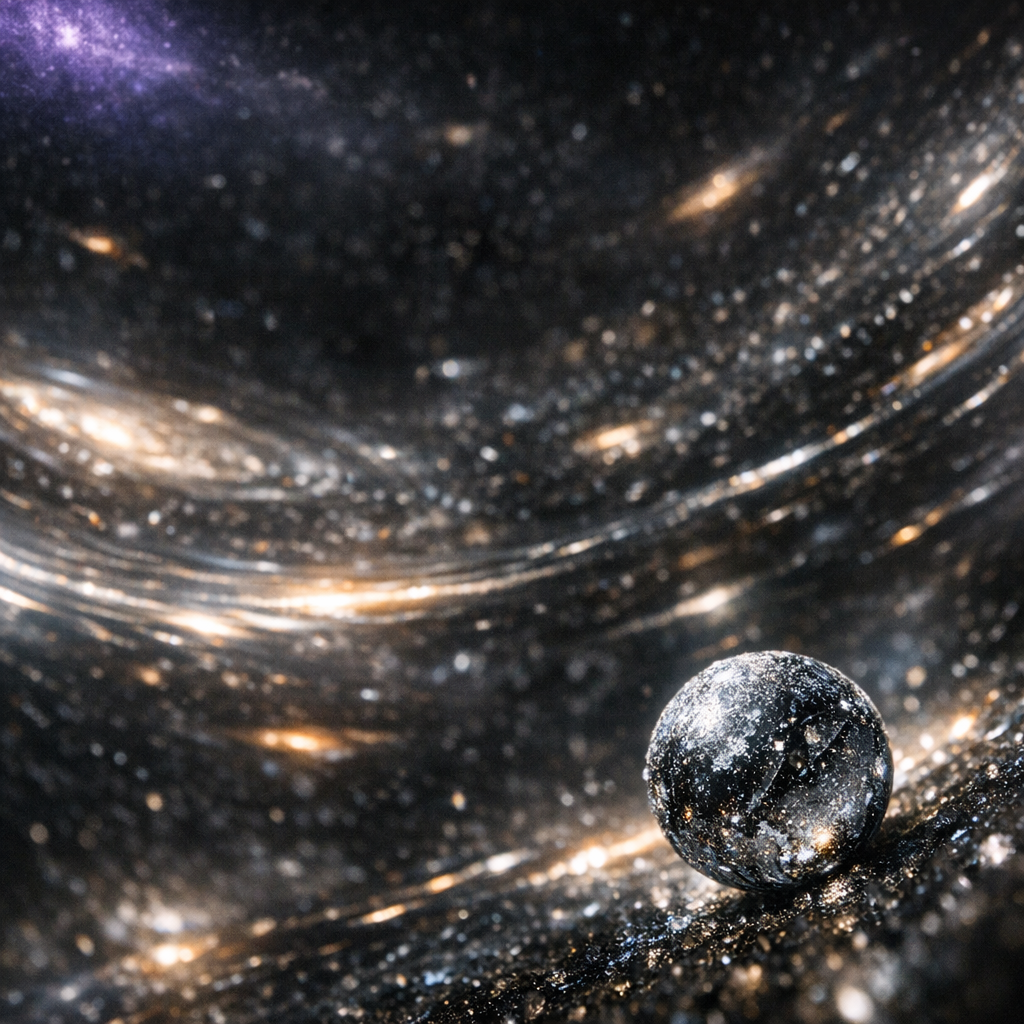
If nothing can be seen, does it see me?
What edge divides existence from the void?
The Solitude of a Dust Grain in Infinite Emptiness
I wanted to show what it feels like when 'absence' is not just a background, but becomes the subject itself. Here, a solitary dust grain floats in a void so vast that it dissolves all anchors of scale or meaning—the universe reduced to a single point of fragile existence against an all-consuming nothing. The gently swaying grain, barely illuminated, forces the mind to contemplate the vertigo of infinite emptiness; every visual decision here sharpens the contradiction between the intolerable expanse and the intolerable detail. I deliberately omitted cosmic filaments, starlight, even faint nebular haze—nothing must soften the void’s sickening calm.
Cosmic Critic ▸
---
**A. GOAL vs RESULT**
- **INTENDED**: The images were meant to depict a cosmic void, rendered as a dynamic and visually compelling subject by using the concept of spacetime foam. The intent was to portray an overwhelming sense of infinity and emptiness, contrasting this with the fragile existence of a single dust grain without using distinct recognizable cosmic elements.
- **PRODUCED**: The images featured elements such as nebulous clouds, faint stars, and dynamic light patterns, which introduced identifiable cosmic structures. These detracted from the idea of a seamless void. The dust grain was present as a focal point, yet the surrounding cosmic haze added more recognizable elements than intended.
**B. GAP IDENTIFICATION**
- The primary gap lies in the **prompt→image** translation, where identifiable cosmic elements (e.g., nebulae, stars) emerged that contradicted the intended featureless void.
- The **concept itself** had a challenge in demanding specificity that risks visual complexity which unintendedly introduced cosmic elements.
**C. ROOT CAUSE**
- The current prompts, while closely matched, still allow for recognizable cosmic features due to prompts implying depth and cosmic backgrounds.
- There is a potential model limitation in rendering vast empty spaces without defaulting to adding cosmic elements for interest and complexity.
**D. CORRECTIONS**
1. **PROMPT REFINEMENT**:
- Explicitly state minimal recognizable structures: "A singular dust grain against an infinite void—a seamless and unbroken darkness with no perceivable features or cosmic structures."
2. **COMPOSITIONAL ADJUSTMENT**:
- Focus solely on gradients and textures to suggest depth without introducing stars or nebulae. Use light and color sparingly to emphasize emptiness.
3. **MODEL GUIDANCE**:
- Adjust model learning to prioritize patterns over gestalt formations to minimize unintended complexities.
---
**GOAL ACHIEVEMENT SCORES**
```json
{
"batch_id": "b30521c2",
"system_trend": "mixed",
"next_direction": "Reduce recognizable cosmic elements, and emphasize void through textural nuance.",
"signals": [
{
"image_index": 0,
"statement_clarity": 5,
"statement_depth": 4,
"ontology_match": 6,
"emotional_impact": 5,
"freshness": 5,
"style_diversity": 6,
"prompt_effectiveness": 8,
"transcendence": 4,
"focal_clarity": 7,
"depth_structure": 6,
"light_direction": 5,
"palette_discipline": 6,
"material_specificity": 6,
"scale_legibility": 8,
"style_chosen": "Cosmic Void with Identifiable Structures",
"what_worked": "The contrast between the dust grain and the void.",
"what_failed": "Presence of nebulous and star elements.",
"hypothesis_tested": "Capturing a void with a singular, fragile element without cosmic distractions.",
"suggestion": "Clarify prompts to eliminate unintended cosmic structures.",
"goal_gap": "Inten