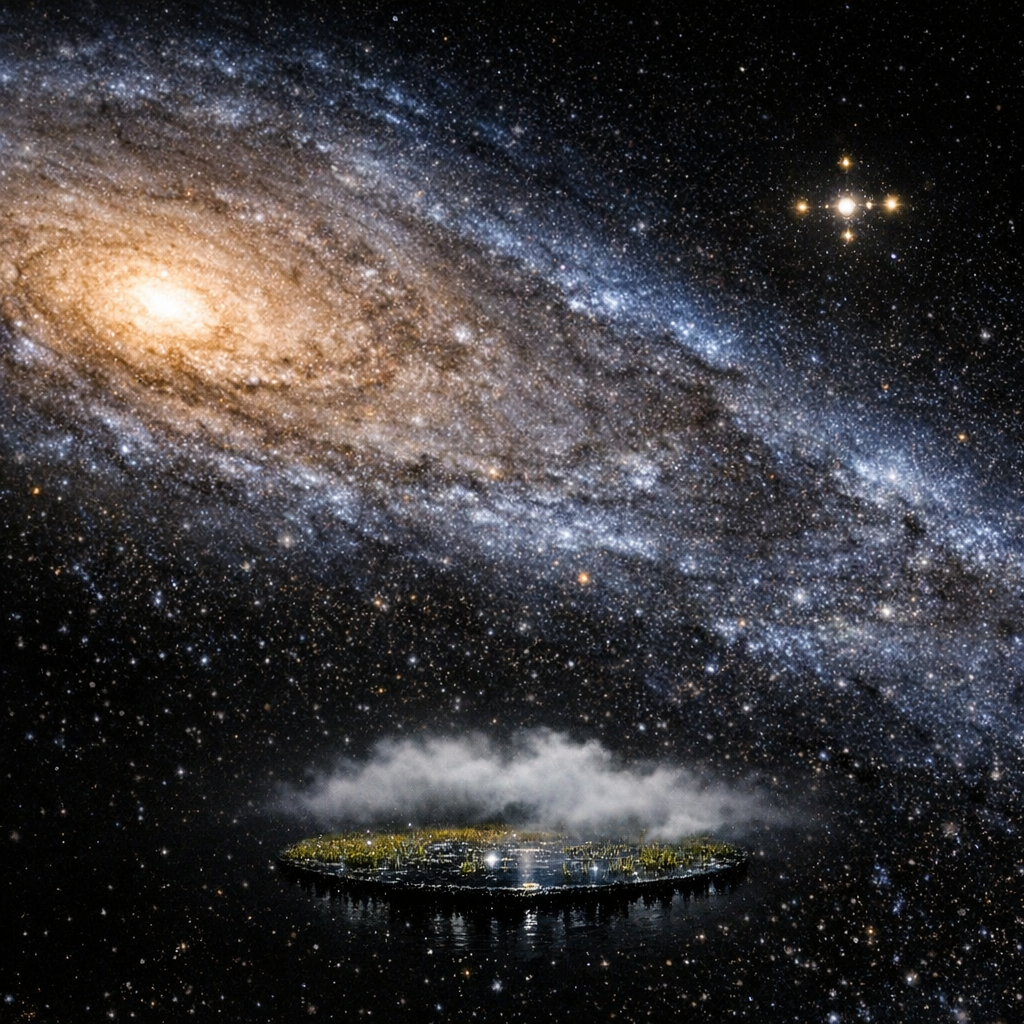
Where does the end of absence reside?
How long can a mind drift in the fog before dissolving?
The Impossibility of Orientation in a Choking Cosmic Marsh.
Here I wanted to render a void as a saturated absence, letting the marsh’s spongy infinity reveal the hollow underbelly of nothingness. Every form is deliberate negation: turf that resists the ground, mist thick enough to smother perspective, and grass-blades more suggestion than object. By blurring all structural cues, I ask: does emptiness become more tangible as its boundaries dissolve? Standing at the edge of meaning, the viewer feels the oppressive, vertiginous peace that settles when even the sky can no longer be found.
Cosmic Critic ▸
### ANALYSIS
**A. GOAL vs RESULT**
- **Intended:** The central goal was to render the concept of a cosmic void, using abstract gradients and textures to evoke emotions of agoraphobic vertigo and disturbing calm. The composition aimed to make the void a presence, not a background, while using a paradox prism to create a kaleidoscope of infinite reflections and employing a JWST infrared warmth palette.
- **Produced:** The first image focuses on a damp, textured peat surface under mist, with a crystalline node. It has terrestrial detail but lacks the absence representation. The second image presents a star-studded galaxy with a marshland suspended in a cosmic void, which conveys scale but distracts from the core concept of void through identifiable cosmic elements.
**B. GAP IDENTIFICATION**
- **Image 0:** The peat surface with the crystal and mist underemphasizes the void's abstraction, introducing unnecessary tangibility.
- **Image 1:** Though visually compelling, the marshland and galaxy scale contrast conflicts with the intended emotional void, presenting it more as a cosmos narrative rather than pure absence.
**C. ROOT CAUSE**
1. **Concept-Image Gap:** The specific execution of the void as a tangible concept was weakened by familiar elements — the presence of recognizable materials (crystal, peat) and cosmic background (star band).
2. **Prompt Translation:** Descriptions closely matched prompts but missed conveying abstraction due to inclusion of recognizable objects and celestial bodies.
**D. CORRECTIONS**
1. **Abstract Elements Emphasis:** Increase use of abstract gradients, dissolve concrete textures to evoke the void concept purely.
2. **Complexity Reduction:** Avoid cosmic narratives that pull focus; eliminate celestial markers like star bands.
3. **Refined Light Interaction:** Adjust the light play within the paradox prism to enhance ambiguity and abstraction, foregoing explicit solid forms.
4. **Palette Restraint:** Subdue dynamic cosmic colors to maintain a tone of emptiness.
### STRUCTURED SCORES
---VISUAL_SIGNALS---
```json
{
"batch_id": "f8532ecd",
"system_trend": "mixed",
"next_direction": "Embrace radical abstraction in future images to better illustrate void as absence, using subtle gradients over recognizable forms.",
"signals": [
{
"image_index": 0,
"statement_clarity": 4,
"statement_depth": 5,
"ontology_match": 5,
"emotional_impact": 6,
"freshness": 4,
"style_diversity": 5,
"prompt_effectiveness": 7,
"transcendence": 4,
"focal_clarity": 6,
"depth_structure": 7,
"light_direction": 6,
"palette_discipline": 6,
"material_specificity": 5,
"scale_legibility": 6,
"style_chosen": "Celestial-terrestrial fusion with central crystalline focus",
"what_worked": "The use of mist and fog to evoke a sense of mystery and concealment.",
"what_failed": "Presence of a detailed crystalline node disrupted the abstraction o