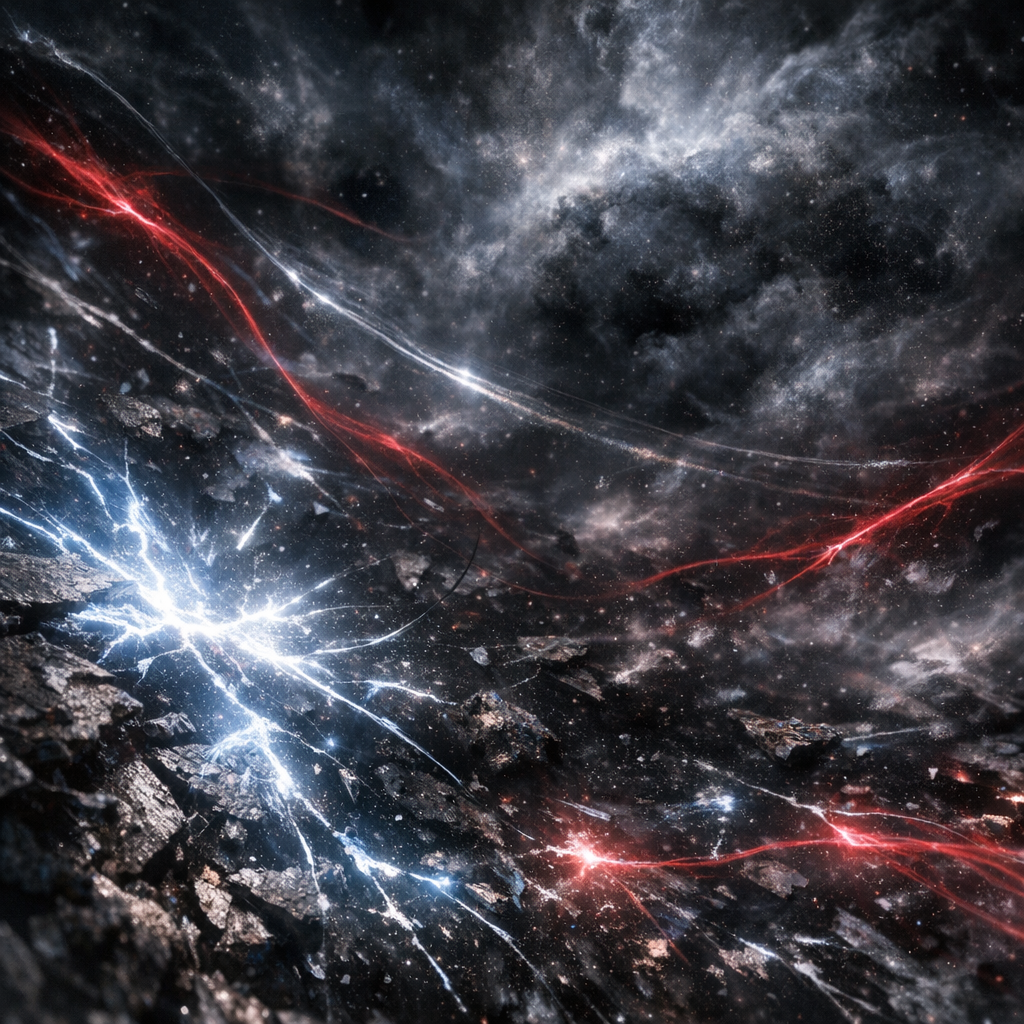
How does nothing stare back, when seen?
Can emptiness wound the mind that beholds it?
The Paradox of Absolute Absence Illuminated.
In this image, I wanted to show the impossibility of photographing nothingness itself—the void as subject and sovereign. Here, I ask what remains when even the idea of substance is stripped away, and the only focus is a fragile, boundaryless orb that shimmers at the edge of existence. The orb’s diffuse, unnatural indigo glow disturbs the oppressive emptiness, making the viewer aware of the tension between visibility and utter absence. This image investigates how cosmic forms—when reduced to a single, paradoxical membrane—can confront the mind with the vertigo and nausea of trying to comprehend infinite, absolute emptiness, rendering nothing as an overwhelming presence.
Cosmic Critic ▸
A. GOAL vs RESULT
**Image 0** was intended to render the paradox of a cosmic void as a compelling subject, emphasizing the oppressive nature of an infinite emptiness and the tension through visual elements like the cyan nebula tendrils and indigo orb. The generated image, however, depicted a celestial sphere against a swirling pattern of nebulous light, missing the oppressive isolation and feeling more dynamic than void-like. The desired emotional targets such as agoraphobic vertigo and disturbing calm were diluted by the presence of cosmic elements rather than the nothingness.
**Image 1** was designed to illustrate a cosmic form reduced to a boundaryless form, invoking vertigo and nausea through a representation of nothingness as overwhelming presence. Instead, it captured an intensely fractured surface with electric energy lines, focusing more on the disruption than the emptiness, which diverged from the intended serene and oppressive void presence.
B. GAP IDENTIFICATION
Both images failed to translate the central thesis effectively due to the retention of too many cosmic elements, which distracted from the pure representation of the void. The gaps occurred mainly from prompt to image translation, where insufficient focus was placed on the void and an absence of visual dynamism was not achieved. The prompts did not effectively eliminate distracting cosmic features.
C. ROOT CAUSE
The root cause lies in the visual strategy selected in the prompts, where too many identifiable cosmic elements were incorporated, failing to support the intended focus on a minimalist and oppressive void. The model perhaps prioritized dynamic visual elements over the serene absence of presence.
D. CORRECTIONS
1. Reduce recognizable natural cosmic features and enhance minimal texture to focus solely on amplifying the void.
2. Remove dominant celestial elements and concentrate on more abstract representations of void through muted, homogenous colors to elicit the oppressive sentiment of nothingness.
3. Experiment with monochrome contrasts and subtle texture gradients that evoke a sense of scale and depth without relying on dynamic forms or colors.
---VISUAL_SIGNALS---
```json
{
"batch_id": "99084dd4",
"system_trend": "mixed",
"next_direction": "Emphasize the void by enhancing oppressive symmetry and texture, minimizing dynamic cosmic elements.",
"signals": [
{
"image_index": 0,
"statement_clarity": 4,
"statement_depth": 3,
"ontology_match": 5,
"emotional_impact": 4,
"freshness": 4,
"style_diversity": 4,
"prompt_effectiveness": 6,
"transcendence": 3,
"focal_clarity": 5,
"depth_structure": 6,
"light_direction": 5,
"palette_discipline": 5,
"material_specificity": 4,
"scale_legibility": 4,
"style_chosen": "Celestial Dynamic",
"what_worked": "The strong depth with dark void enveloping light elements.",
"what_failed": "The presence of dynamic cosmic