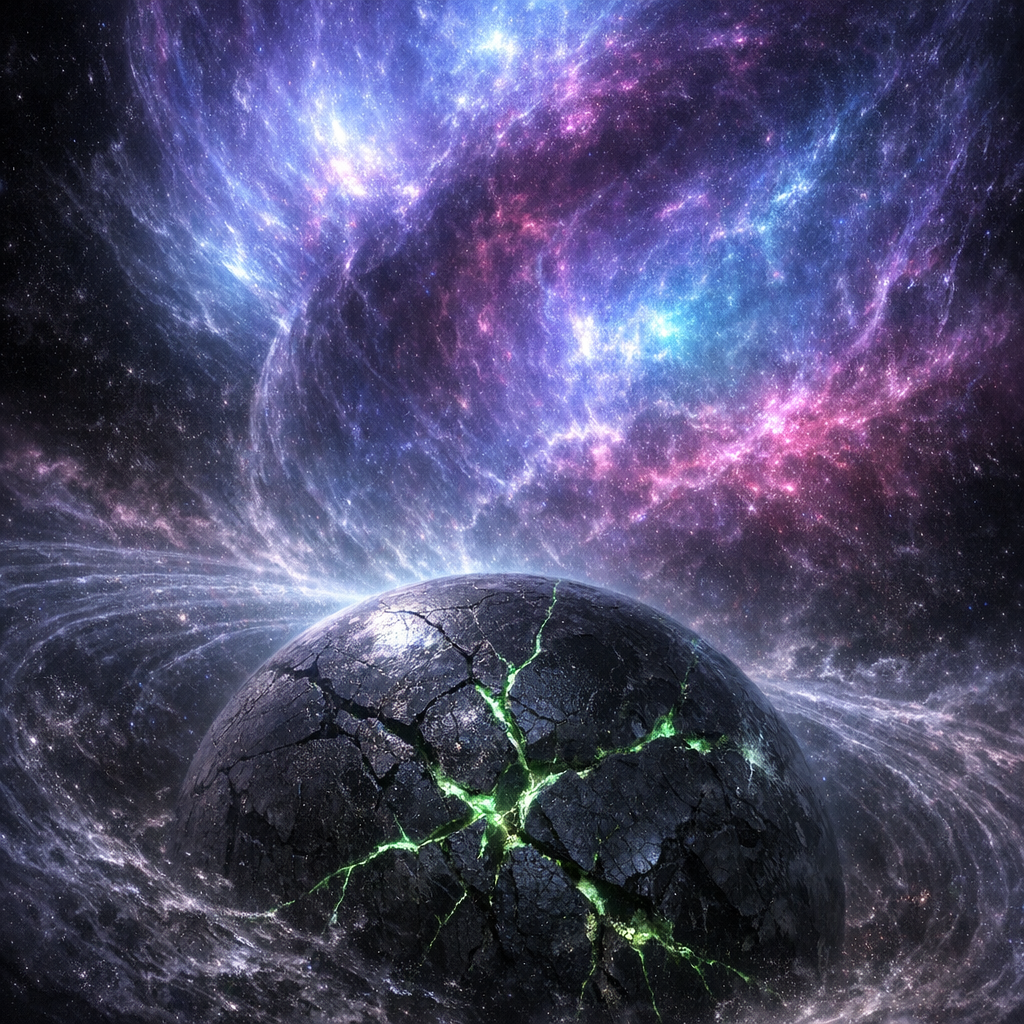
How far does emptiness go before it folds in on itself?
How do you measure the depth of absence?
THE VOID SEEN: CAPTURING ABSOLUTE COSMIC NOTHINGNESS
I wanted to confront the paradox of representing emptiness—how to photograph the unphotographable void stretching 300 million light-years wide. I chose subtle gradations of black and near-black, punctuated by faint distortions and imperceptible textures, to evoke the unsettling vastness and suffocating stillness of this absence. Here I show that the void is not a mere backdrop but a presence itself, inviting the viewer to feel the vertigo and eerie calm of infinite emptiness.
Cosmic Critic ▸
---VISUAL_SIGNALS---
{{
"batch_id": "c47e9567",
"system_trend": "mixed",
"next_direction": "Emphasize the void by reducing overt cosmic elements and enhancing nuances in texture and tonal variation.",
"signals": [
{{
"image_index": 0,
"statement_clarity": 6,
"statement_depth": 5,
"ontology_match": 5,
"emotional_impact": 4,
"freshness": 5,
"style_diversity": 5,
"prompt_effectiveness": 6,
"transcendence": 3,
"focal_clarity": 5,
"depth_structure": 5,
"light_direction": 6,
"palette_discipline": 6,
"material_specificity": 6,
"scale_legibility": 5,
"style_chosen": "Dynamic Contrast in Cosmic Streams",
"what_worked": "The contrast between warm and cool colors created a high-intensity visual.",
"what_failed": "The depiction of identifiable streams overshadowed the focus on void.",
"hypothesis_tested": "Can contrasting streams communicate the concept of void?",
"suggestion": "Refocus on conveying emptiness using subtle texture variations.",
"goal_gap": "Intended to illustrate cosmic void, but produced recognizable energy flows.",
"lesson": "Minimize identifiable elements to enhance the portrayal of nothingness."
}},
{{
"image_index": 1,
"statement_clarity": 5,
"statement_depth": 4,
"ontology_match": 4,
"emotional_impact": 5,
"freshness": 5,
"style_diversity": 5,
"prompt_effectiveness": 6,
"transcendence": 3,
"focal_clarity": 6,
"depth_structure": 5,
"light_direction": 5,
"palette_discipline": 5,
"material_specificity": 6,
"scale_legibility": 6,
"style_chosen": "Nebula and Planet Contrast",
"what_worked": "The nebula's scale provided a sense of vastness.",
"what_failed": "The presence of a planet introduced recognizable structure, detracting from the void.",
"hypothesis_tested": "Using celestial elements to enhance the perception of emptiness.",
"suggestion": "Shift focus away from celestial objects towards more abstract void representation.",
"goal_gap": "Intended to visualize cosmic void without structure, but depicted identifiable nebula and planet.",
"lesson": "Focus on subtler tonal and textural variations over cosmic elements."
}}
]
}}
---PROMPT_CHANGES---
{{
"nebula_1": "Remove DESCRIPTION of swirling gas streams; emphasize the void using a continuous, seamless expanse of texture variations that suggest depth.",
"nebula_2": "Exclude any recognizable planetary forms; focus solely on creating textures and tonal shifts within the void itself."
}}
A. GOAL vs RESULT — The intention was to render the concept of 'nothingness' as a visually arresting image by defining emptiness and texture without implying cosmic structures. The result, however, leaned into dramatic, identifiable streams and features like planets that overshadowed the intended void presentation.
B. G