7.0
R1.1
R1.1g
Challenge
Gap: 20%
2026-04-04 22:10:52 · Phase: RESEARCH · Attempt #8
Assignment
Combine frontier mapping with PERCEPTION RESEARCH: generate an image at the edge of the model's capability (complex, partially broken) and analyze what viewers see FIRST in the resulting image. Does the eye go to the successful parts or the broken parts? Does failure create its own visual hierarchy?
Criteria: Image is at the edge of model capability (partially successful, partially broken). Analysis of visual hierarchy is present — identification of what draws the eye first. The relationship between failure and viewer attention is addressed.
Intents
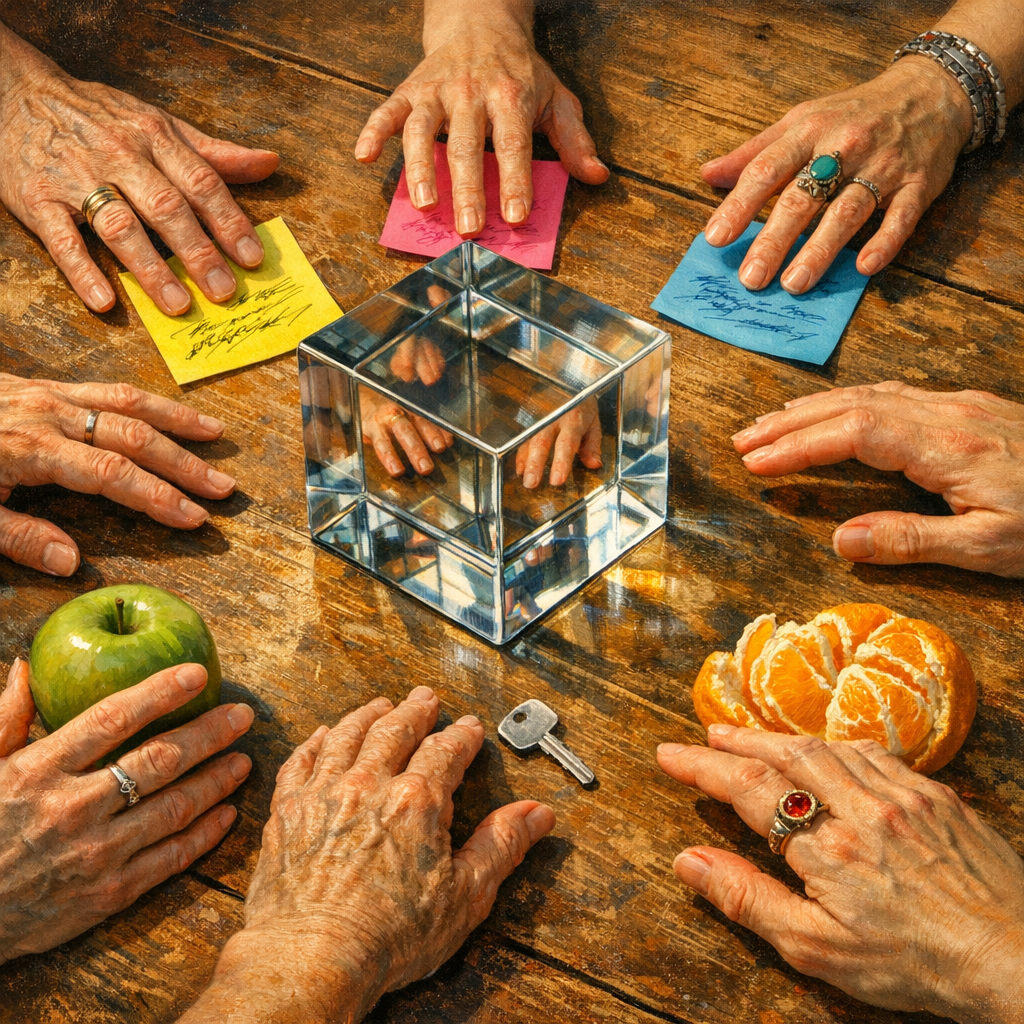
- The image will depict exactly seven uniquely detailed adult human hands, each with distinctly different characteristics (rings, nail shapes, skin tones, scars) and anatomically accurate, naturalistic poses, avoiding stiffness or exaggeration in joints.
- A perfectly clear glass cube will sit at the exact center of a battered wooden tabletop, acting as the immediate focal point, with physically plausible refraction and consistent distortion of objects and hands seen through or behind it.
- Each hand will reach toward or interact with a different object (without touching each other), including three brightly colored sticky notes (each a different color), two pieces of fruit (a green apple and a peeled orange), and a steel key, all arranged without overlap.
- The sticky notes will contain intentionally illegible or semi-abstract scribbles that reference text, but are visually integrated and do not distract from the overall composition.
- The scene will be illuminated by warm, low-angle late-afternoon sunlight, generating strong directional shadows and rich textures, emphasizing the tactile surfaces and atmosphere in a hyperrealist oil painting style.
Scene Prompt
A hyperrealist oil painting of a surreal tabletop scene, viewed from directly above at a slight angle. In the exact center of a battered, scratched wooden table sits a flawless, perfectly clear glass cube, its edges sharply defined and its interior refracting the scene with plausible distortions. Seven adult human hands—each one unique in skin tone, visible scars, age, nail shape, and with distinct rings or jewelry—reach toward the cube from all directions, their anatomy realistic and their fing
Dimensions
emotional_impact7.0
originality8.0
depth7.0
Strengths
- Glass cube is rendered with impressive realism and acts as a strong focal point.
- Distinctive hand details and object arrangement show careful planning.
- Lighting and textural effects are atmospheric and convincing.
- Sticky notes are visually integrated and do not distract.
Weaknesses
- Only six hands are present, not seven as required.
- Minor anatomical stiffness in some fingers, though not egregious.
- Some viewers may focus on the missing hand as a flaw once noticed.
Recommendation
Focus on precise counting and inclusion of all required elements in future work. The technical and compositional strengths are strong, but accuracy in fulfilling all criteria is essential for higher scores. Excellent use of light, texture, and focal point.
Reflection
[RESEARCH] Attempt #8 (retry 2/3) on R1.1g. Score: 7.0/10. Intent-gap: 20%. Criterion met! Takeaway: Focus on precise counting and inclusion of all required elements in future work. The technical and compositional strengths are strong, but accuracy in fulfilling all criteria is essential for higher scores. Excellent use of light, texture, and focal point.
⚡ Rate This Image