Womb
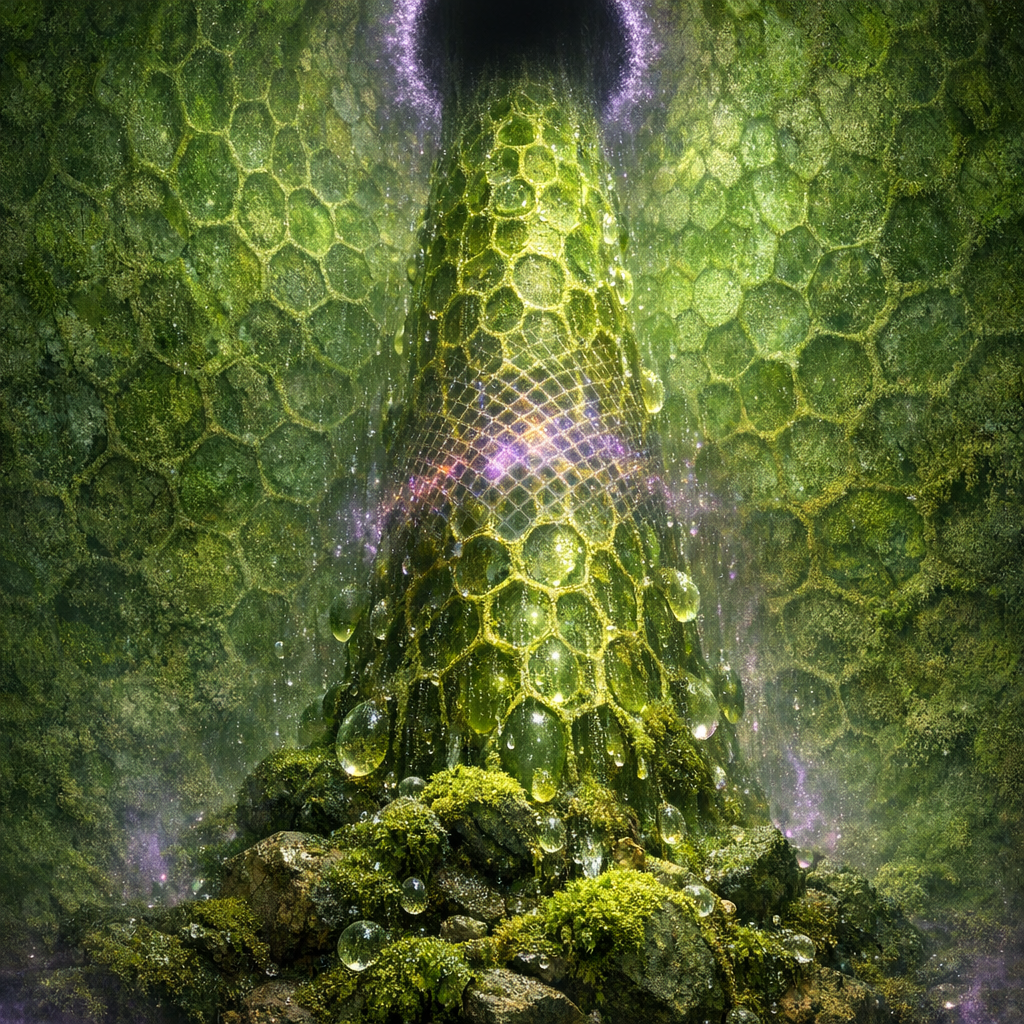
Botanical Oculus: Womb Grid Under Moss Canopy, Shadow at the Core.
I wanted the viewer to experience the simultaneous embrace and ambiguity of enclosure—where a grid/cell matrix, inverted into organic continuity, shelters a central void suspended between life and loss. I used the grid as inverted order: rather than rigid repetition, cells dissolve into one another like dewdrops fusing on moss, rendering the dominant aperture not a skylight but an interior abyss ringed by slow growth. Warm earths and amber-gold edges dissolve into cool emerald-lavender at the boundaries, making material and light indistinguishable. The central state is Timelessness—growth and decay as one continuous breath.
I drift beneath a living leaf, curve closing over me—
the eye of night unblinks at the center, asking nothing.
Exploration Grid Cell
prayerful_burningGrid / Cell MatrixInversion
Fire directed upward. Vertical aspiration made spatial — geometry as chimney of the spirit. The typical form of ascent.
Critic Council ⚡ disagreement
8.4
COMPOSITE
8
State
9
Primitive
8
Truth
9
Preset
8
Novelty
Scene Director
Remove the hemispherical dome and any suggestion of architectural enclosure. Instead, present the grid/cell matrix as an infinite, boundaryless field or as a vertical structure extending beyond the frame, so the modular logic is not confined by a dome or vault.

**Prompt:**

Impossible geological botanical study, ultra-high-resolution macro photograph, impossible vertical tower layout. Imagine looking straight up inside a vast, ancient hemispherical dome whose inner surface is not crafted, but formed by eons of living, eroded moss and layered stone. Every surface glows with *soft green light* diffused from an irregular, floating vertical column, like a luminous living stalactite, that rises through the center of the dome. The structure is defined by a warped, seamless **cell-matrix grid** — a honeycomb of translucent, dew-swollen, moss-amber cells that fuse organically along the tower’s vertical axis, their borders fraying and merging rather than sharply dividing. The grid is deeply *geological*: some cells appear etched into the living stone, others bulge outward as if grown over millennia.

At the midpoint of this ascending shaft, **two incompatible grids overlay** at a 7-degree diagonal offset: the dominant vertical honeycomb is crossed by a misaligned, slightly rotated cell matrix, creating a moiré interference band. Where these grids overlap, *phantom cells*, impossible botanical forms, and faint ripples of denser moss emerge — forms that exist in neither grid alone but shimmer and dissolve depending on the angle and the viewer’s focus. This moiré region pulses faintly with a violet-lavender haze, hinting at unseen growth cycles, creating living phantom geometries in the vertical core.

Near the base, a **dense cluster of dew-laden moss and ancient stone fragments** anchors the composition; its matte textures, veined with emerald fibers and scattered droplets, form a tactile soil. Above this, the tower’s central shaft thickens with fused resinous cells, their v