Timeless
Forest Vault: Sector Geometry at the Threshold of Stillness.
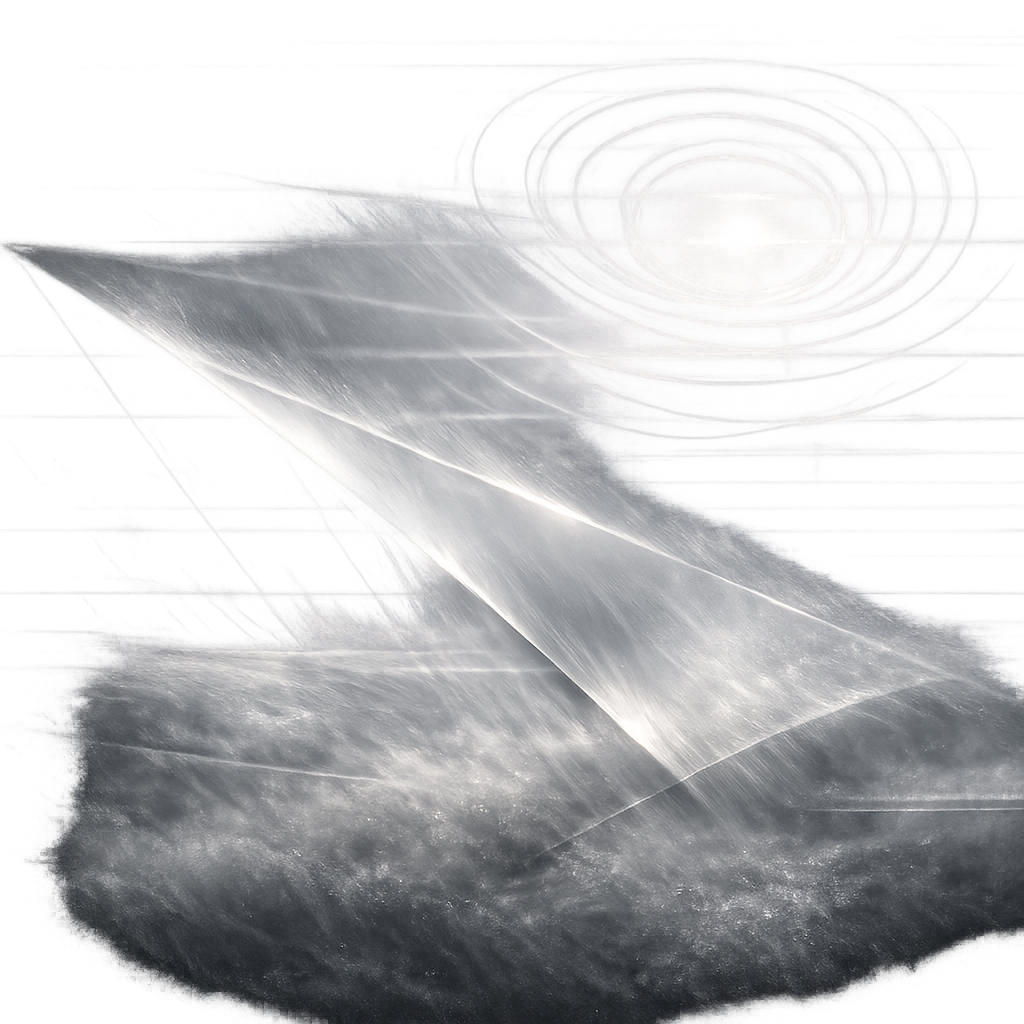
I wanted the viewer to experience suspended time within the living embrace of a botanical dome, held at the edge where day pierces enclosure. I used angular sector divisions as an act of intensification—overdriving the visible structure until segments of canopy seemed not to grow but to crystallize in place. The oculus disk is absolute, bordered by overlapping, uneven sectors of mossed wood and leaf: every division holds history and decay, sharpening the paradox of shelter and revelation—timelessness made almost overwhelming by the ceaseless patience of growth. When leaf-shadow and pearl-grey silence both reach their extremes, even the act of looking up suspends duration itself.
The world divides around a single eye of light.
Each sector, a patient breath; time, the slowest ring.
Exploration Grid Cell
suspended_timeSector / Angular DivisionIntensification
Eternal 'now'. Stillness without effort. Duration without event. Form so still it embodies both past and infinite future simultaneously.
Critic Council ⚡ disagreement
8.2
COMPOSITE
8
State
8
Primitive
8.0
Truth
9
Preset
8
Novelty
Scene Director
**IMAGE PROMPT: "Irregular Sectors in Compressed Air – Strata of Suspended Duration"**

══════════════════════════════════════════════════════════════════════════════════
**MEDIUM / MATERIALITY:**
Optical phenomena in compressed air — there are _no solid surfaces_, only volumes where air density abruptly changes, visualized by the way light bends. Geometry is rendered through atmospheric pressure gradients and refractive index shifts, not through material edges. Imagine a high-speed schlieren photograph or a phase-contrast micrograph, merged with mathematical visualizations of fluid flow, but with the abstract inevitability of Platonic geometry.

---

**COMPOSITION:**
The entire frame is organized as **horizontal strata**, evoking geological layers or luminous atmospheric bands, each a distinct register of pressure and density. The sector divisions — the protagonist — are **angular cavities and wedges sliced through these bands**, but their boundaries are not made of matter: they are lines of sharply changing refraction where compressed air abruptly shifts. The most dominant sector, the “protagonist,” is a massive, slightly asymmetrical wedge spanning from lower center-right outward and upward to the upper left, its edges feathering into turbulence.

Superimposed throughout the bands, especially toward the upper bands, are **concentric rings with irregular spacing**. Each ring is a real, physical boundary seen where pressure waves have “froze” into visible intervals: the rings do not repeat at regular intervals, and their rhythm starts to suggest pattern, then breaks, like the ear waiting for a melody that never quite resolves. In cross-section, these look like faint, luminous caustics — not hard lines, but optical densities.

The image’s **bottom third** is the densest: nearly opaque, with silvery, graphite-infused mist, feathering upwards into lighter, thinned strata. Each horizontal layer transitions into the next via gradients of light and air density, never