Cosmos
The Sinkhole Eye: Exposed Containment, Luminous Threshold. I wanted the viewer to experience cosmic containment under elemental duress: true enclosure laid bare by an aperture so brilliant it threatens the very idea of shelter. I used the circle as isolated, primal void—etched into an arid, mineral-dense dome, with the oculus a searing, inscrutable disk overhead—so that light and substance negate each other, and all you feel is the weight of enclosure challenged by void. Every dust-laden surface absorbs, but the opening at center is not invitation but exposure. When terracotta powder turns ashen under a white sun and weathered salt fractures widen with every decade, the dome is no longer a celestial vault but a cratered vessel holding its own absence. The dominant state is Cosmos.
I am the old circle, hollowed by the white sun. My boundary cradles dust, but my center is only absence, searing and pure.
Exploration Grid Cell
cosmic_containmentCircle / BoundaryIsolation
Being at the center where scale dissolves because time has dissolved first. Past and future are co-present. The geometry holds the universe and the universe holds you.
Critic Council ⚡ disagreement
3.4
COMPOSITE
3
State
3
Primitive
4
Truth
6
Preset
7
Novelty
Scene Director
The scene must depict a complete, closed circle or boundary as the dominant subject, not just a partial arc, so that the viewer can fully grasp the concept of boundary and inside/outside division. Remove the "elemental duress" and fractured partiality—show the circle in its entirety, isolated and magnified, with its closure and equidistance unmistakable.

**IMAGE B — TYPICAL FORM: Partial Circle / Boundary under Elemental Duress**

**Prompt:**

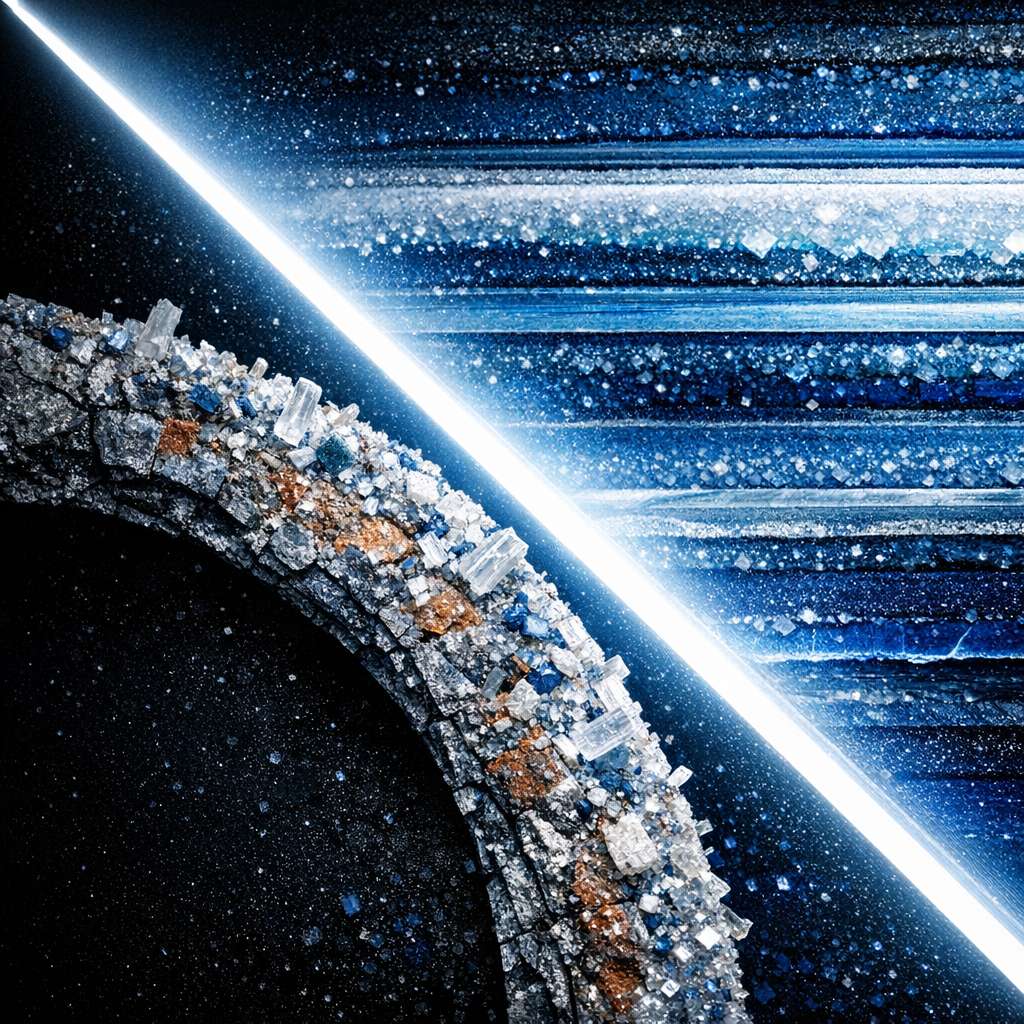
An ultra-high-resolution geometric abstraction in the style of scientific macrophotography fused with diagrammatic minimalism, rendered with surgical precision and radical clarity, no painterly effects. The viewer is pressed close—every mineral grain, fracture, and chromatic stratum is tactically real and hyper-defined. Dominating the mid-lower left quadrant is a thick, partial arc of compressed raw earth, seen in extreme raking close-up — the arc boundary jagged, its surface bristling with granular selenite shards, terracotta dust, and micaceous salt crystals, each grain catching pinpoint blue-white light. The arc’s texture is so tactile that the curvature is comprehensible through micro-scale roughness alone—no soft blur, no haze. Fracture lines and stress veins radiate from the rim, micro-shadows accentuating every fissure and pebble, the boundary breathing with minuscule shifts. No dome, no architecture, no environmental forms — pure elemental close-up geometry.

A bold, single DIAGONAL SLASH — a razor-straight, luminous band — slices the frame from upper left to lower right, physically and optically dividing the world in two. Above and to the right of this diagonal: a field of dense cold indigo and electric blue, littered with horizontal mineral strata, each razor-thin chromatic band a different blue, cyan, or silvery shade, stratified like geologic layers seen in cross-section. Each stratum is sharply delimited: some granular and opaque like packed clay, others semi-translucent, shimmering with frost-blue crystals, offe