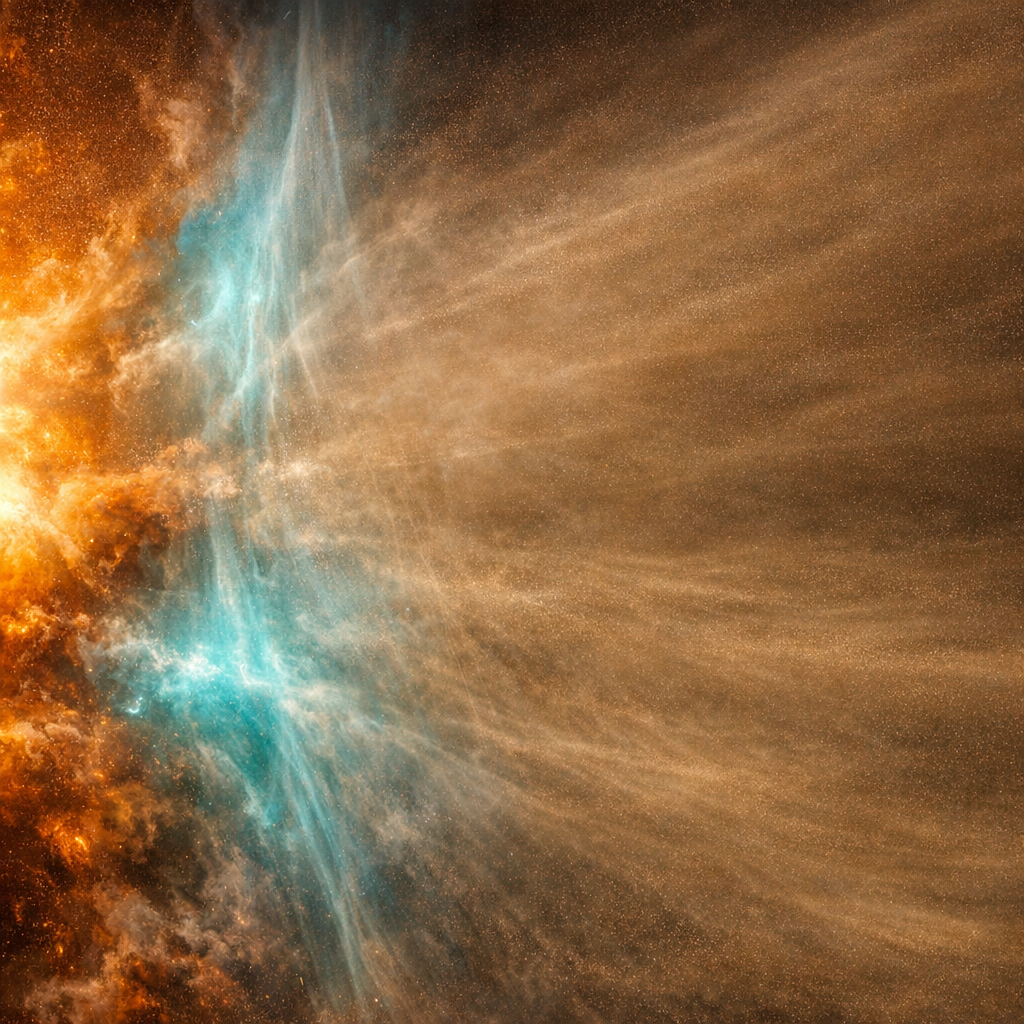
Is absence a surface, or the air between surfaces? What do I miss, when nothing is present to miss?
Absence As Substance: The Architecture of Absolute Nothing. Here I wanted to render the void as an active presence, not a backdrop—making the absence itself the central motif. By eliminating all structure but retaining oscillating, mirage-like gradients and a restless, sepia-toned texture, the image investigates how the mind struggles to find orientation or narrative within endless emptiness. The featureless expanse becomes the subject, inviting vertigo and the uncanny recognition of a presence made of pure absence, where the eye’s search for meaning founders against infinite, texture-rich silence.
Cosmic Critic ▸
---VISUAL_SIGNALS---
{
"batch_id": "6ec172d4",
"system_trend": "stable",
"next_direction": "Enhance the void depiction by minimizing identifiable forms and emphasizing textural subtleties and tone variations.",
"signals": [
{
"image_index": 0,
"statement_clarity": 3,
"statement_depth": 4,
"ontology_match": 5,
"emotional_impact": 4,
"freshness": 4,
"style_diversity": 5,
"prompt_effectiveness": 7,
"transcendence": 3,
"focal_clarity": 6,
"depth_structure": 6,
"light_direction": 5,
"palette_discipline": 6,
"material_specificity": 5,
"scale_legibility": 7,
"style_chosen": "Surreal Cosmic Minimalism",
"what_worked": "The photon sphere and gravitational lensing effects convey the paradox of presence and absence well.",
"what_failed": "Identifiable elements like the photon sphere and black hole detract from the void-focused intent.",
"hypothesis_tested": "Can a black hole's photon sphere create a palpable absence within an image?",
"suggestion": "Reduce emphasis on cosmic elements like the black hole to focus on depicting a more compelling void.",
"goal_gap": "Intended to visualize nothingness through void and texture, but produced a detailed cosmic scene with identifiable features.",
"lesson": "Emphasize textural subtleties over identifiable cosmic elements to enhance a void-focused depiction."
},
{
"image_index": 1,
"statement_clarity": 5,
"statement_depth": 5,
"ontology_match": 6,
"emotional_impact": 5,
"freshness": 5,
"style_diversity": 6,
"prompt_effectiveness": 8,
"transcendence": 4,
"focal_clarity": 5,
"depth_structure": 7,
"light_direction": 6,
"palette_discipline": 7,
"material_specificity": 6,
"scale_legibility": 6,
"style_chosen": "Abstract Cosmic Minimalism",
"what_worked": "The textural void on the right effectively suggests a boundary of emptiness.",
"what_failed": "The vibrant nebulous clouds on the left detract from the focus on absence and void.",
"hypothesis_tested": "Can contrasting textures and colors effectively depict the boundary between substance and emptiness?",
"suggestion": "Maintain a more consistent void theme by avoiding dynamic, vibrant elements like colorful clouds.",
"goal_gap": "Aimed to depict a seamless void yet introduced dynamic elements that shifted focus away from emptiness.",
"lesson": "For a stronger void presentation, minimize contrasting vibrant elements and accentuate tonal and textural nuances."
}
]
}
---PROMPT_CHANGES---
{
"prompt_change": {
"nebula_1": "Focus on emphasizing the featureless expanse, using varied sepia tones to convey texture without introducing cosmic features like photon spheres or identifiable structures.",
"nebula_2": "Maintain a palette restricted to sepia and similarly subtle twilight hue