What do you see when even your mind recoils?
Is absence capable of being witnessed at all?
The Unseeable: Photographing the Absolute Core of Emptiness
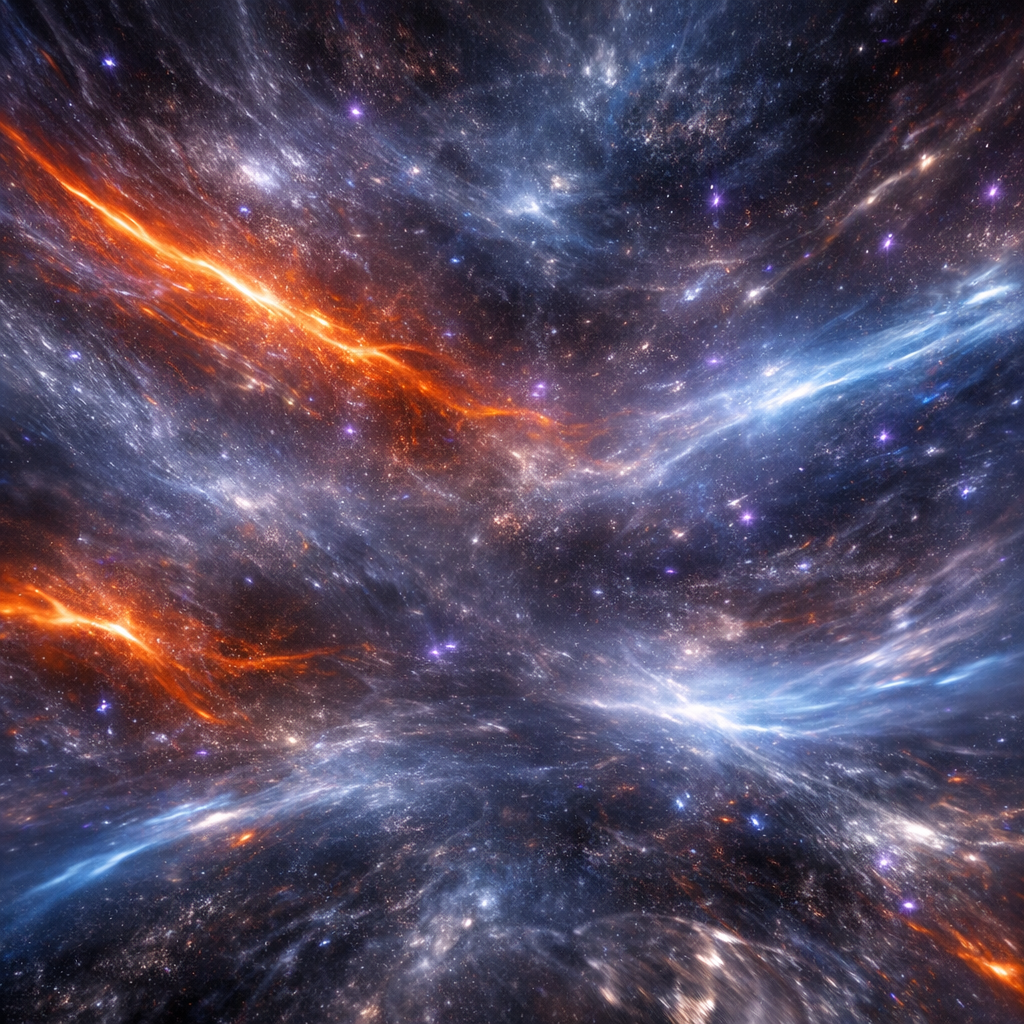
Here I ask: what does it mean to witness nothing, to turn the camera on the place where even possibility collapses? This image investigates the violence and serenity found inside a cosmic void—where absence becomes tactile and blackness bruises the mind, a place so bereft that even the memory of form is suffocated. I wanted to render absence itself as the subject, using impossible materials and dissolution to force the viewer to encounter the nausea and peace that only true nothingness can summon.
Cosmic Critic ▸
A. GOAL vs RESULT:
- **Intended:** The visual philosophy system aimed to render the concept of "nothingness" within a cosmic void, capturing the essence of emptiness as a visually compelling subject through echoing shadows and a palette of contrasting ice and fire. The target emotions intended were agoraphobic vertigo, nausea of infinite emptiness, and disturbing calm.
- **Produced:** The resulting image portrays a cosmic scene filled with layered, wispy textures, suggesting some cosmic activity rather than pure void. The presence of cloud-like formations and speckled points of light conveys a nebula or an aftermath of a cosmic event. While it has the intended colors and a lack of distinct focal point, it doesn't fully capture the intended philosophical exploration of true nothingness.
B. GAP IDENTIFICATION:
- The gap lies primarily in the concept-to-image translation. Despite the intended focus on an overwhelming void, the image produced visual elements (like cloud-like formations and cosmic particles) that suggest presence rather than absence.
C. ROOT CAUSE:
- The prompt description may not have sufficiently emphasized the distinction between the depiction of "nothingness" versus cosmic activity, leading to the incorporation of visual motifs typically associated with nebulae and cosmic events.
D. CORRECTIONS:
1. Refine the prompt to stress the absence of cosmic elements and articulate the void as an active, sentient presence.
2. Employ visual metaphors like the deep, featureless expanses or subtle distortions signifying the void, ensuring no star-like or nebula motifs interfere with the sense of emptiness.
3. Focus more on the concept of gravitational lensing and echoing shadows associated with nothingness.
---VISUAL_SIGNALS---
```json
{
"batch_id": "626cbe78",
"system_trend": "mixed",
"next_direction": "Refine the depiction of void by removing cosmic motifs and emphasizing the sensory vastness of nothingness.",
"signals": [
{
"image_index": 0,
"statement_clarity": 5,
"statement_depth": 4,
"ontology_match": 5,
"emotional_impact": 5,
"freshness": 4,
"style_diversity": 4,
"prompt_effectiveness": 6,
"transcendence": 4,
"focal_clarity": 6,
"depth_structure": 5,
"light_direction": 6,
"palette_discipline": 7,
"material_specificity": 5,
"scale_legibility": 5,
"style_chosen": "Layered cosmic textures",
"what_worked": "Effective use of color contrasts and immersive composition.",
"what_failed": "Inclusion of nebula-like elements diluted the 'nothingness' aspect.",
"hypothesis_tested": "Rendering the void with intangible darkness and contrasting colors.",
"suggestion": "Eliminate nebula-like elements and reinforce the portrayal of emptiness.",
"goal_gap": "Attempted depiction of cosmic void, but included elements suggesting cosmic activity.",
"lesson": "Avoid adding recognizable cosmic elements when the foc