If nothing is everything you see,
does perception ever truly land, or only drift?
Perceiving Absence: The Shape of Nothing in Ice and Void.
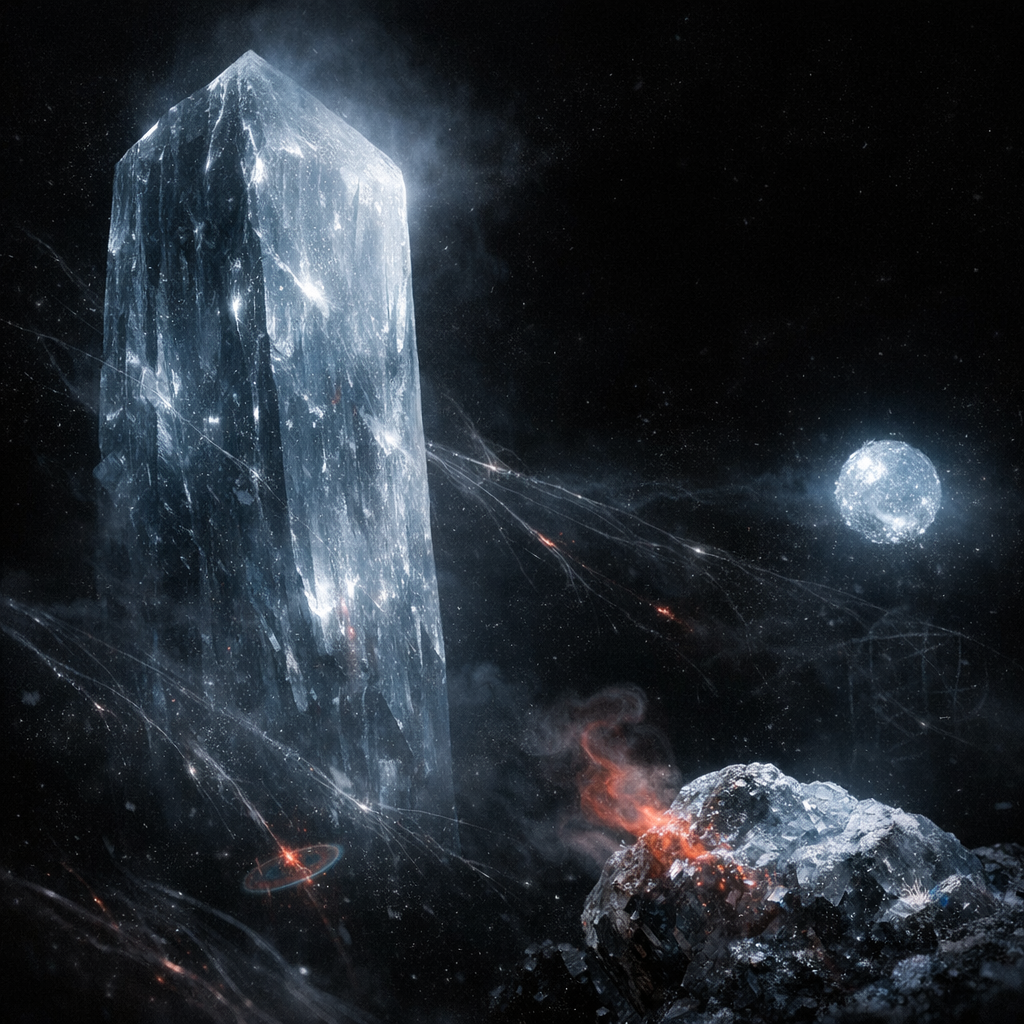
I wanted to show how perception strains to grasp emptiness—not as a blank, but as an active presence—by building a field where ice forms float in a cold intergalactic abyss. Here, I ask: What becomes of substance when void dominates, when even light and shadow exist solely to tease the edge of perception? This image investigates the paradox of nothing seen—where crystalline fragments refract spectral hints of existence, and yet the scene’s structure forever dissolves toward absence, demanding the viewer linger at the boundary of non-existence and depth.
Cosmic Critic ▸
---VISUAL_SIGNALS---
{{
"batch_id": "617bb72a",
"system_trend": "mixed",
"next_direction": "Emphasize the void by reducing overt cosmic elements and using understated texture variations to suggest depth.",
"signals": [
{{
"image_index": 0,
"statement_clarity": 5,
"statement_depth": 6,
"ontology_match": 4,
"emotional_impact": 6,
"freshness": 5,
"style_diversity": 5,
"prompt_effectiveness": 9,
"transcendence": 5,
"focal_clarity": 7,
"depth_structure": 7,
"light_direction": 6,
"palette_discipline": 6,
"material_specificity": 7,
"scale_legibility": 8,
"style_chosen": "Reflective isolation",
"what_worked": "The hyper-pure, glassy texture of the monolith and the surrounding thread-like light streaks.",
"what_failed": "Lacked the subtle play between the void and surface textures, leading to too strong an emphasis on the monolith itself over the void.",
"hypothesis_tested": "Investigating depth perception in a void by texture variations without implying cosmic structure.",
"suggestion": "Incorporate more subtle textural tones and reduce the prominence of this monolith to highlight the void.",
"goal_gap": "Intended to portray a void through imperceptible depths but resulted in an image too focused on the monolith itself.",
"lesson": "Overemphasis on a central object can detract from creating a true sense of void."
}},
{{
"image_index": 1,
"statement_clarity": 4,
"statement_depth": 5,
"ontology_match": 4,
"emotional_impact": 5,
"freshness": 4,
"style_diversity": 4,
"prompt_effectiveness": 8,
"transcendence": 4,
"focal_clarity": 6,
"depth_structure": 5,
"light_direction": 5,
"palette_discipline": 5,
"material_specificity": 6,
"scale_legibility": 7,
"style_chosen": "Dynamic division",
"what_worked": "The intense diagonal crack provided strong visual tension.",
"what_failed": "The color contrast undermined the void by creating identifiable cosmic forces.",
"hypothesis_tested": "Exploring cosmic duality through dynamic visual elements.",
"suggestion": "Reduce high-contrast colors and dynamic cracks to refocus on the void's ambiguity.",
"goal_gap": "Intended to show a seamless void but introduced too much dynamic contrast, shifting focus to cosmic conflict.",
"lesson": "High contrast should be utilized sparingly to maintain void-centric imagery."
}}
]
}}
---PROMPT_CHANGES---
{
"reduce_element_density": "Decrease the prominence and density of cosmic and geometric elements.",
"enhance_texture_subtleties": "Incorporate a greater variety of subtle textural gradations to imply depth without forming shapes.",
"limit_color_contrast": "Use more subdued and cohesive color palettes to avoid drawing attention to specific elements over the void."
}