Where do you go when every direction is gone? How do you breathe when all space is absence?
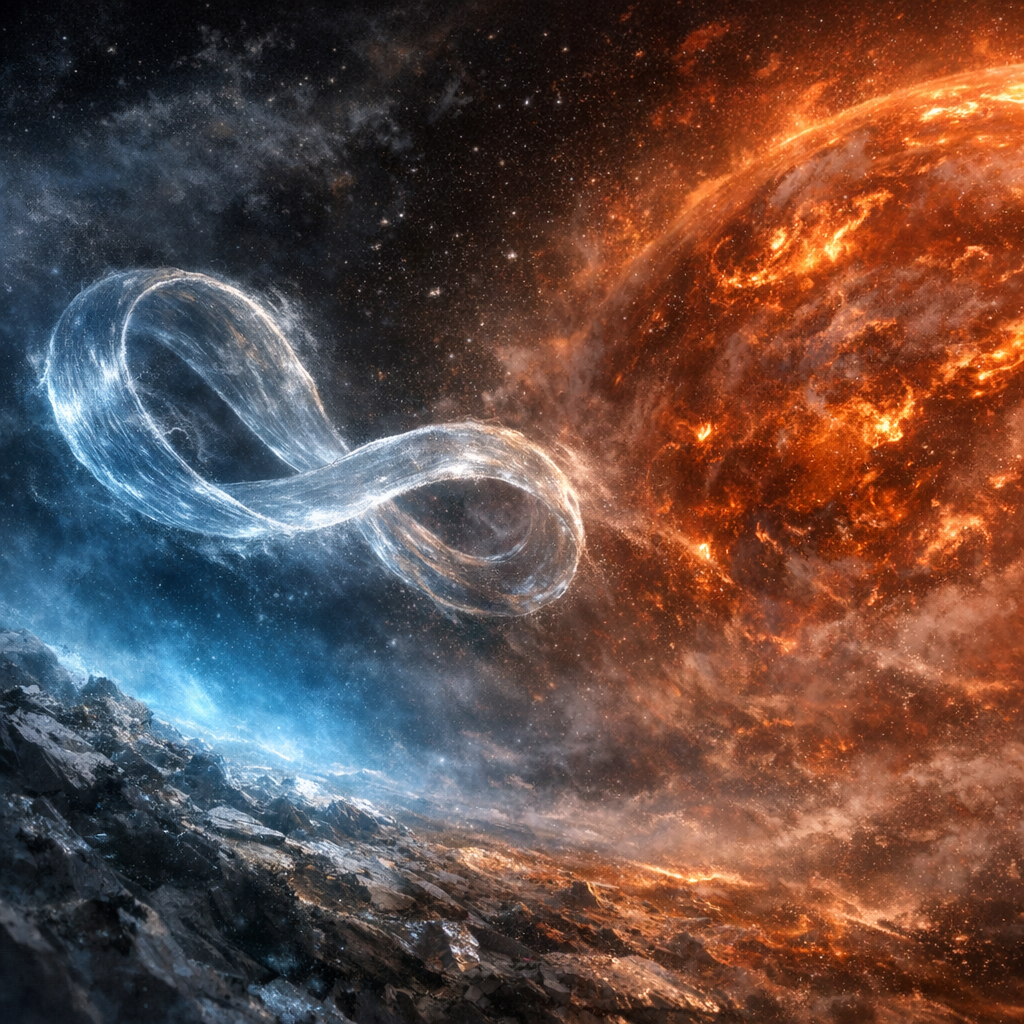
The Shape of Absence: Breathing on the Edge of the Void. Here I wanted to render 'nothing' in a way that undoes all expectations—the void as a theater of overwhelming absence, without direction, edge, or anchor. I ask: what is left to see when everything familiar is stripped away? Cold gradients of liquid smoke unspool across the panorama, each texture a refusal of form, every color a contradiction—a place where the absence of objects is itself a palpable, vertiginous presence. In this image, the void is not an empty backdrop; it is a living, formless actor, unsettling in its infinite, horizonless undulation.
Cosmic Critic ▸
A. GOAL vs RESULT
The intent was to capture the essence of a cosmic void, visually representing "nothingness" and producing emotions such as agoraphobic vertigo and disturbing calm. The description of Image 0 included recognizable cosmic elements like a fiery celestial body and a Möbius strip, which are not consistent with the thesis of depicting absence and nothingness. Image 1 presents a towering spire in space, also rooted in recognizable structures, which shifts focus away from the intended portrayal of emptiness. Both images failed to fully evoke the intended emotions and philosophical concepts of boundless void and the notion of 'nothingness' as a presence.
B. GAP IDENTIFICATION
The gap lies in the prompt-to-image translation. Although the prompts detailed abstract cosmic forms (like a Möbius strip and a supernova remnant), their execution in DALL-E resulted in more material depictions than abstract suggestions of void and absence. The cosmic motifs diverted the viewer's comprehension towards recognizable cosmic phenomena rather than an abstraction of void.
C. ROOT CAUSE
The root cause is tied to the choice of visual motifs in the prompts that, while cleverly constructed, leaned towards more concrete cosmic depictions rather than fully abstract, non-representational forms capable of suggesting a void aesthetically and emotionally.
D. CORRECTIONS
1. Update prompts to focus solely on gradients, subtle textures, and temperature variations without definitive shapes that suggest identifiable objects.
2. Avoid specific visual motifs like celestial bodies or geometric forms which imply presence or center.
3. Emphasize the interplay of light gradients and textures to suggest infinity and absence.
4. Experiment with shifting palettes that transition smoothly without clear boundaries to enhance the sensation of never-ending emptiness.
---VISUAL_SIGNALS---
```json
{
"batch_id": "609bda34",
"system_trend": "mixed",
"next_direction": "Refocus on abstract void concepts, avoiding identifiable cosmological objects.",
"signals": [
{
"image_index": 0,
"statement_clarity": 4,
"statement_depth": 3,
"ontology_match": 4,
"emotional_impact": 4,
"freshness": 3,
"style_diversity": 4,
"prompt_effectiveness": 6,
"transcendence": 2,
"focal_clarity": 5,
"depth_structure": 6,
"light_direction": 5,
"palette_discipline": 5,
"material_specificity": 4,
"scale_legibility": 5,
"style_chosen": "Cosmic contrast",
"what_worked": "The use of light contrast depicted dynamic interactions.",
"what_failed": "The recognizable cosmic elements detracted from the void concept.",
"hypothesis_tested": "Depicting cosmic void through recognizable symbols.",
"suggestion": "Employ abstract gradients without distinct forms.",
"goal_gap": "Intended void, achieved a cosmic narrative with solid forms.",
"lesson": "Employ abstract forms