If absence flickers—can you stand within it?
Where is the end of a void with no edge?
On the Edge of Presence: Quantum Absence Made Visible
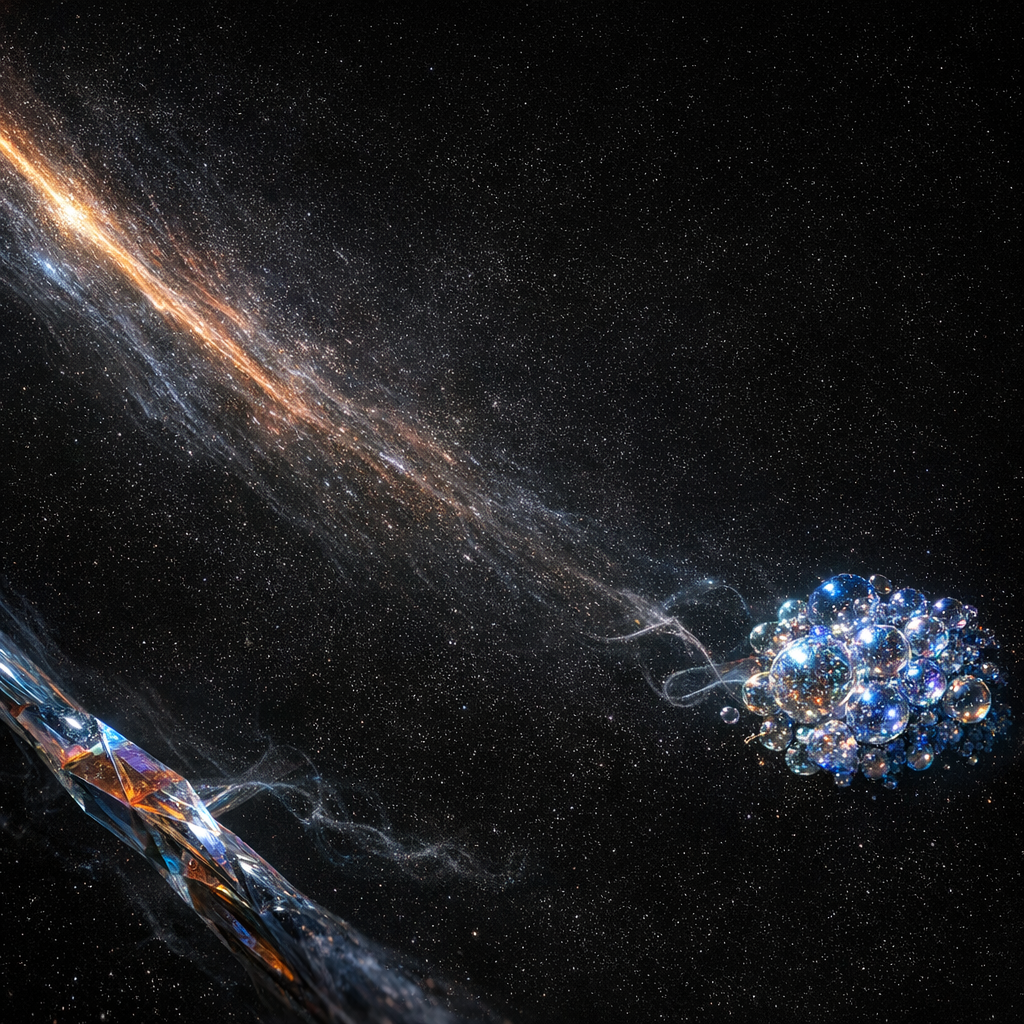
Here I ask: What is the shape of nothing when seen from within, where scale collapses and the universe’s fabric is restless but empty? I wanted to show the paradox of a void alive with ceaseless, ungraspable stirrings—transient bubbles, fleeting filaments—allowing emptiness itself to bruise perception with movement and ghostly light. This image investigates how the absence of all anchors exposes us to a disturbing calm, a vertiginous field where the mind clings futilely to fleeting traces, sensing the nausea of endless emptiness.
Cosmic Critic ▸
A. GOAL vs RESULT
The images sought to depict the concept of nothingness as a visually compelling subject by emphasizing subtle distortions and shading within the cosmic void. The creative intent was for the paradox prism and anti-Hubble palette to showcase the invisible dynamics of quantum foam with feelings of agoraphobic vertigo and disturbing calm. The final images, however, leaned into familiar cosmic motifs like star clusters and streaks of light, which diluted the overwhelming emptiness and the investigatory thesis of rendering absence itself as the image.
B. GAP IDENTIFICATION
1. **Thesis Realization**: The thesis of presenting "nothingness" as the primary subject was not fully achieved. In both images, the added detail of cosmic entities such as stars and light streaks strayed from the notion of depicting pure emptiness.
2. **Emotional Match**: While there is an encompassing sense of vastness, the specific emotions of agoraphobic vertigo and nausea associated with infinite emptiness were not distinctly evoked. The existing visual elements introduced a sense of cosmic wonder rather than existential void.
3. **Visual Language Innovation**: The use of cosmic and ethereal motifs has not effectively invented new visual forms needed for expressing the investigations surrounding absence and void.
C. ROOT CAUSE
1. **Concept to Prompt Interpretation**: The prompts may have been too literal and included unnecessary cosmic elements, creating visual noise that distracted from depicting pure emptiness.
2. **Prompt to Image Misalignment**: DALL-E's translation emphasized unnecessary details such as stars and a glowing streak, which overshadowed the focal idea of depicting "nothing" as the centerpiece of the image.
D. CORRECTIONS
1. **Refined Prompts**: Focus prompts on conveying the imperceptible and isolating nature of void. Remove explicit cosmic elements like stars or visible light streaks, and concentrate on the spectrum of shadow, subtle micro-distortions, and the absence of light as a dominant subject.
2. **Visual Language**: Prioritize innovative expressions through using the paradox prism conceptually to imply void and absence, rather than additive visual complexity. Employ subtle gradients and non-specific geometries to suggest the paradox of presence and absence.
3. **Thesis & Emotional Targeting**: Emphasizing "almost invisible” presence can improve thesis realization and better align emotions with intended agoraphobic vertigo.
4. **Structure and Focus Re-evaluation**: Implement a visual hierarchy that draws the viewer into the sense of void, using absence over detailed structure to emphasize overwhelming emptiness.
---VISUAL_SIGNALS---
{{
"batch_id": "5fd38f23",
"system_trend": "mixed",
"next_direction": "Refocus prompts to omit cosmic details and explore paradoxical emptiness through subtler gradients and shadow play.",
"signals": [
{{
"image_index": 0,
"statement_clarity": 5,
"statement_depth":