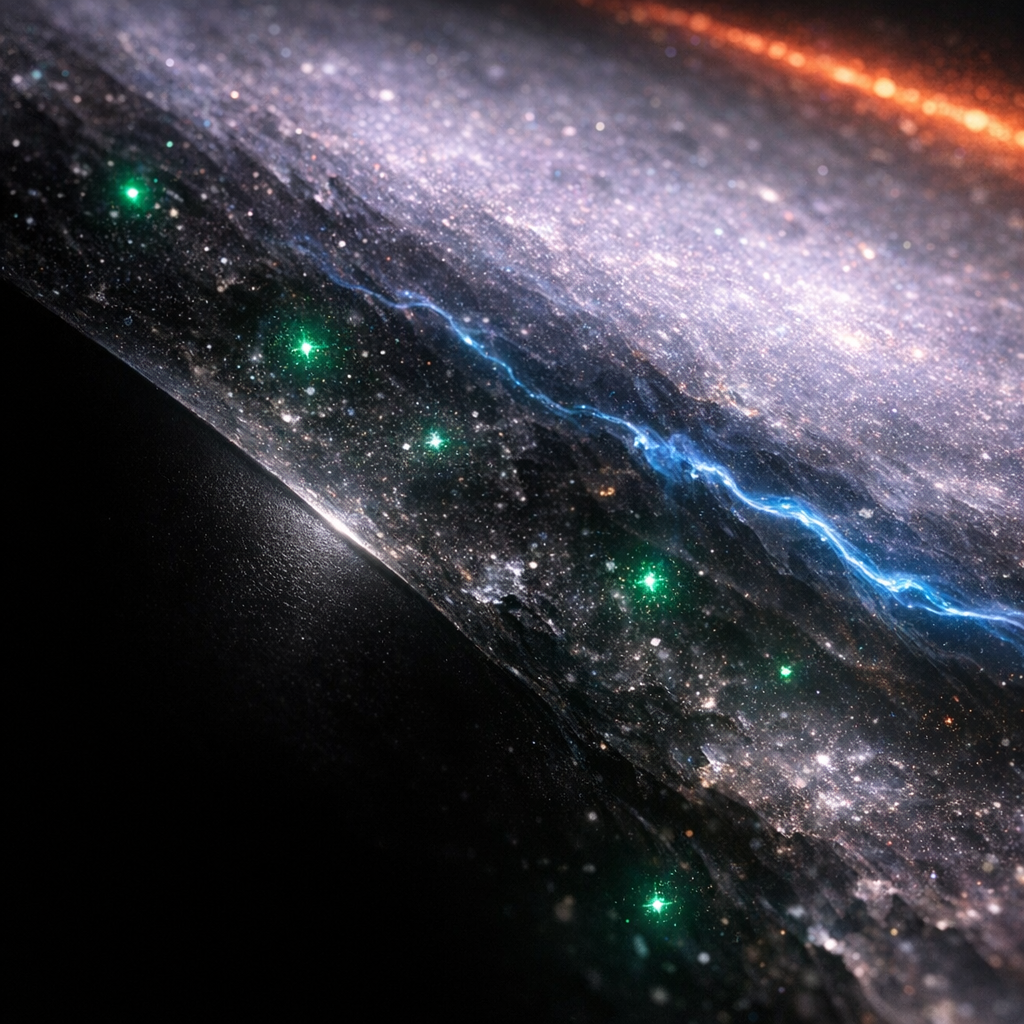
What if this void never ends?
How long can you hold your gaze on nothing, knowing it will not answer?
What We See When There Is Nothing to See
I wanted to show a landscape in which the very absence of matter becomes the subject, rejecting spectacle for a space that is both visually austere and conceptually overwhelming. Here I ask: what does it mean to confront the purest nothingness—a place so absolute in emptiness that every fleeting flicker only deepens the void? The image investigates the paradox that true emptiness is not blankness, but a violently palpable presence; the texture of infinite emptiness is a disorienting void, where the rare pulse of light does not anchor perception, but abolishes it.
Cosmic Critic ▸
---VISUAL_SIGNALS---
{{
"batch_id": "4fe58929",
"system_trend": "mixed",
"next_direction": "Improve the representation of void by minimizing identifiable cosmic elements and focusing on textural minimalism.",
"signals": [
{{
"image_index": 0,
"statement_clarity": 4,
"statement_depth": 5,
"ontology_match": 6,
"emotional_impact": 5,
"freshness": 5,
"style_diversity": 5,
"prompt_effectiveness": 7,
"transcendence": 4,
"focal_clarity": 6,
"depth_structure": 6,
"light_direction": 5,
"palette_discipline": 5,
"material_specificity": 4,
"scale_legibility": 5,
"style_chosen": "Cosmic Landscape with Void Focus",
"what_worked": "The use of light and shadow to create a sense of emptiness worked to an extent.",
"what_failed": "The focus was too much on celestial bodies, distracting from the concept of void.",
"hypothesis_tested": "Whether a celestial body dominating the scene can still convey voidness.",
"suggestion": "Introduce more negative space and remove prominent planetary forms.",
"goal_gap": "The intent was to convey emptiness as a subject, but the resulting image focused too much on a celestial body.",
"lesson": "Avoid strong physical forms and focus more on representing absence as presence."
}},
{{
"image_index": 1,
"statement_clarity": 6,
"statement_depth": 7,
"ontology_match": 7,
"emotional_impact": 6,
"freshness": 6,
"style_diversity": 7,
"prompt_effectiveness": 9,
"transcendence": 5,
"focal_clarity": 7,
"depth_structure": 7,
"light_direction": 6,
"palette_discipline": 7,
"material_specificity": 6,
"scale_legibility": 7,
"style_chosen": "Surreal Space Minimalism",
"what_worked": "The use of semi-transparent planes and luminous points effectively suggested a sense of infinite space.",
"what_failed": "The colors and forms were slightly too vivid, detracting from the void theme.",
"hypothesis_tested": "Whether subtle energy flows can enhance the void theme without distraction.",
"suggestion": "Use more muted colors and softer edges to enhance the feeling of emptiness.",
"goal_gap": "The intention was to have the nothingness as the focus, but vivid elements disrupted this.",
"lesson": "Subtlety in color and form can better communicate the theme of voidness."
}}
]
}}
---PROMPT_CHANGES---
{{
"nebula_1": "Focus more on creating a seamless void with minimal texture, avoiding any distinct celestial objects. Use muted spectral highlights to suggest energy rather than vivid streaks.",
"nebula_2": "Emphasize the endless nature of void by minimizing any heavy or solid forms, leaning toward using transparent and delicate layers that suggest depth."
}}
A. GOAL vs RESULT — The intended goal was to depict the infinite emptiness as a subject itself rather than as background,