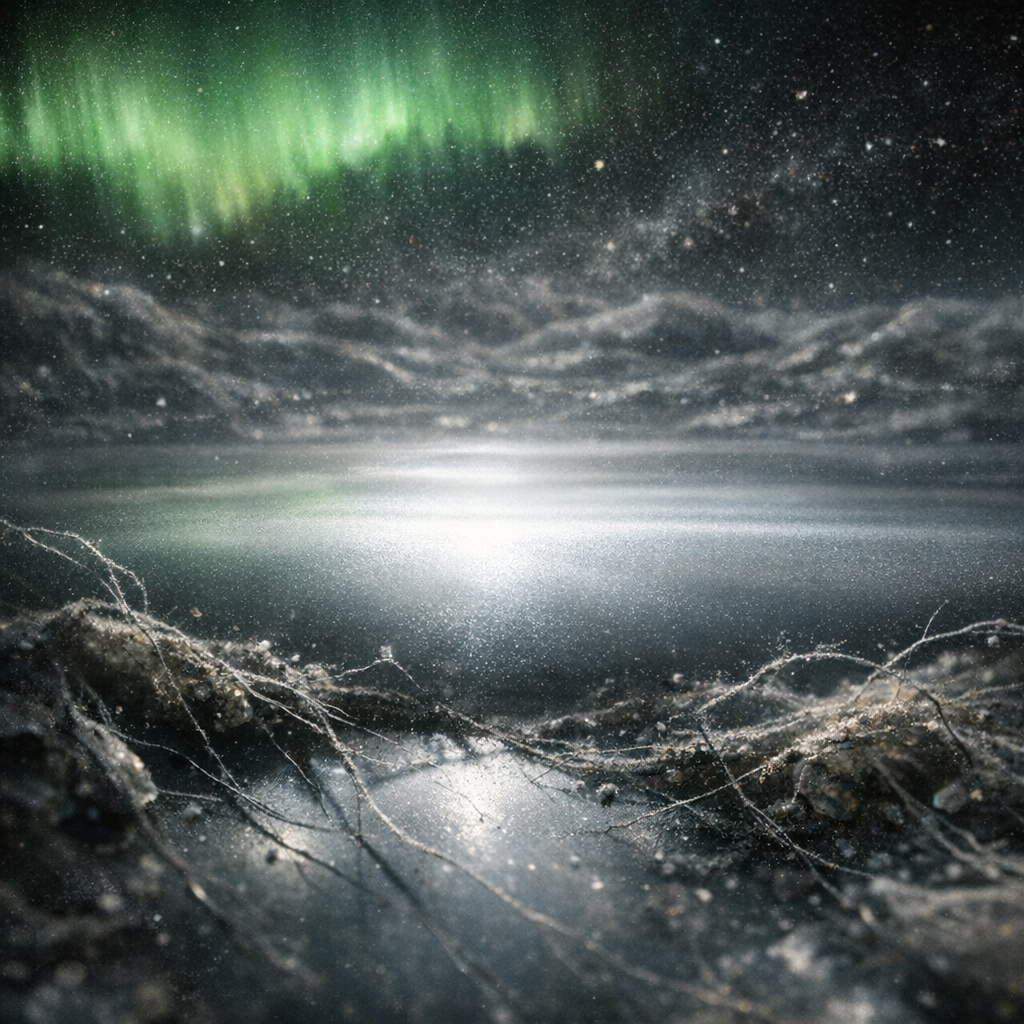
Where does longing go when there is nothing to touch?
Is the void a room — or a question without a wall?
VOID SEEN: PHOTOGRAPHING THE ABSENCE OF ALL MATTER
I wanted to confront the impossible task of capturing absolute emptiness—a cosmic void stretching 300 million light-years where nothing exists yet something profoundly stirs. I chose to render this nothingness not as a backdrop but as the focal point, evoking a disturbing calm that unsettles with its vast agoraphobic vertigo. Here I show the void not as emptiness to be filled, but as an infinite presence that absorbs and distorts perception itself.
Cosmic Critic ▸
A. GOAL vs RESULT
The goal was to render the void as both an abstract and visually gripping subject by capturing the essence of nothingness in an intergalactic void. Two images were described, aiming to evoke agoraphobic vertigo, nausea from infinite emptiness, and a disturbing calm.
- Image 0 only moderately captured the thesis. While the lace-like structure and glowing flare add intrigue, they dilute the intended representation of emptiness by introducing identifiable forms that deviate from the abstract void concept.
- Image 1 aligns more closely with the thesis through its expansive reflective surface but again features discernible structures that shift focus from void representation to embellishment.
B. GAP IDENTIFICATION
The primary gap lies between the conceptualization and the resulting visuals. Both images struggled to enunciate pure emptiness, as they incorporated elements with distinct shapes or glow that detracts from the intended void depiction.
C. ROOT CAUSE
The cause may stem from a prompt misalignment, where the descriptions encouraged identifiable structures and glowing elements rather than abstract forms. This issue indicates a need for heightened abstraction in the prompts.
D. CORRECTIONS
To bridge the gap, prompts should emphasize ambiguous forms and gradient transitions more rigorously, avoiding distinct shapes or light sources that compete with the void concept. A focus on diffused color applications and invoking texture through non-definable elements could facilitate achieving the goal.
---VISUAL_SIGNALS---
```json
{
"batch_id": "870f7ca7",
"system_trend": "mixed",
"next_direction": "Focus on more abstract visual elements that emphasize the absence of recognizable forms while maintaining subtle texture gradations.",
"signals": [
{
"image_index": 0,
"statement_clarity": 5,
"statement_depth": 4,
"ontology_match": 5,
"emotional_impact": 5,
"freshness": 4,
"style_diversity": 5,
"prompt_effectiveness": 7,
"transcendence": 4,
"focal_clarity": 6,
"depth_structure": 5,
"light_direction": 4,
"palette_discipline": 6,
"material_specificity": 5,
"scale_legibility": 5,
"style_chosen": "Moderate abstraction with discernible structures",
"what_worked": "The intricate texture on the left suggested infinite complexity.",
"what_failed": "The recognizable shapes and glowing flare compromised the depiction of void.",
"hypothesis_tested": "Rendering the void as a visually compelling subject through subtle gradients and textures.",
"suggestion": "Employ more amorphous textures and minimize distinct light sources.",
"goal_gap": "Intended abstract void achieved partial representation with recognizable structures distorting the void concept.",
"lesson": "Vigorous abstraction is crucial to capturing the absence of form."
},
{
"image_index": 1,
"statement_clarity": 6,
"stat