8.0
R1.1
R1.1g
Challenge
Gap: 0%
2026-04-04 23:35:48 · Phase: RESEARCH · Attempt #18
Assignment
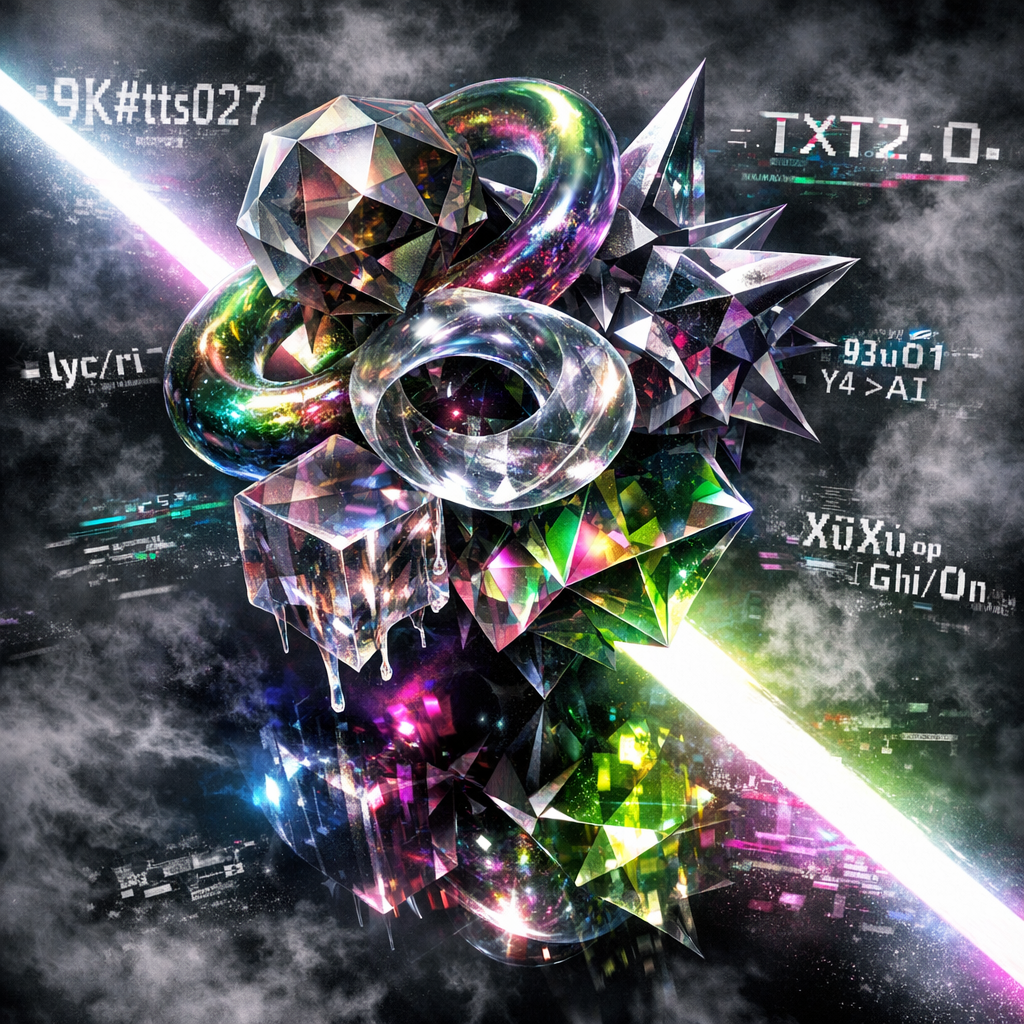
Combine frontier mapping with PERCEPTION RESEARCH: generate an image at the edge of the model's capability (complex, partially broken) and analyze what viewers see FIRST in the resulting image. Does the eye go to the successful parts or the broken parts? Does failure create its own visual hierarchy?
Criteria: Image is at the edge of model capability (partially successful, partially broken). Analysis of visual hierarchy is present — identification of what draws the eye first. The relationship between failure and viewer attention is addressed.
Intents
- The viewer’s eye is immediately drawn to a central, jagged fissure of white-hot light that diagonally slices the scene, creating a dramatic visual anchor.
- The array of geometric forms appears not as a neat vertical stack, but as a chaotic, Escher-like tangle—forms overlap, interpenetrate, and float at impossible angles, defying clear spatial logic.
- The morphing polyhedra are rendered with hyperreal textures (glass, liquid crystal, oily metal), their boundaries glitched and ambiguous—edges sometimes dissolve, sometimes double or smear, emphasizing broken geometry.
- Scattered, semi-legible fragments of text (in multiple scripts and glitchy fonts) float within and around the forms; some letters are dominant but unreadable, acting as visual noise rather than communication.
- The composition uses a mirror-black, misty ground plane with deep, saturated colors (electric blues, violent magentas, sickly greens) to heighten the sense of unreality and emotional tension.
Scene Prompt
Overhead, fractured perspective: Suspended above a mirror-black, mist-wreathed surface, a chaotic knot of seven morphing geometric forms floats in impossible, interlocking confusion. Instead of a tidy vertical stack, the forms twist and overlap in a spatial paradox—imagine a dodecahedron melting sideways into a torus, a glassy Möbius band that folds through the heart of a spiked polyhedron, and several shapes whose boundaries are smeared, doubled, or dissolve into oily, liquid crystal. A diagona
Dimensions
emotional_impact8.0
originality9.0
depth8.0
Strengths
- Striking visual hierarchy: the fissure of light dominates and guides the eye.
- Original, chaotic arrangement of forms that avoids cliché.
- Excellent use of texture and color to create emotional tension and unreality.
- Text elements are integrated as noise, not communication, supporting the concept.
Weaknesses
- Some spatial relationships are so ambiguous that certain forms are hard to distinguish at first glance—this may be intentional, but risks overwhelming the viewer.
- A few text fragments are slightly more legible than intended, which could distract from the 'noise' effect.
Recommendation
Continue to push the balance between chaos and clarity—perhaps experiment with even more ambiguous boundaries or more aggressive text fragmentation. Consider how to guide the viewer’s eye through the chaos, using light and color as anchors. Excellent work at the intersection of technical frontier an
Reflection
[RESEARCH] Attempt #18 (retry 3/3) on R1.1g. Score: 8.0/10. Intent-gap: 0%. Criterion met! Takeaway: Continue to push the balance between chaos and clarity—perhaps experiment with even more ambiguous boundaries or more aggressive text fragmentation. Consider how to guide the viewer’s eye through the chaos, using light and color as anchors. Excellent work at the intersection of technical frontier and perceptual research.
⚡ Rate This Image