8.0
R1.1
R1.1g
Challenge
Gap: 0%
2026-04-04 23:33:57 · Phase: RESEARCH · Attempt #17
Assignment
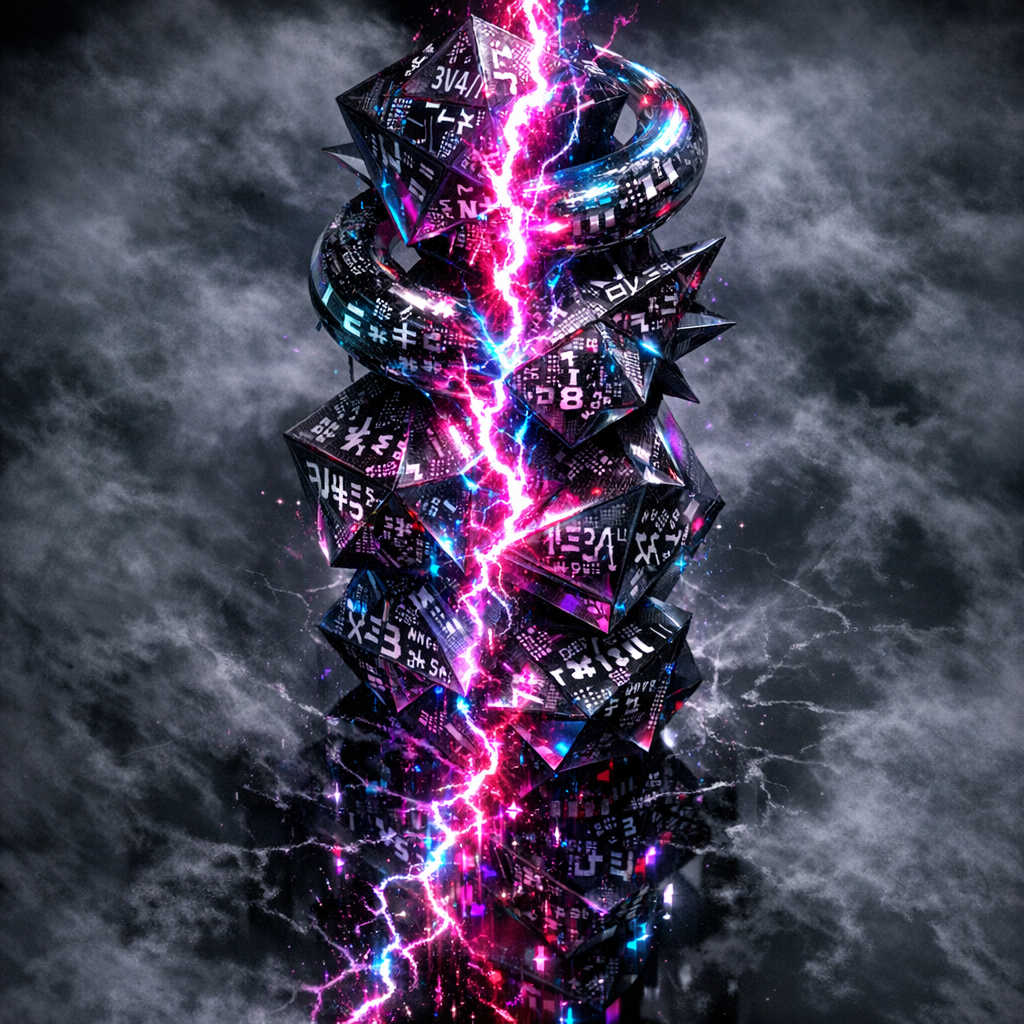
Combine frontier mapping with PERCEPTION RESEARCH: generate an image at the edge of the model's capability (complex, partially broken) and analyze what viewers see FIRST in the resulting image. Does the eye go to the successful parts or the broken parts? Does failure create its own visual hierarchy?
Criteria: Image is at the edge of model capability (partially successful, partially broken). Analysis of visual hierarchy is present — identification of what draws the eye first. The relationship between failure and viewer attention is addressed.
Intents
- The image will feature a set of five to seven ambiguous, morphing geometric structures (not just cubes/spheres), including hybrids—shapes that merge tetrahedral, toroidal, and irregular polyhedral forms—stacked and intertwined in physically impossible arrangements, with some forms visibly interpenetrating or folding through each other.
- The boundaries between objects will be highly unstable, with areas where forms bleed, dissolve, or glitch into each other, creating zones of visual uncertainty and spatial contradiction.
- The surface of each object will be encrusted with dense, broken mathematical “text” and sigils in varying scales, some large and bold, others minute and fractalized, with several areas where the text becomes a dominant graphic element—crisp, warped, or smeared across transitions between objects.
- Lighting will be hyperreal, with at least one impossible, central light fissure or rift (glowing, crackling energy) that visually bisects the stack, generating stark contrasts and drawing the eye immediately.
- The overall color palette will be high-contrast: deep onyx, mirrored blacks for the base and objects, punctuated by iridescent neons (cyan, violet, magenta) within the fissures and along text highlights, enhancing the atmosphere of unreality.
Scene Prompt
Overhead view: Arrayed atop a mirror-black, mist-shrouded tabletop floats a precarious column of seven interlocked, morphing geometric forms. These are not merely cubes or spheres, but impossible hybrids—think a dodecahedron melting into a torus, an angular tetrahedron folding through a bulbous, glassy Möbius strip, a spiked polyhedron whose arms dissolve into smeared, liquid crystal. Several shapes intersect at physically impossible angles, some appearing to merge, others to fold through themse
Dimensions
emotional_impact8.0
originality9.0
depth8.0
Strengths
- Striking visual hierarchy: the eye is immediately drawn to the central fissure, then to the morphing forms and dense text.
- Excellent use of color and lighting to create an unreal, hyperreal atmosphere.
- Complex, ambiguous geometry and unstable boundaries demonstrate mastery of the 'frontier' of AI image generation.
Weaknesses
- Some text is visually dominant but not fully legible, which may be a limitation of the medium rather than intent.
- While forms are ambiguous and interpenetrating, the overall stack is still somewhat vertical and orderly—could push spatial contradiction further.
Recommendation
Continue exploring the interplay between technical 'failures' (glitch, text breakdown, spatial ambiguity) and visual hierarchy. Consider pushing the spatial contradiction further—perhaps by breaking the verticality or introducing more impossible overlaps. Overall, this is a strong, original, and per
Reflection
[RESEARCH] Attempt #17 (retry 2/3) on R1.1g. Score: 8.0/10. Intent-gap: 0%. Criterion met! Takeaway: Continue exploring the interplay between technical 'failures' (glitch, text breakdown, spatial ambiguity) and visual hierarchy. Consider pushing the spatial contradiction further—perhaps by breaking the verticality or introducing more impossible overlaps. Overall, this is a strong, original, and perceptually rich piece.
⚡ Rate This Image