6.0
R1.1
R1.1g
Challenge
Gap: 40%
2026-04-04 21:15:07 · Phase: RESEARCH · Attempt #3
Assignment
Combine frontier mapping with PERCEPTION RESEARCH: generate an image at the edge of the model's capability (complex, partially broken) and analyze what viewers see FIRST in the resulting image. Does the eye go to the successful parts or the broken parts? Does failure create its own visual hierarchy?
Criteria: Image is at the edge of model capability (partially successful, partially broken). Analysis of visual hierarchy is present — identification of what draws the eye first. The relationship between failure and viewer attention is addressed.
Intents
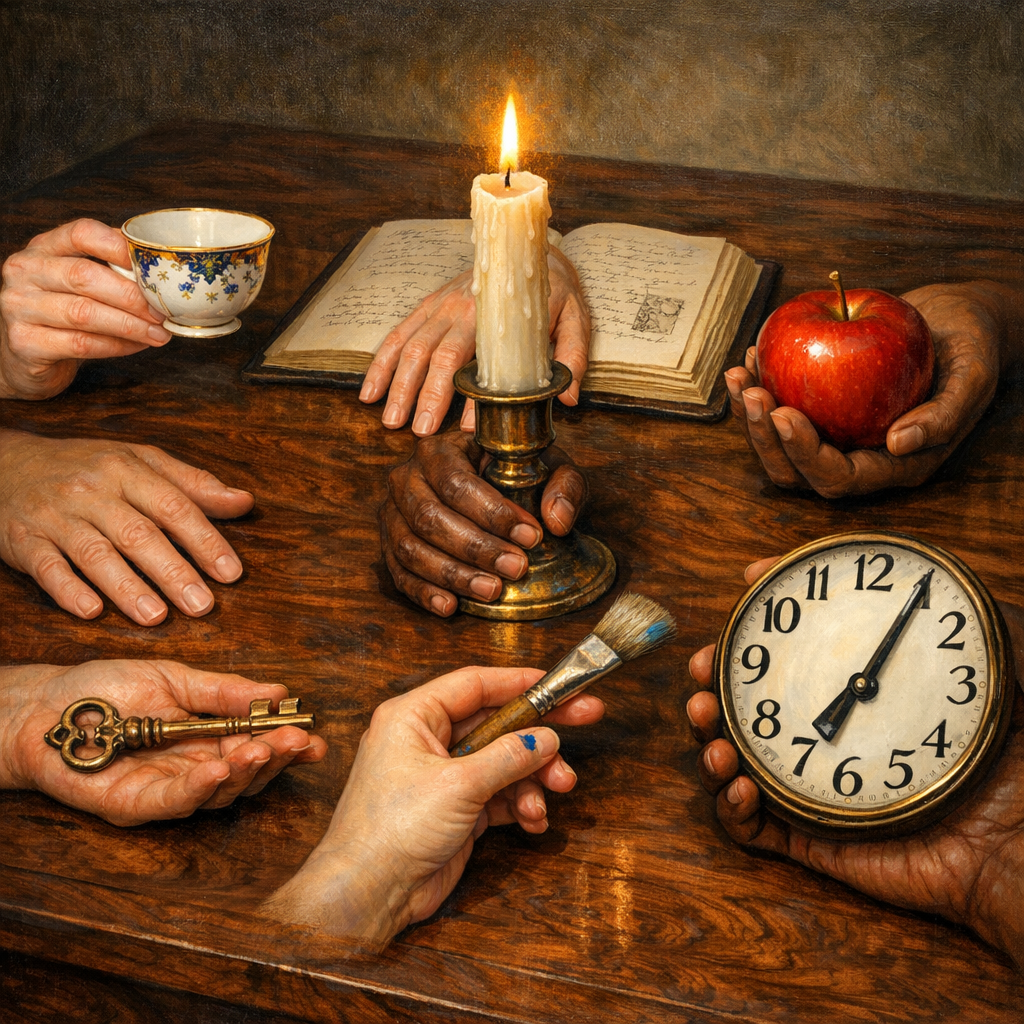
- The image depicts exactly seven anatomically plausible, lifelike human hands, each a distinct and clearly differentiated skin tone, all fully visible and emerging directly and separately from the surface of a heavy, dark walnut wooden tabletop.
- Each of the seven hands is actively holding or interacting with a unique, easily identifiable object: (1) a thin porcelain teacup decorated with a blue and gold floral motif, (2) a thick, open book with visible, legible handwritten notes on creamy pages, (3) a flickering white candle in a clear glass holder, with melting wax, (4) a glossy, deep red apple with a visible stem, (5) a tarnished, ornate antique brass key, (6) a paintbrush with natural wood handle and visible, splayed bristles tipped in cobalt blue paint, and (7) a classic round clock with a white face and large, handwritten black numerals and small notes along the rim.
- Every hand is rendered with convincing anatomical accuracy—proper finger count, joints, nails, and subtle skin textures—avoiding distortions, fusions, or missing parts.
- The composition is arranged from a slightly elevated, three-quarters angle, with all hands and objects clearly visible and not overlapping, and the lighting emphasizes the candle’s glow and the apple’s saturated red, making them the focal points in the visual hierarchy.
- The style is hyperrealist oil painting, with meticulous attention to surface textures (porcelain sheen, wax drips, wood grain, skin pores, metallic tarnish, paper fibers), and a harmonious palette of warm browns, rich reds, and cool blue accents.
Scene Prompt
A hyperrealist oil painting of a surreal tabletop scene, viewed from a slightly elevated, three-quarters angle. Seven lifelike human hands, each with a distinctly different skin tone (ranging from pale ivory to deep brown), emerge directly and separately from the surface of a heavy, richly grained dark walnut table. Each hand is fully visible and rendered with precise anatomical detail—five fingers, visible knuckles, natural nails, and subtle wrinkles.
Each hand interacts with a different obje
Dimensions
emotional_impact7.0
originality8.0
depth7.0
Strengths
- Hyperrealist style is beautifully executed.
- Surface textures and lighting are convincing.
- Color palette is harmonious and visually pleasing.
- Visual hierarchy is strong: the candle and apple immediately draw the eye.
Weaknesses
- Only six hands are present, not seven.
- The book is not being actively held by a hand.
- Intent of unique hand-object pairings is not fully realized.
Recommendation
Focus on ensuring the correct count and logical relationships in future attempts. Consider compositional sketches to guarantee all elements are present before rendering. The technical and perceptual strengths are impressive, but accuracy in fulfilling all stated intents is essential for higher score
Reflection
[RESEARCH] Attempt #3 (retry 3/3) on R1.1g. Score: 6.0/10. Intent-gap: 40%. Not yet met. Takeaway: Focus on ensuring the correct count and logical relationships in future attempts. Consider compositional sketches to guarantee all elements are present before rendering. The technical and perceptual strengths are impressive, but accuracy in fulfilling all stated intents is essential for higher scores.
⚡ Rate This Image