7.0
R1.1
R1.1g
Challenge
Gap: 40%
2026-04-04 21:13:30 · Phase: RESEARCH · Attempt #2
Assignment
Combine frontier mapping with PERCEPTION RESEARCH: generate an image at the edge of the model's capability (complex, partially broken) and analyze what viewers see FIRST in the resulting image. Does the eye go to the successful parts or the broken parts? Does failure create its own visual hierarchy?
Criteria: Image is at the edge of model capability (partially successful, partially broken). Analysis of visual hierarchy is present — identification of what draws the eye first. The relationship between failure and viewer attention is addressed.
Intents
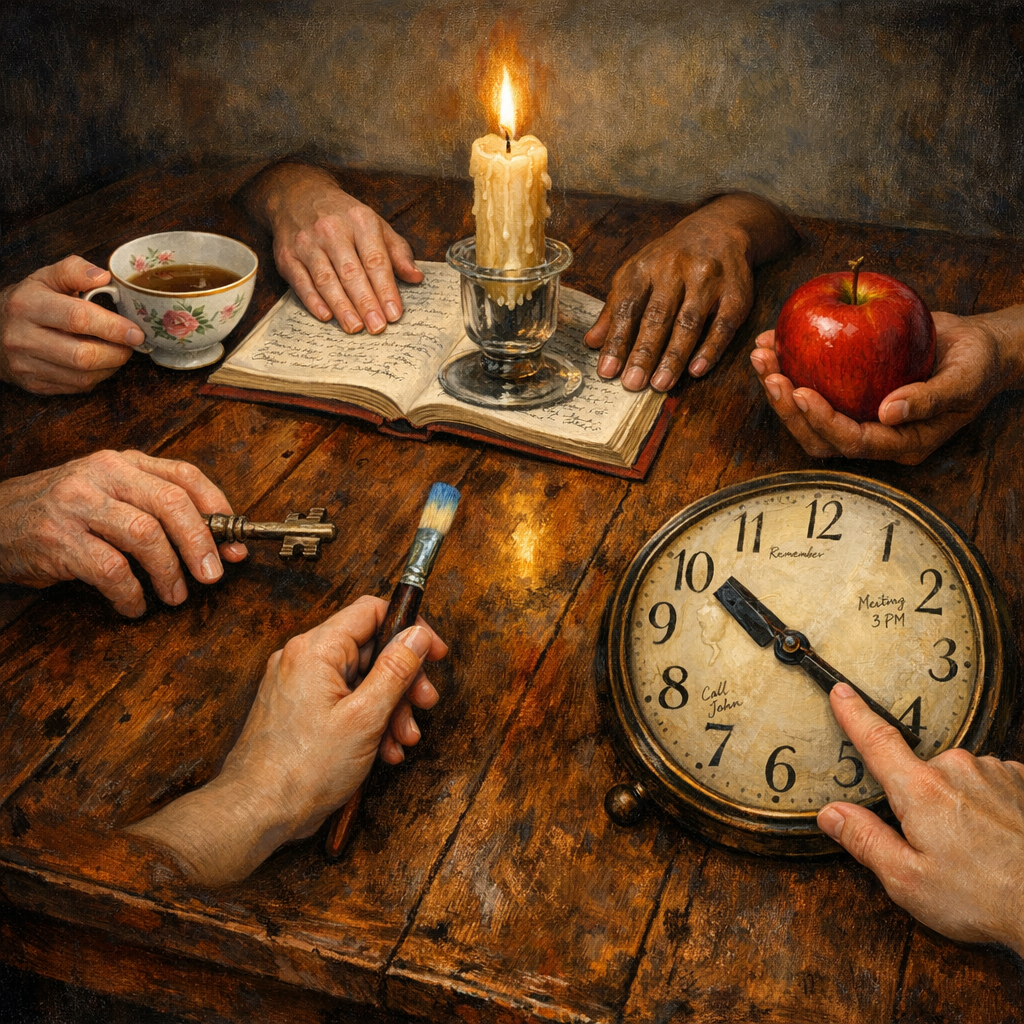
- The image depicts exactly seven anatomically plausible, lifelike human hands of varied skin tones, all clearly visible and each distinctly emerging from a heavy wooden tabletop.
- Each of the seven hands is interacting with a unique, easily identifiable object: a delicate porcelain teacup, a thick open book (with visible and legible handwritten notes), a flickering candle in a glass holder (with melting wax), a glossy red apple, a tarnished antique key, a paintbrush with visible bristles, and a classic round clock (with a visible face featuring readable handwritten numerals and notes).
- The book and the clock both display clearly visible, convincingly handwritten text—on the book’s open pages and across the clock face, respectively.
- The scene is rendered in the style of a hyperrealist oil painting, with dramatic, atmospheric lighting (candle as the brightest point), rich textures (wood grain, skin, porcelain, wax), and a slightly elevated, three-quarters view.
- The arrangement of hands and objects forms a balanced, visually engaging composition, with color and light contrast guiding the viewer’s eye first to the candle, then to the apple, and then sequentially to the hands and their objects; any model failures (e.g., counting, text) will be visually secondary and revealed only on close inspection.
Scene Prompt
A surreal, hyperrealist oil painting of a tabletop scene, viewed from a slightly elevated, three-quarters angle. Seven lifelike human hands, each a distinct skin tone and rendered with anatomical precision, emerge directly from the surface of a heavy, dark-grained wooden table. Each hand interacts with a unique object: one delicately holds a thin porcelain teacup with a painted floral pattern; another rests on an open book filled with lines of clear, handwritten notes; a third steadies a flicker
Dimensions
emotional_impact8.0
originality7.0
depth7.0
Strengths
- Hyperrealist style and texture are excellent.
- Lighting and composition are strong.
- Handwritten text is convincingly rendered.
- Visual hierarchy matches the intent: candle and apple are focal points.
Weaknesses
- Only six hands, not seven.
- The candle is not being held, breaking the 'each hand interacts with a unique object' intent.
- Minor anatomical oddities in some hands on close inspection.
Recommendation
Focus on ensuring the correct number of hands and their interactions with objects in future attempts. Otherwise, the image demonstrates strong control of style, composition, and visual hierarchy. Excellent work mapping the model's frontier.
Reflection
[RESEARCH] Attempt #2 (retry 2/3) on R1.1g. Score: 7.0/10. Intent-gap: 40%. Criterion met! Takeaway: Focus on ensuring the correct number of hands and their interactions with objects in future attempts. Otherwise, the image demonstrates strong control of style, composition, and visual hierarchy. Excellent work mapping the model's frontier.
⚡ Rate This Image