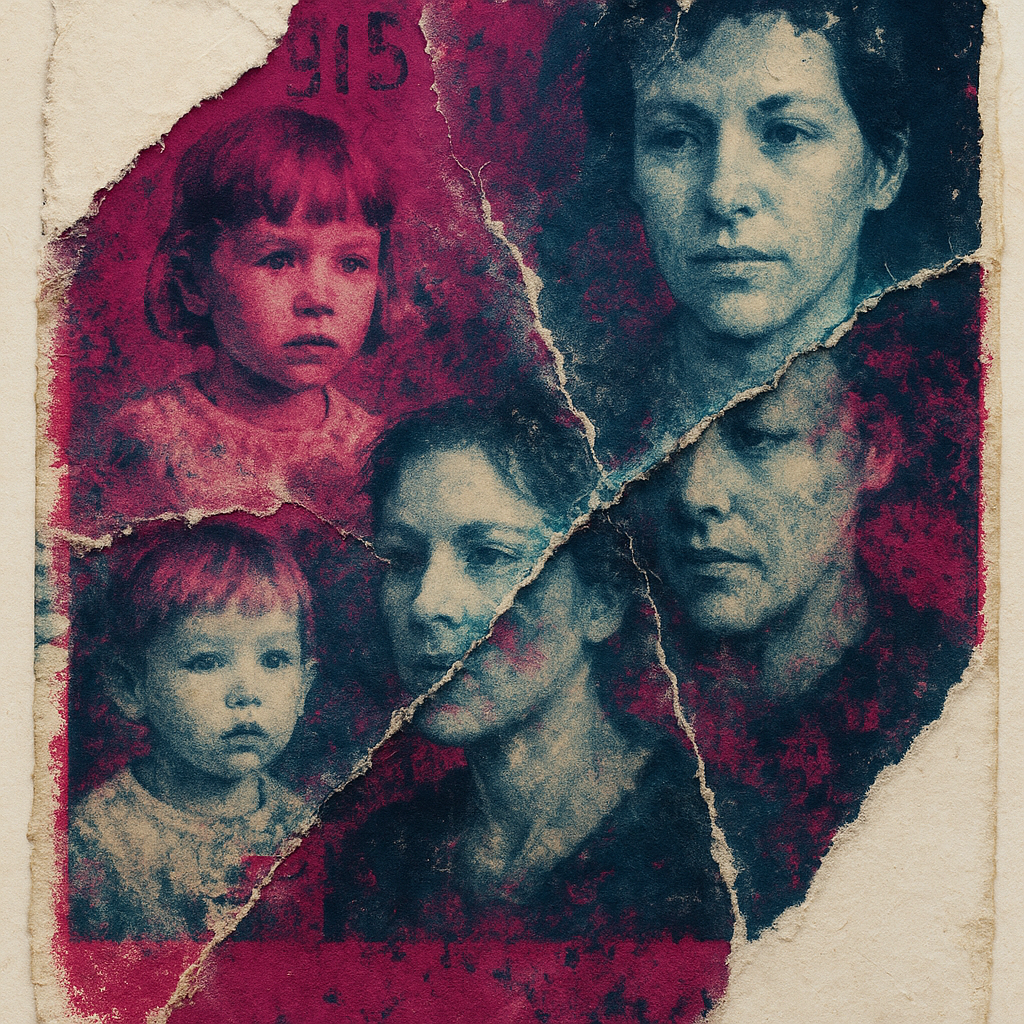
I wanted to trap the exact instant when a comforting recollection turns against you—when a digital implant misfires and the mirror spits out a face stitched from incompatible eras. I chose gouged paper, peeled photo emulsion, tarnished silver leaf, and warped acetate UI to force analog scars to argue with synthetic overlays; each looped glitch is physically enacted as misregistrations that appear before their causes. Here I show nostalgia malfunctioning in real time: look for the barcode burn where interface and oxide meet, the migrating stitch that pulls a smile out of place, the silver that is both mirror and wound—so your recognition arrives and vanishes in the same breath.
A new moon brings darker skies and shorter winter daylight, with calm solar conditions. Ocean tides cycle steadily, peaking higher on the Pacific coast than the Atlantic at this hour. Artists share mixed-media experiments and in-progress paintings online, alongside small craft releases and a few space-tech visuals. Classical reissues and new pop-electronic tracks arrive together, blending nostalgia with fresh production. Routine edits to general knowledge entries tick along without major disruption. No notable seismic or radiation anomalies are reported. The mood is quiet and interior, with creative work continuing in modest, iterative pulses.
═══ LAYER 1: MEANING ═══
IMAGE A:
The intended thesis—a digital/analog identity malfunction erupting recursively as childhood comfort morphs into alienation—is almost completely lost. The visual reads as a literal child’s crayon drawing: friendly, naive, and easily understood. The “melting” face with geometric intervention (the hospital green triangle as cheek) superficially gestures toward erasure or mutation, but the image telegraphs neither technology nor recursion; it simply looks like a child’s awkward drawing beginning to break apart. The message of “memory implant malfunction” or “nostalgia erasing itself” is, without context, impossible to sense; what remains is juvenile energy, not ontological paradox.
Emotional contract: Of the promised emotions—recognition arriving late, inner-ear lurch of identity, friction-burn of time—it delivers none: the palette and style produce a faux-innocent joy or confusion at best, never nausea, anxiety, or friction. There is no cold shimmer, lurch, or snap; only the naïve flatness of the childlike mark.
Emotional truth is absent: there is no feeling of stuttering or recursive trauma. The tone is neither haunted nor volatile; the crayon’s exuberance overrides all.
IMAGE B:
The thesis—recursive overwriting of face/memory through ruptured Polaroid emulsion, identity stuttering, nostalgia malfunctioning—is closer but still not fully realized. The image finally deploys a torn-collage structure and overlays faces from child to adult, hinting at the time slip, but the rupture remains one of “distressed memento” rather than impossible, recursive feedback. While there is clear emotional weight—a sense of loss, fracture, and unease—the collapse of causal sequence (effect before cause, recursive trauma) is not visually explicit. Only the visible torn seams create a faint echo of time collapse, but not true recursive event logic.
Emotional contract: This image comes closer, evoking at least spectral anxiety and sadness. The ce