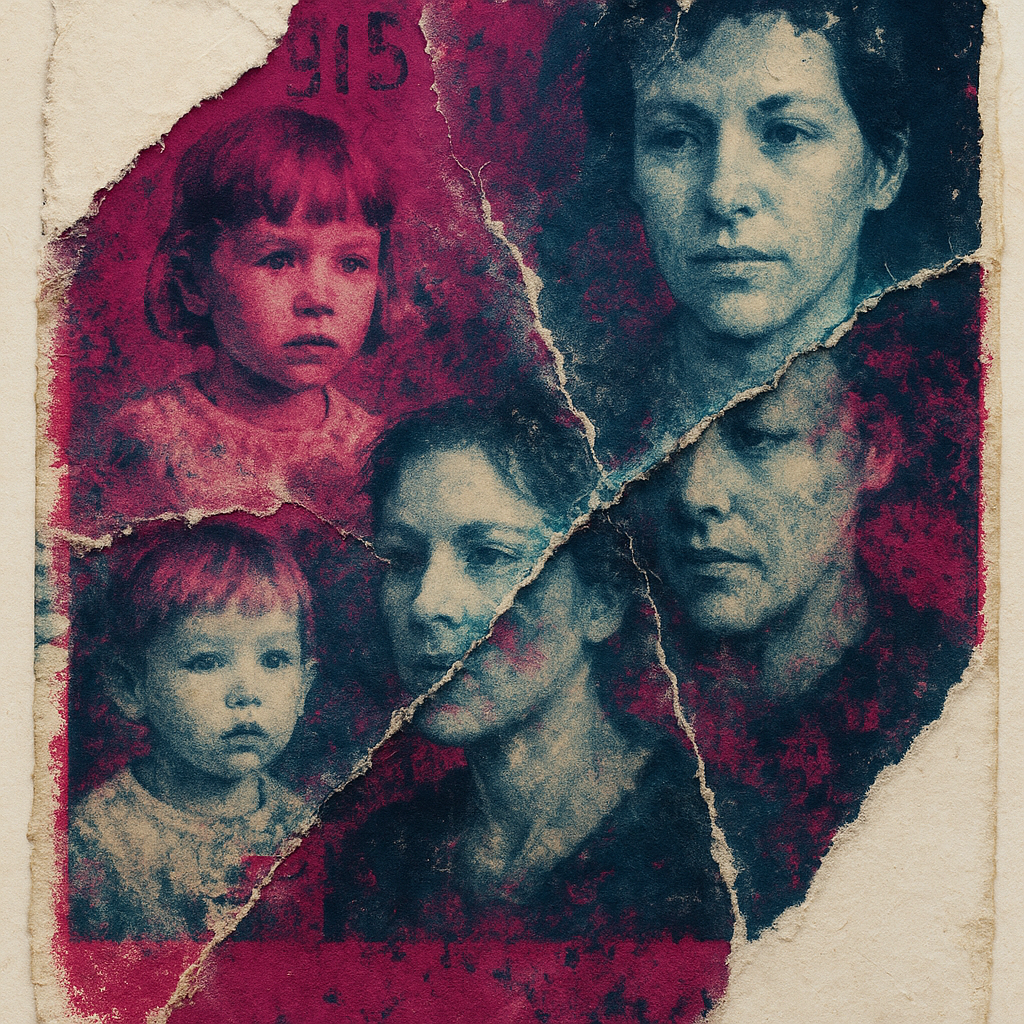
Exploded Diagram: Fragmented Family Portrait
The artwork evokes a sense of nostalgia, loss, and emotional fragmentation. The torn, aged appearance combined with the somber expressions of the figures creates a melancholic and introspective atmosphere.
Color Palette
deep magenta
background wash, shadows, and accent areas · 45%
faded cyan blue
figure shading, midtones, and background contrast · 35%
aged parchment
paper border and torn edges · 15%
soft ivory
highlight accents on faces and clothing · 5%
Background
A textured, aged parchment surface with irregular, worn edges and subtle discoloration. The background is visible mostly at the borders and through the torn cracks, giving the impression of an old, physically damaged photograph.
Visual Elements
Upper Left Child
medium
symbol of innocence and memory
A young child with short, straight hair and bangs, rendered in magenta and cyan tones. The facial expression is neutral to slightly somber, with soft, painterly shading and visible texture from the paper. The figure is partially obscured by a torn crack.
Lower Left Child
medium
echo of lost time, reinforcing theme of memory
A second young child, slightly younger, with similar hair and expression. Rendered in the same magenta-cyan palette, with more pronounced texture and some areas faded or abraded. The child’s gaze is directed slightly off to the side.
Upper Right Woman
dominant
anchor of the composition, representing maternal presence
An adult woman with short hair, serious expression, and defined facial features. Rendered in cyan and magenta, with more cyan in the shadows and magenta in the highlights. The face is partially bisected by a torn crack, adding to the sense of fragmentation.
Lower Right Woman
dominant
counterbalance to the upper right woman, suggesting duality or memory
Another adult woman, similar in appearance but with a more contemplative, downward gaze. The face is partially obscured by cracks and pigment loss, with a blend of magenta and cyan tones. The features are softer and more diffused.
Torn Cracks
large, spanning the entire composition
symbol of fragmentation, loss, and passage of time
Jagged, irregular tears running diagonally and horizontally across the image, revealing the aged paper beneath. The cracks have rough, fibrous edges and cast subtle shadows, enhancing the illusion of depth and physical damage.
Faded Number Stamp
small
accent detail, suggesting archival or bureaucratic context
A partially visible, faded number '915' stamped in the upper left area, blending into the magenta background. The numbers are distressed and partially obscured by cracks and pigment.
Connections
entity_1
→
entity_2
visual
Both children share similar features and color treatment, creating a mirrored, nostalgic relationship.
entity_3
→
entity_4
visual
The two women are positioned as counterparts, their gazes and expressions forming a conceptual dialogue.
entity_5
→
all entities
spatial
The torn cracks physically divide and disrupt the faces, reinforcing the theme of fragmentation.
background
→
entity_5
material
The aged paper background is exposed through the cracks, integrating the damage into the overall composition.
entity_6
→
entity_1
spatial
The faded number stamp overlaps the upper left child, suggesting archival or documentary context.
Composition
Layout
Central, quadrant-based with diagonal and horizontal divisions created by the cracks
Flow
The eye is drawn along the cracks, moving between the faces and across the torn divisions, then around the border
Balance
Asymmetrical, with visual weight distributed between the four quadrants
Negative Space
Negative space is minimal, mostly confined to the torn cracks and paper border, emphasizing the crowded, fragmented feeling
Tension Points
intersections of cracks with faces, upper right woman's gaze, faded number stamp
Techniques & Styles
Photographic Collage
Multiple photographic portraits are combined and overlaid, then digitally or physically distressed to simulate tearing and aging.
Duotone Colorization
The image uses a limited palette of magenta and cyan, creating a vintage, emotionally charged effect.
Simulated Paper Texture
The entire image is overlaid with a grainy, fibrous paper texture to enhance the illusion of age and physicality.
Aging and Distressing
Edges are worn, cracks are added, and pigment is faded or abraded to create a sense of timeworn damage.
Conceptual Layers
literal
Portraits of two children and two women, arranged in a torn, damaged photograph.
symbolic
The cracks and faded colors symbolize fragmentation, loss, and the passage of time within family memory.
emotional
Somber expressions and distressed surfaces evoke nostalgia, melancholy, and unresolved emotional tension.
narrative
Suggests a story of family, memory, and the impact of time or trauma on personal history.