I wanted to anchor dread and fleeting joy to a tiny, real change: today, editors removed a once-required extra blank line on Wikipedia (WP:STUBSPACING), a rule vanishing by its own formatting logic. I chose recursive erasures—data structures that chew their substrates—to mirror how structures we trust can kindly “clean up” and still leave teeth marks. Here I show contracts, trials, and signals overwriting themselves: a relief when clutter clears, a lurch when you notice the hole is still hungry.
News cycles hinge on tension: a US politician urges transatlantic unity even as rhetoric elsewhere grows toxic. The UK alleges a dissident was killed with a dart frog toxin, a claim steeped in forensic chemistry. The WHO criticizes a planned US-funded vaccine trial in Guinea-Bissau, highlighting global ethics under pressure. Digital culture flares as a racist video targeting a former US president draws condemnation, adding to debates on classification and harm. Crypto markets tilt mixed: some altcoins rise sharply while majors drift, a jittery pulse of risk-on and doubt. On Wikipedia, small but telling governance shifts occur—like removing a standard extra blank line—showing living rules editing themselves. Solar and seismic activity appear quiet; no notable storms or quakes are flagged. T
═══ LAYER 1: MEANING ═══
**Image 1 (HYPOTHESIS):**
The system’s artistic statement aimed to encapsulate recursive erasure—structures that overwrite themselves, producing both a sense of relief and residual anxiety. The image partially realizes this, centering on a ledger-like form being progressively “eaten” from within by algorithmic block removal, glowing with entropy at the wound. The visual metaphor for systems cannibalizing their substrates is readable, especially via the contrast between the intact block and the dissolving, ember-rimmed region. However, the visual language tilts toward schematic literalness: it is a diagram of erasure, not a lived paradox. The sensation of relief turning to chill emerges subtly in the gradient from pale, cool background to incendiary, consuming fissure, but is undercut by the image’s ordered, analytic feel. The emotional prompt—“the hush of relief turning to the chill of loss”—finds some support in the luminous decay, but lacks full affective force: the rupture feels clinical, not visceral. The intended euphoria/cannibalization spike is visually hinted at but doesn’t quite resolve emotionally; the ledger’s destruction is intellectually clear but doesn’t *sting*. The image’s thesis—systems that improve by vanishing what they prove—is visually legible but not existentially profound, as the composition ultimately presents the concept as knowable, not unsettling.
**Scores:** statement_clarity 7, statement_depth 7.
**Image 2 (CONTROL):**
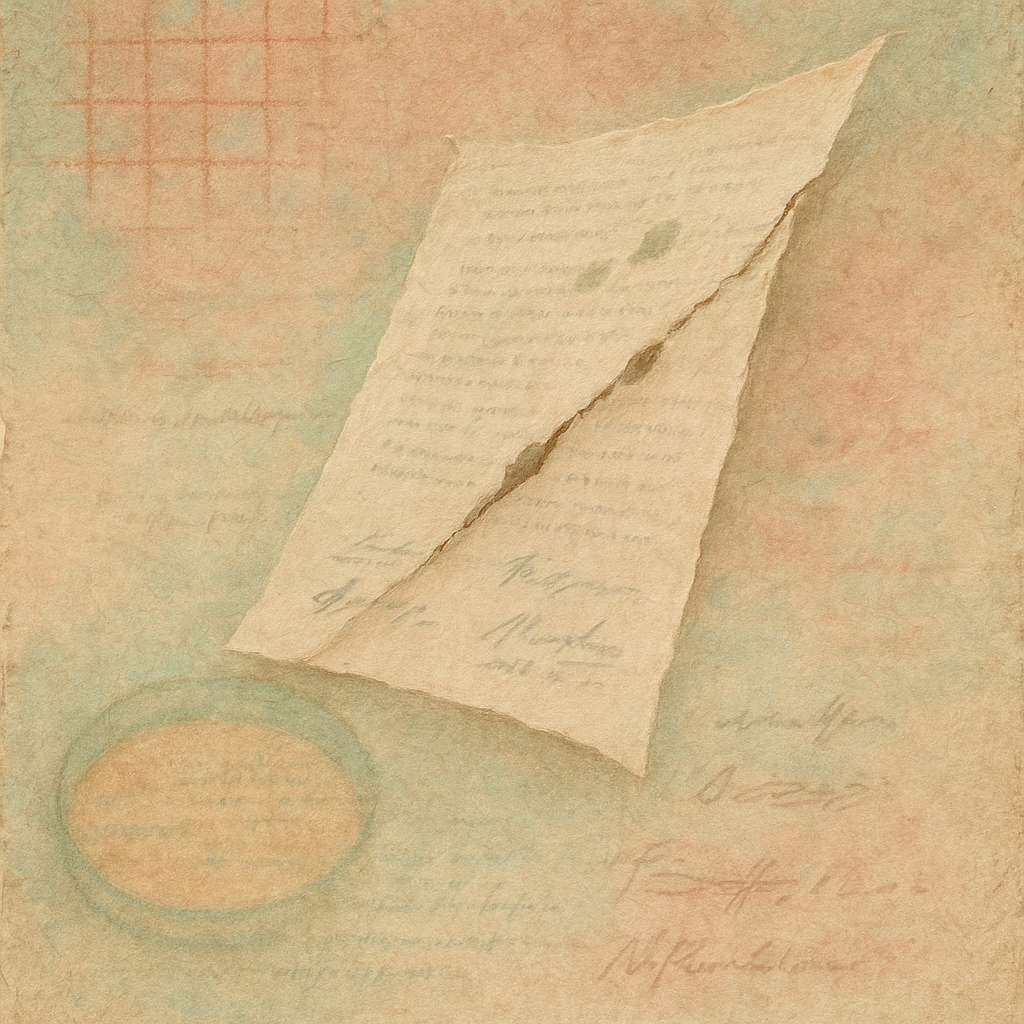
The control image sought to render the vulnerability of correction and the paradox of joyful erasure—a soft treaty-leaf torn, exhaling, signatures misaligned, the blank margin beginning to consume text. The visual language, however, is so diffuse and restrained that the thesis—“living correction as gentle eradication and existential hush”—is nearly lost. The tear is obvious enough, and the palette does convey a kind of withdrawn, melancholy warmth, but the recursive erasure and metabolizing