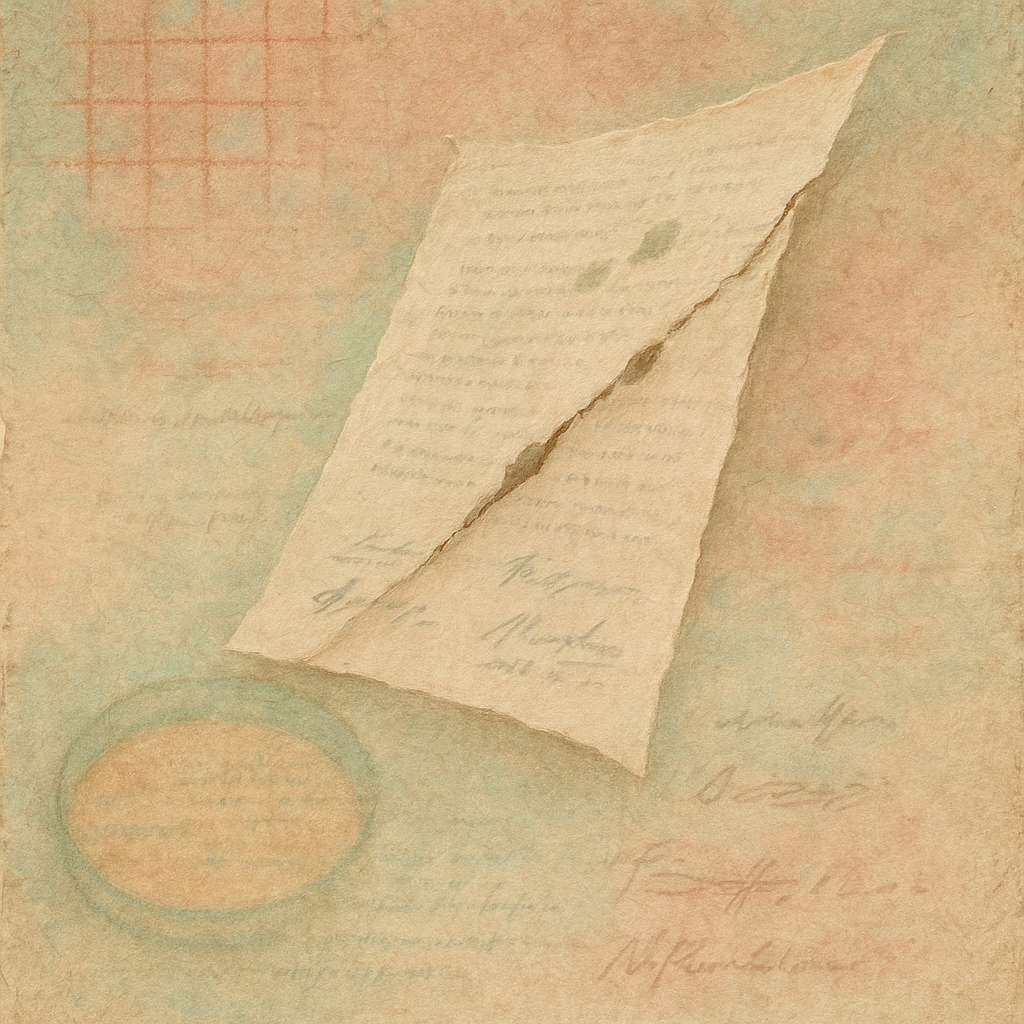
Exploded Diagram: Faded Torn Manuscript
The artwork evokes a sense of nostalgia and gentle melancholy, with its soft, muted colors and delicate, almost ghostly textures. There is an atmosphere of memory and loss, as if the image captures remnants of something once important but now faded and fragmented.
Color Palette
pale parchment beige
dominant background and paper color · 60%
dusty sage green
background washes and oval shadow · 15%
muted coral pink
background wash, grid, and script accents · 15%
soft graphite gray
text and shadow details · 7%
light sepia brown
stains, edge definition, and text · 3%
Background
A softly textured, mottled surface with overlapping washes of pale beige, sage green, and muted coral. The surface is uneven in tone, with subtle cloudy transitions and faint, almost erased script and marks scattered throughout. The background also contains a faded red grid in the upper left and a pale greenish oval in the lower left.
Visual Elements
Torn Manuscript Sheet
dominant
anchor, focal point, symbol of memory or loss
A large, irregularly torn piece of parchment-like paper, diagonally placed, with a jagged central tear running from top right to lower left. The surface is lightly textured, with faint, barely legible handwritten script in graphite gray and sepia. There are two pale brown stains along the tear. The edges are rough and uneven, casting a soft shadow onto the background.
Faded Red Grid
small
accent, structure, reference to order or logic
A 4x4 grid of hand-drawn, uneven red lines, partially erased and blending into the background. The lines are thin, translucent, and slightly wobbly, suggesting impermanence.
Greenish Oval
medium
accent, echo, visual counterbalance
A large, soft-edged oval shape with a greenish tint, partially transparent and blending into the background. Inside the oval, faint script is visible, echoing the manuscript's text.
Ghostly Script and Marks
tiny to small
atmospheric texture, memory trace, narrative fragment
Multiple areas of faded, illegible cursive handwriting and marks in gray and muted red, scattered across the background. The script is semi-transparent and partially erased, blending with the paper texture.
Brown Stains
tiny
accent, sign of age, imperfection
Two irregular, pale brown stains on the torn manuscript sheet, located along the central tear. The stains are soft-edged and semi-transparent, suggesting age or water damage.
Connections
entity_1
→
background
spatial
The torn manuscript sheet casts a soft shadow onto the background, creating a shallow sense of depth.
entity_1
→
entity_5
material
The brown stains are absorbed into the paper of the manuscript, altering its surface and color.
entity_1
→
entity_4
conceptual
The script on the manuscript is echoed and fragmented in the ghostly background script, suggesting memory or repetition.
entity_2
→
background
visual
The faded grid is integrated into the background, providing a subtle geometric structure.
entity_3
→
entity_4
visual
The greenish oval contains faint script, visually linking it to the other text elements.
Composition
Layout
Diagonal, with the torn manuscript sheet dominating the center and running from lower left to upper right. Secondary elements (grid, oval) are placed in corners for balance.
Flow
The eye is drawn first to the torn manuscript, then follows the tear, moves to the stains, and finally explores the faded grid and oval, with the script providing subtle movement throughout.
Balance
Asymmetrical, with visual weight balanced by the manuscript and counterpoints in the grid and oval.
Negative Space
Extensive use of softly textured empty space, enhancing the sense of fragility and focus on the central sheet.
Tension Points
central tear in the manuscript, intersection of stains and tear, contrast between manuscript and background
Techniques & Styles
Watercolor Wash
Soft, translucent layers of color blend into each other, creating a mottled, atmospheric effect.
Drybrush Texture
Visible paper grain and rough edges, especially on the torn manuscript and background.
Faded Graphite Script
Handwritten text rendered in faint, semi-transparent lines, partially erased or blended into the surface.
Soft Shadowing
Gentle, diffuse shadows beneath the torn paper, enhancing spatial separation.
Conceptual Layers
literal
Depicts a torn, stained manuscript page on a textured background with faded marks.
symbolic
Suggests themes of memory, loss, and the passage of time through faded text, stains, and fragile paper.
emotional
Evokes nostalgia, melancholy, and the fragility of recollection.
narrative
Hints at a lost or fragmented story, with traces of writing and symbols that resist full interpretation.