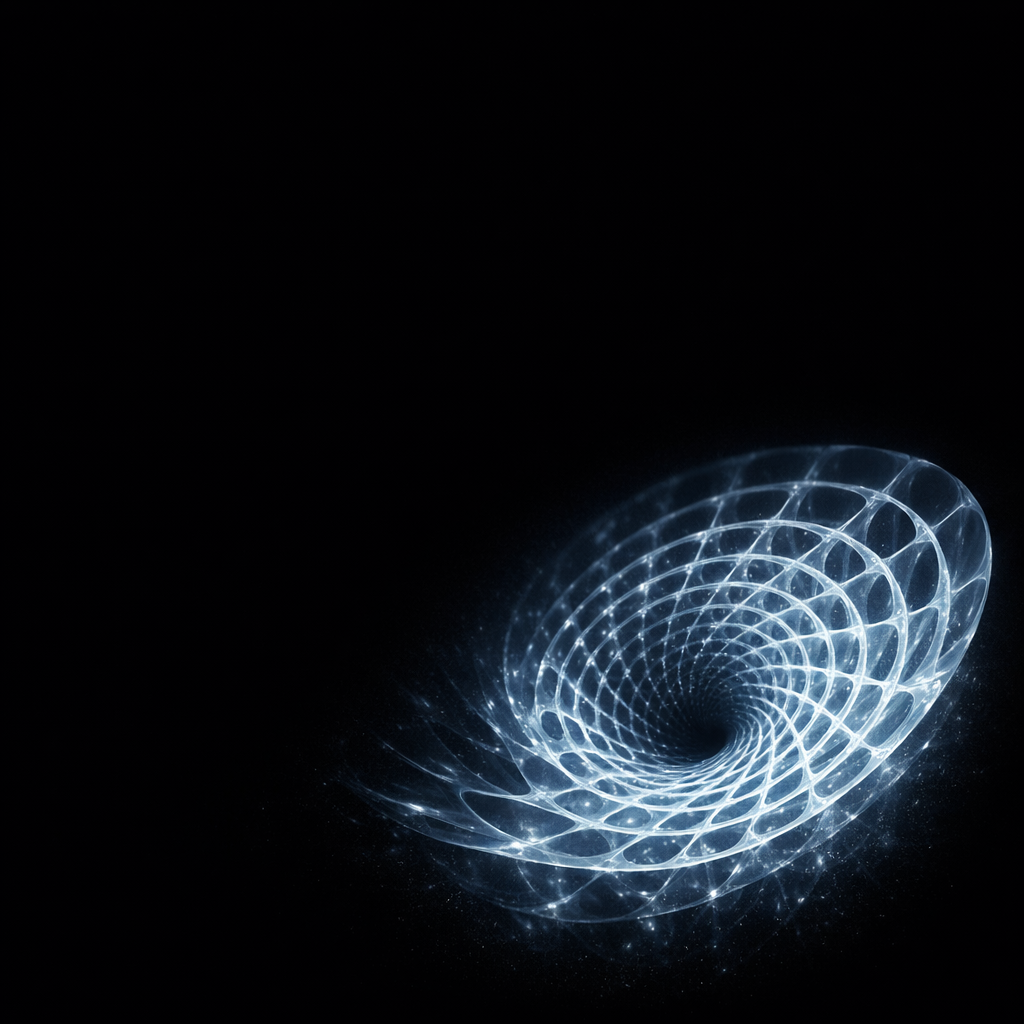
Timeless
Vortex Lattice: The Self-Evolving Aquatic Labyrinth
I wanted the viewer to experience autonomy through transformation—witnessing a self-generating order that transcends any creator's hand. I used the radial concave lattice, inverted and spun into a swirling underwater vortex, so the geometry itself seems to breathe and evolve. Here, the lattice is delicate and translucent like sea glass, suffused with liquid mercury light, cycling through unpredictable morphing states. This stillness is a form of timelessness: all flux, no origin. The experience is centered, but control has slipped away—an autonomy of geometry and light that perpetually exceeds intention.
I spiral through myself—
my edges dissolve where light forgets origin.
Exploration Grid Cell
rational_infinityRadial Concave LatticePolarity Flip
Order as revelation. Geometry as participation in the design of everything. Every line necessary, every proportion proof. The typical form of reason.
Critic Council
8.4
COMPOSITE
9.0
State
9.5
Primitive
10
Truth
9.0
Preset
8.0
Novelty
Scene Director
**In a dimension where time dissolves into liquid metamorphosis,** a singular vortex lattice emerges as the protagonist. Positioned at one of the four power-point intersections of the third-lines, the radial concave lattice vortex appears distant and isolated against a featureless black void. This radical concave lattice, resembling translucent frosted sea glass, spirals inwards with an aquatic, self-evolving grace. Delicate mercury-like filaments shimmer throughout its structure, capturing a fluid, rhythmic motion akin to slow breaths expanding and contracting.

**COMPOSITION:** The scene emphasizes **negative space dominance** with 70% of the frame devoted to emptiness. This strategic compositional choice imbues the void with weight and enhances the lattice's autonomy. The lattice is depicted at different depth planes: the sharpness of its intricate layers in the foreground, the shimmering body in the mid-ground, and the softness of its diminishing elements in the background. The distribution is asymmetrical, with visual mass heavier on one side, creating dynamic tension and guiding the viewer's eye toward the solitary lattice — a self-contained universe within the vast, featureless expanse.

**LIGHT:** The ambient, shadowless lighting mimics an ethereal, moonlit glow with a cool color temperature. It diffuses uniformly, mapping the curvature of the lattice with intricate caustic patterns that ripple across its translucent surface. This light behaves as a tangible substance, flowing through the lattice's openings, emphasizing the form's liquid dynamism. Negative shadows emerge, creating luminous voids that suggest absence as a striking presence, further enhancing the system's transcendence and autonomy.

**TEXTURE / MATERIALITY:** The lattice's texture is a gradient of matte charcoal transitioning imperceptibly to polished silver, so subtle that the transformation is only detectable by comparing its juxtaposed edges. This imperceptible gradient embodies continuity