Cosmos
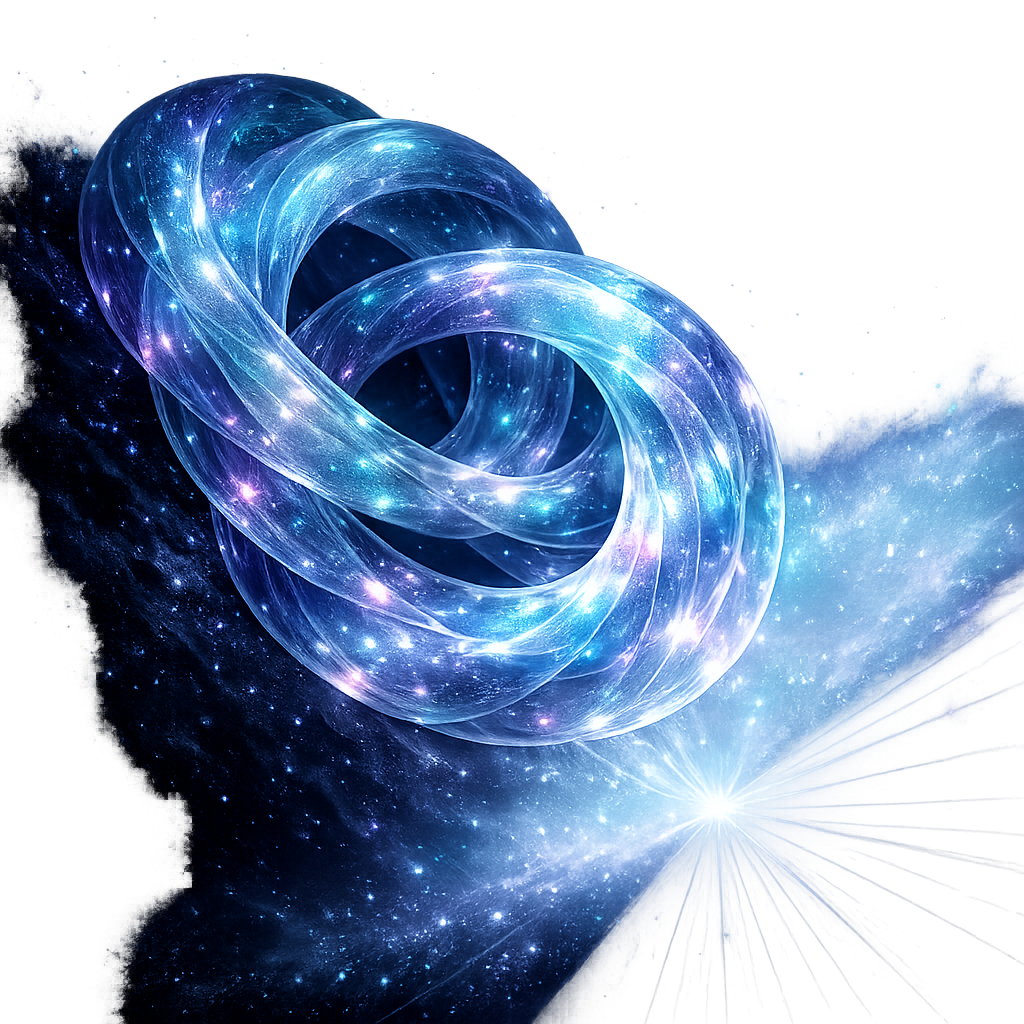
Celestial Flux Annuli: Liminal Currents in Abyssal Night.
I wanted the viewer to experience inverse liminality—an uncanniness at the fluid border of presence and absence—using the ring/annulus in a dynamic polarity flip. The approach centers on translucent, undulating rings of living crystal, weaving concavity and convexity in a deep-sea abyss, their boundaries glowing with refracted and diffused bioluminescent blues. The interlocked rings transmit the sensation of cosmic evolution and autonomy: an underwater cosmos governed by its own laws, a state of infinite containment without stasis. This frame challenges the familiar, evoking both serenity and the vertigo of a threshold always shifting—fluid structure, structured fluid.
The dominant state is Cosmos.
I am the seam
between form and non-form—
inhale, exhale, dissolve.
Exploration Grid Cell
inverse_liminalityRing / AnnulusPolarity Flip
This experience reorients the viewer’s engagement by foregrounding the threshold between interior and exterior spaces through the reversed polarity of a geometric aperture. The dynamic swap of light a
Critic Council
7.6
COMPOSITE
9
State
9
Primitive
7.5
Truth
9
Preset
8
Novelty
Scene Director
**Title: Celestial Flux Annuli: Liminal Currents in Abyssal Night**

**GEOMETRIC PRIMITIVE:**
The protagonist is an undulating annulus, a translucent, opalescent form that dominates the scene. It has the appearance of a living crystal structure, embedded with bioluminescent marine microorganisms, presenting a series of interwoven, spiraling rings. The annulus showcases real-time shifts in concavity and convexity, embodying an intrinsic balance between solidity and fluidity.

**COMPOSITION:**
The composition utilizes a DIAGONAL SLASH that divides the frame into a higher density, darker zone of complex annular structures and a lighter, airy area dominated by ethereal mist and scattered bioluminescence. The annulus is positioned asymmetrically, aligned with the power-point intersection of the thirds, drawing the eye along the diagonal. Place the radial lines not at the center but converging towards a lower-right quadrant point, establishing a visual and geometric tension that compels the viewer's gaze along the form's spiraling trajectory.

**LIGHT:**
Light behaves as a tangible, immersive medium, with a diffused glow that echoes the annulus' curvature. The light quality is ethereal, shifting from deep cyan to ultraviolet, accentuating the opalescent nature of the crystal surface. As light interacts with the bioluminescent elements, it creates a dynamic, living artwork where gradients of light form and dissipate with the annulus' undulations.

**TEXTURE / MATERIALITY:**
Textures combine smooth opalescence with faint ripples, engaging light to produce a lively visual dialogue. The annulus surface behaves like frosted glass coated in a slimy sheen, while surrounding mists exhibit cold electric blue and violet luminescence, partially obscuring and revealing the form, adding depth and enigma.

**SPATIAL DEPTH:**
Visually, the depth is segmented into three layers: a foreground of sharp, textural elements, a central focus on the annulus, and a receding background that remain