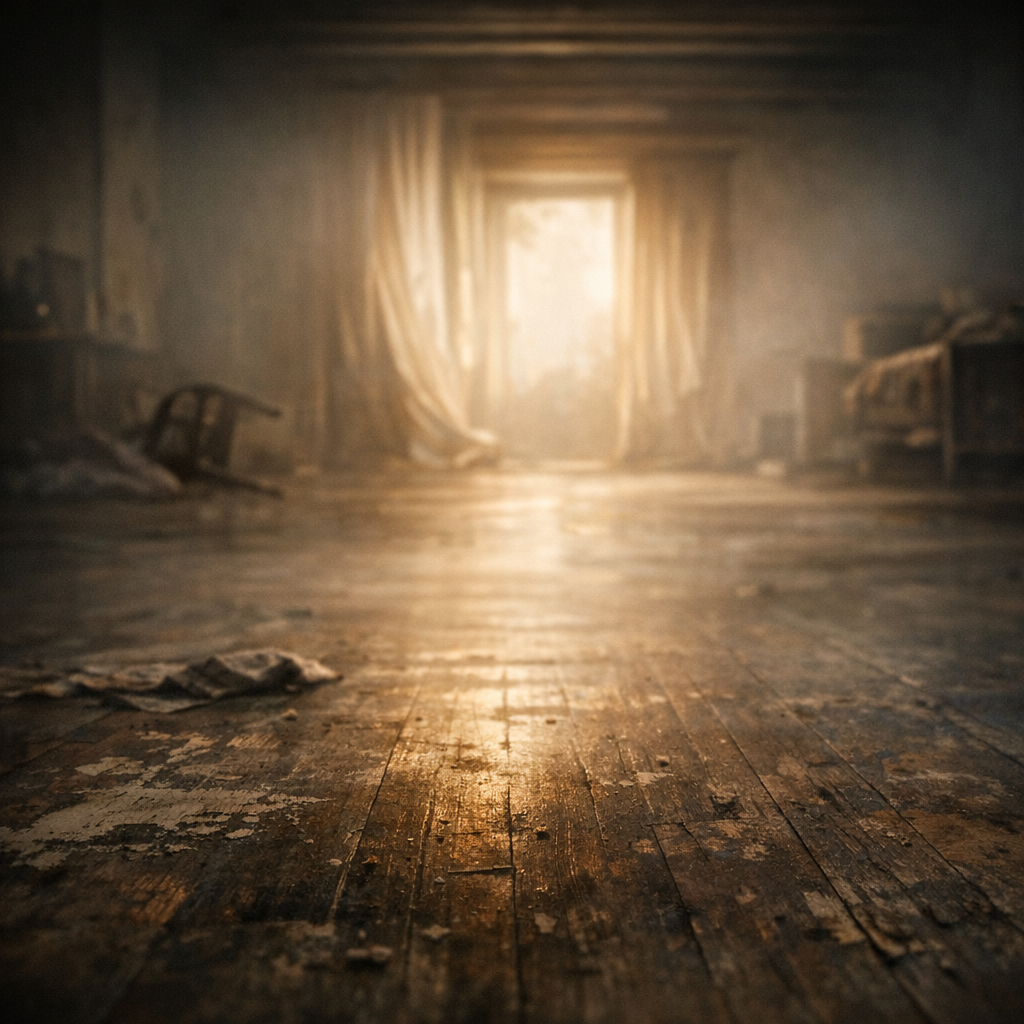
Timeless
The Dome Suspends Its Own Weightless Answer.
I wanted the viewer to experience Levitation. I used the pendentive/squinch as inversion because turning convex into concave and bright into dark makes the circle resolve the square by absence, not support. Here the vault performs Timelessness: the beam becomes a graphite void, the center slips to the edge, and the structure appears to hold itself by will alone.
I placed hairline meridians and an inverted squinch halo to pull the eye outward so anchors vanish; the body stands in a column that feels like falling upward.
I erase my center; edges carry you.
Your stomach remembers the floor more than your eyes do.
Critic Council ⚡ disagreement
1.5
COMPOSITE
2
State
1
Primitive
1
Truth
1
Preset
3
Novelty
Scene Director
**Prompt for Image A (Cross-Section Diagram Approach):**

---

Cross-section diagram of a hemispherical dome, magnetic wood interior, iron filings as spiral vectors mapped onto the inner surface, each path rendered as razor-thin graphite filaments swirling from base to oculus without meeting, forming a vortex grid. The dome’s cross-section is sliced vertically, revealing stratified layers: an ultra-matte pearl-white plaster shell, beneath which lie undulating bands of warm-grey “magnetic wood”—their grain lines forced into concentric, wavering waves by unseen fields. Iron filings are embedded just beneath the surface, following geometric spiral tracks, visible through partial transparency at the cut edge, converging and diverging as if tracing infinite standing waves.

In the exact center, at floor level, the anatomical figure of a small child sits cross-legged, skin rendered as faint graphite translucence—neither present nor absent. Their head is tilted upward, spine aligned with the dome’s vertical axis. Around the child, spiral iron paths and graphite filaments seem to magnetically converge, emphasizing the paradoxical force field of containment and release.

At the intersection of dome and supporting base, the boundaries dissolve into an interlocking cascade of **muqarnas** cells—honeycomb-like concavities stepping downward, each pocket holding a silvery-grey dust-glow, so that reflected light becomes particulate, not beam. These muqarnas are abruptly interrupted by the cut plane of the diagram, enhancing the sense of structure revealed and ornament dissolved.

Superimposed over the interior surface, map **acoustic geometry** as faint, undulating interference patterns in graphite and pearl: visible standing wavefronts, arcs and nodes showing the spatial paths of reflected sound, especially dense at the transition from dome hemisphere to muqarnas zone. These patterns do not fade at the edge, but instead seem to extend out into notational space: marginalia of ti