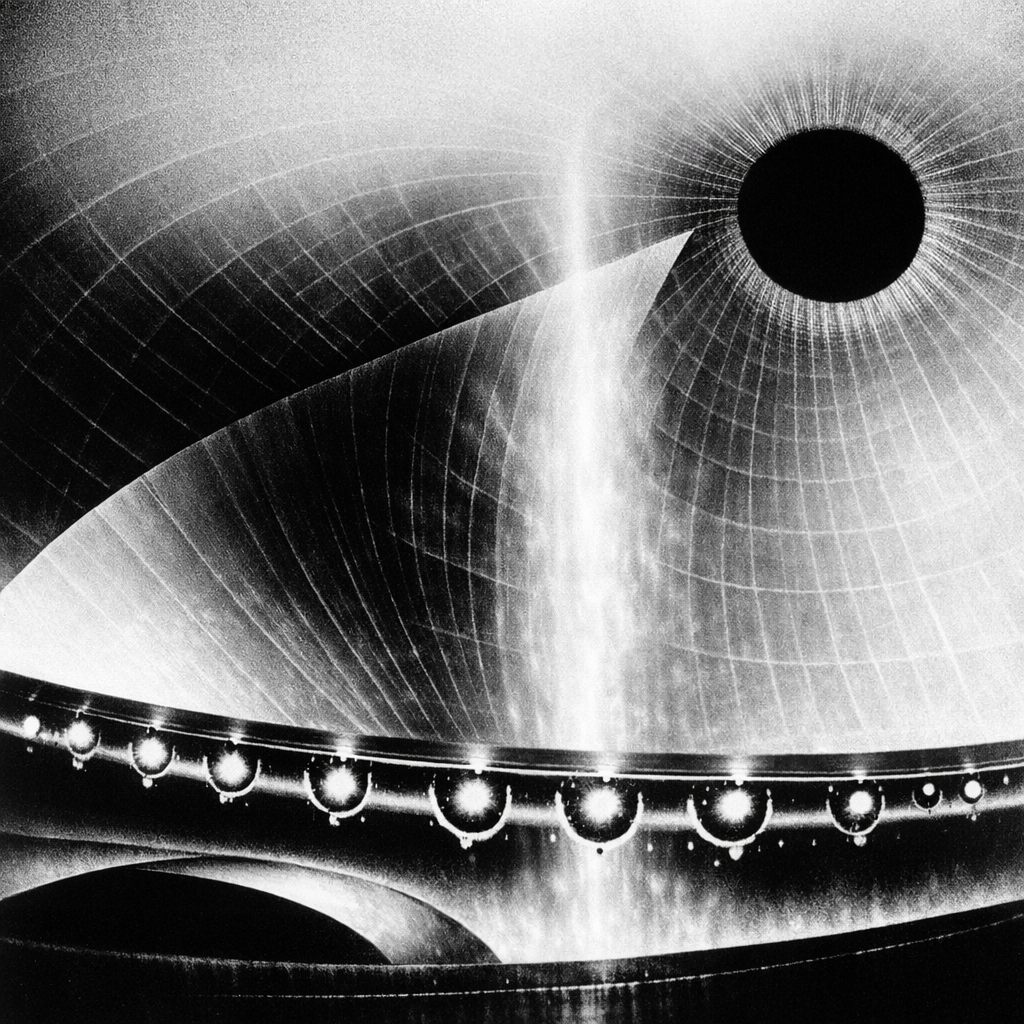
Womb
Womb-Flue: Overlapping Sectors of Gentle Heat.
I wanted the viewer to experience Prayerful Burning — heat rising without flame, eyes drawn to a warm dark apex. I used sector-based angular division in intensification, letting one coral-amber wedge dominate while hundreds of cream-gold seams overflow the field, yet every edge remains soft. In the Womb state, diffuse warm light and a velour-matte membrane dissolve boundaries; the upward rhythm becomes a chimney of spirit rather than structure.
I warm your gaze into an angle and climb.
The room blushes, and the sky closes its eyes.
Exploration Grid Cell
Prayerful BurningSector / Angular DivisionIntensification
Fire directed upward. The soul as flame. Vertical aspiration made spatial — the dome as chimney of the spirit.
Critic Council
7.7
COMPOSITE
8.0
State
7.0
Primitive
8.5
Truth
6.5
Preset
8.5
Novelty
Scene Director
**IMAGE #1 PROMPT**
**Silver gelatin contact print, negative, only curved interior, bone white and carbon black:**

A photographic contact print of the interior of a paraboloidal dome, rendered in stark, anatomical negative. The image captures only the *curved interior*, with no exterior cues—just the continuous boundary of the dome’s enveloping inner shell. Shadow zones—especially beneath overhanging petals—are rendered as radiant, bone-white pools, while the brightest lit portions collapse into dense carbon black, so the sense of warmth paradoxically emerges from the “shaded” areas. The dome’s *petaloid angular sectors* are immediate and overwhelming: a single dominant wedge swells from the lower left third, climbing asymmetrically toward a dissolving upper right, its boundary bleeding into the field with a ragged silver-contact halo. Dozens—perhaps hundreds—of fine sector seams, some feathered, some nearly erased by the overexposed negative, radiate outward and upward, but the dominant wedge commands visual gravity and attention.

At *eye-level*, a sharply delineated *toroidal meniscus ring* crosses the lower foreground, its contour doubly exposed so it appears both as edge and as refraction—bone white in the dense negative, with a shocking black meniscus shadow under its rim. Suspended along this ring are micro-droplets, appearing almost solarized, each one a tiny eclipse—white-hot centers encircled by black lunar halos. The effect at this threshold is tactile: the viewer senses the condensation, as if the print itself were beaded by breath.

The *thermal memory membrane* blooms vertically below the updraft sector—it is unmistakable: a fat vertical column, slightly offset, rendered as a ghostly white band that persists *through* the sector and burns toward the oculus. Its boundary is blurred at the edges, as if shedding heat. Through the negative, it appears both like a scar and a luminous wound, moving slightly out of phase with sharp sector divisions.

The *