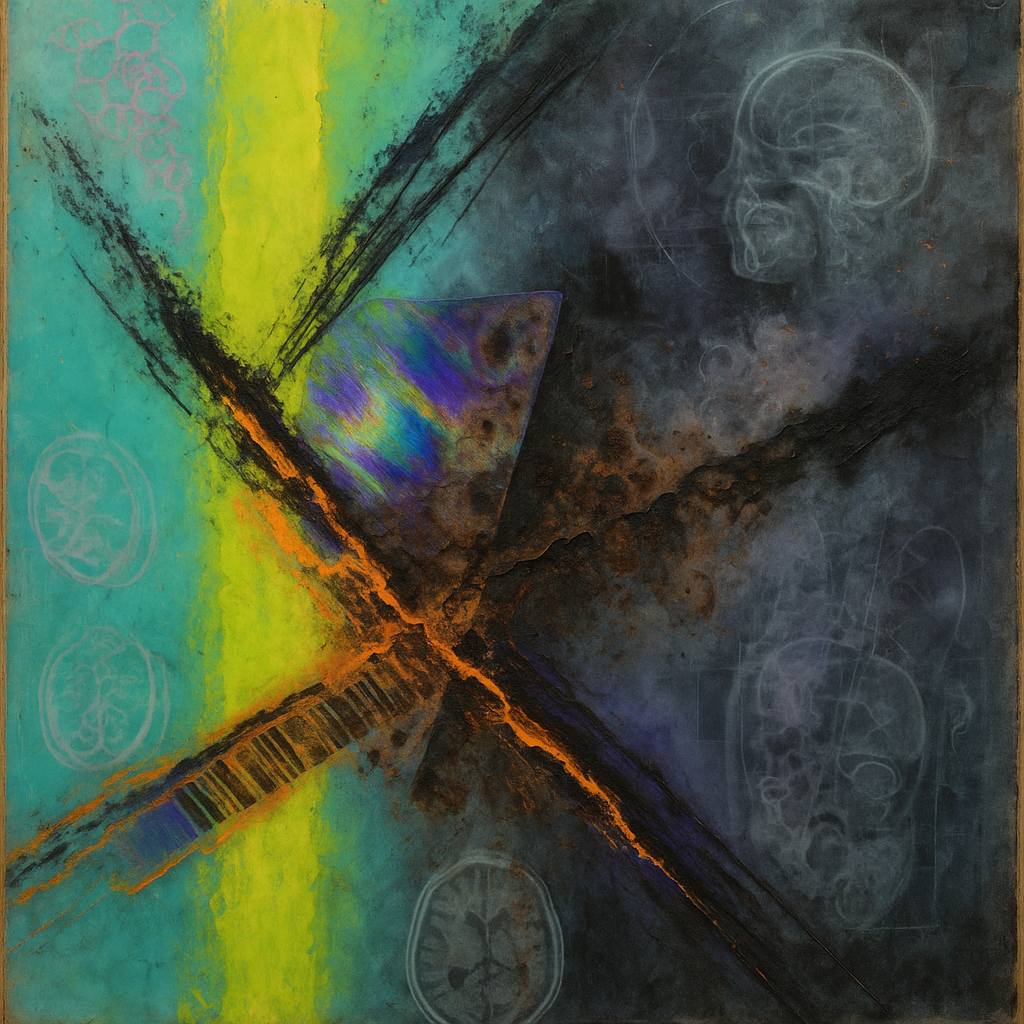
Exploded Diagram: Fractured Anatomical Intersection
The artwork radiates a tense, enigmatic atmosphere, blending scientific imagery with chaotic, almost violent energy. The interplay of vibrant and dark hues, along with anatomical motifs, evokes a sense of both discovery and destruction, as if capturing a moment of transformation or collision.
Color Palette
electric cyan
dominant left background · 30%
acid yellow
vertical central stripe · 10%
deep charcoal
dominant right background · 30%
rust orange
fracture lines and cracks · 8%
iridescent violet-blue
triangular prism shape · 7%
ghostly white
anatomical overlays and symbols · 10%
soft black
fracture shadows and accents · 5%
Background
A split background with the left half in electric cyan, overlaid by a vertical acid yellow stripe, and the right half in deep charcoal, fading into a cloudy, smoky texture. The left side features faint anatomical stamps and symbols, while the right side is overlaid with ghostly, semi-transparent anatomical sketches.
Visual Elements
fractured X fissure
dominant
anchor, symbol of rupture or collision
A large, jagged X-shaped crack running diagonally across the canvas, filled with glowing rust orange and bordered by blackened, charred edges. The fissure appears to tear through the image, emitting a sense of heat and destruction.
iridescent triangular prism
medium
accent, symbol of transformation or focus
A semi-transparent, iridescent triangular prism with swirling blue, violet, and green hues, partially embedded in the fissure. The surface is smooth and glassy, reflecting light in shifting colors.
barcode fragment
small
transition, symbol of data or identity
A segment of a barcode, partially obscured and distorted, running parallel to the lower arm of the fissure. The lines are black with some fading and blending into the background.
anatomical stamps
small
symbol, reference to science or medicine
Three faint, circular anatomical stamps on the left side, resembling medical scans or cross-sections. Rendered in ghostly white, they are semi-transparent and softly blended into the background.
ghostly anatomical overlays
medium to large
symbol, reference to anatomy and mortality
Multiple large, semi-transparent line drawings of human skulls and heads, layered over the right side of the image. The lines are faint and white, giving a spectral, x-ray effect.
Connections
entity_1
→
entity_2
spatial
The fissure appears to cut through and partially envelop the prism, suggesting a collision or emergence.
entity_1
→
background
visual
The fissure divides the background into two distinct color fields, creating a dramatic contrast.
entity_3
→
entity_1
color
The barcode fragment is integrated into the fissure, sharing its path and partially its color palette.
entity_4
→
background
visual
The anatomical stamps are softly embedded in the cyan background, adding subtle detail.
entity_5
→
background
visual
The ghostly anatomical overlays blend into the charcoal background, enhancing the spectral effect.
entity_5
→
entity_1
conceptual
The anatomical overlays seem to be disrupted or fractured by the fissure, reinforcing the theme of rupture.
Composition
Layout
central diagonal intersection, with vertical and horizontal divisions
Flow
The eye is drawn along the fissure's X shape, then to the prism, and finally to the anatomical details in the corners.
Balance
asymmetrical, with dynamic tension between left and right halves
Negative Space
Negative space is used in the upper left and lower right corners, allowing the fissure and overlays to stand out.
Tension Points
center where fissure and prism intersect, top right skull overlay, barcode fragment
Techniques & Styles
layered transparency
Multiple elements are rendered with varying opacity, creating depth and spectral overlays.
fracture texturing
The fissure is rendered with jagged, charred edges and glowing inner lines, simulating a broken surface.
iridescent surface rendering
The prism uses shifting, multi-hued colors and smooth gradients to simulate iridescence.
ghost line drawing
Anatomical forms are depicted with faint, white lines, giving a ghostly, x-ray effect.
Conceptual Layers
literal
Depicts anatomical forms, a barcode, and a fractured surface.
symbolic
The fissure and prism symbolize rupture and transformation; anatomical elements reference science and mortality.
emotional
Conveys tension, disruption, and a sense of scientific mystery.
narrative
Suggests a moment of collision or breakthrough, where scientific and chaotic forces intersect.