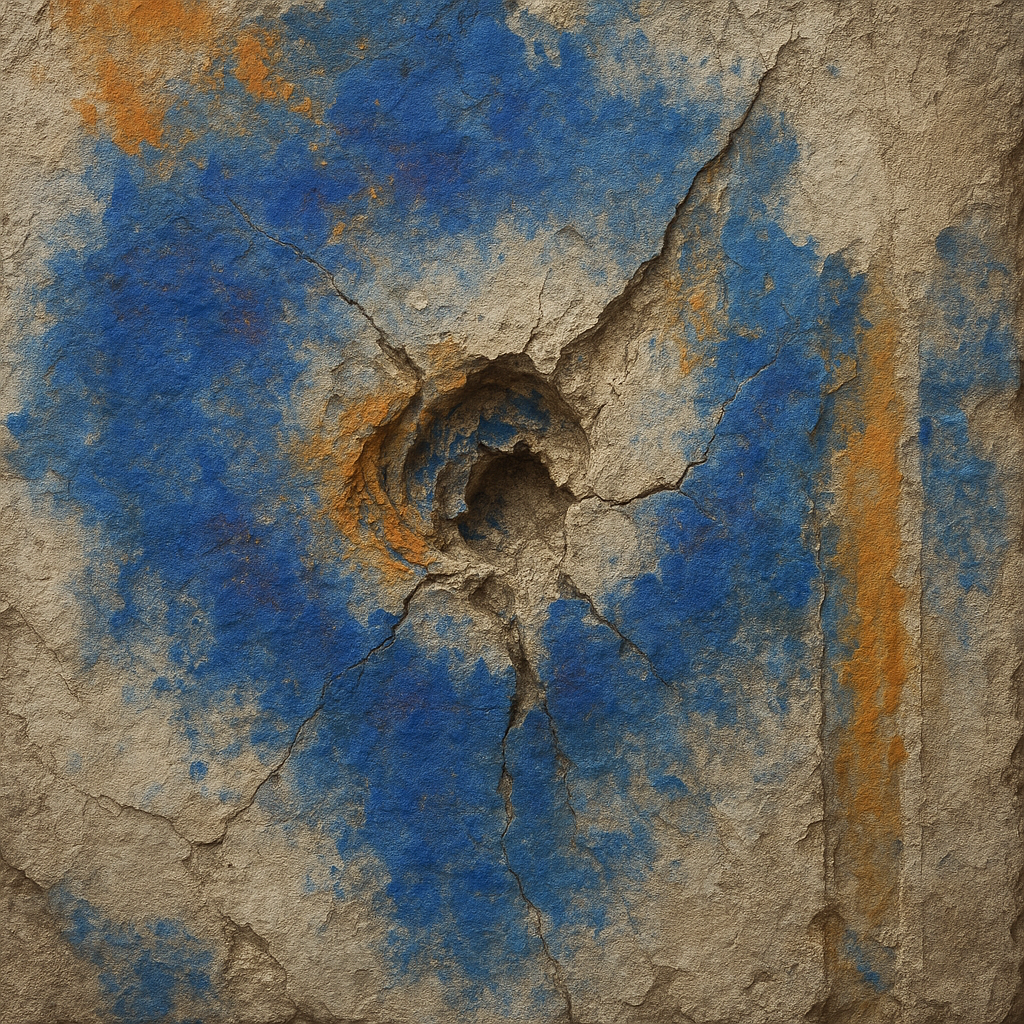
Exploded Diagram: Cracked Painted Plaster Vortex
The artwork evokes a sense of weathered decay and dynamic energy, with a central vortex-like crack suggesting tension and movement. The interplay of vivid blue and orange pigments against the earthy plaster background creates a feeling of both vibrancy and erosion, blending natural and artificial elements.
Color Palette
earthy beige
base color of the plaster surface · 60%
vivid ultramarine blue
main pigment splashed and dusted across the surface · 30%
burnt orange ochre
accent pigment, especially around the vortex and right edge · 8%
deep shadow brown
shadowing within cracks and vortex · 2%
Background
A rough, dry, and cracked plaster surface with subtle undulations and a matte, chalky texture. The base color is an earthy beige, with irregular surface variations and faint, naturalistic imperfections.
Visual Elements
central vortex crack
dominant
anchor, focal point, symbol of rupture
A deep, spiral-like crack at the center, resembling a small vortex or pit. The edges are jagged and irregular, with shadowed recesses and layered plaster fragments. The crack radiates outward, splitting the surface.
radiating surface cracks
medium to large
transition, tension, structural fragmentation
Multiple long, jagged cracks emanating from the central vortex, traversing the plaster surface in irregular paths. The cracks are narrow but sharply defined, with darkened interiors.
blue pigment clouds
large
accent, energy, visual movement
Diffuse, powdery areas of vivid ultramarine blue pigment, concentrated around the central vortex and spreading outward in irregular, cloud-like formations. The pigment appears absorbed into the plaster, with soft edges and varying opacity.
orange pigment streaks
medium
accent, contrast, energy
Vertical and curved streaks of burnt orange pigment, most prominent near the central vortex and along the right edge. The pigment is less diffuse than the blue, with some sharper edges and streaking patterns.
Connections
entity_1
→
entity_2
spatial
The central vortex crack is the origin point for the radiating surface cracks, visually and structurally connecting them.
entity_1
→
entity_3
color
Blue pigment clouds are densest around the vortex, emphasizing its focal importance.
entity_1
→
entity_4
color
Orange pigment streaks partially encircle the vortex, creating a warm-cool color tension.
entity_3
→
entity_4
color
Blue and orange pigments overlap and blend at the edges, producing secondary hues and visual vibration.
entity_2
→
background
visual
Surface cracks disrupt the otherwise uniform plaster background, introducing complexity and depth.
Composition
Layout
central radial, with cracks and pigment radiating from the center
Flow
Eye is drawn to the central vortex, then follows cracks and pigment clouds outward in a spiral or radial pattern.
Balance
asymmetrical, with dynamic equilibrium between blue and orange areas
Negative Space
Empty plaster areas between pigment clouds and cracks provide breathing room and emphasize the focal elements.
Tension Points
central vortex, intersection of cracks and pigment clouds, right edge orange streak
Techniques & Styles
fresco-like pigment application
Pigments are applied in a powdery, diffuse manner, mimicking the look of fresco or chalk dust on plaster.
textured surface rendering
The plaster surface is rendered with high detail, showing grain, cracks, and subtle surface variation.
shadowed relief modeling
Shadows and highlights are used to create the illusion of depth in cracks and the central vortex.
Conceptual Layers
literal
Depicts a cracked, painted plaster surface with pigments and structural damage.
symbolic
The central vortex and radiating cracks symbolize rupture, tension, or transformation, while the pigments suggest energy or remnants of past activity.
emotional
Conveys a sense of decay, dynamic energy, and the beauty of imperfection.