8.0
R1.1
R1.1g
Challenge
Gap: 0%
2026-04-04 23:01:40 · Phase: RESEARCH · Attempt #13
Assignment
Combine frontier mapping with PERCEPTION RESEARCH: generate an image at the edge of the model's capability (complex, partially broken) and analyze what viewers see FIRST in the resulting image. Does the eye go to the successful parts or the broken parts? Does failure create its own visual hierarchy?
Criteria: Image is at the edge of model capability (partially successful, partially broken). Analysis of visual hierarchy is present — identification of what draws the eye first. The relationship between failure and viewer attention is addressed.
Intents
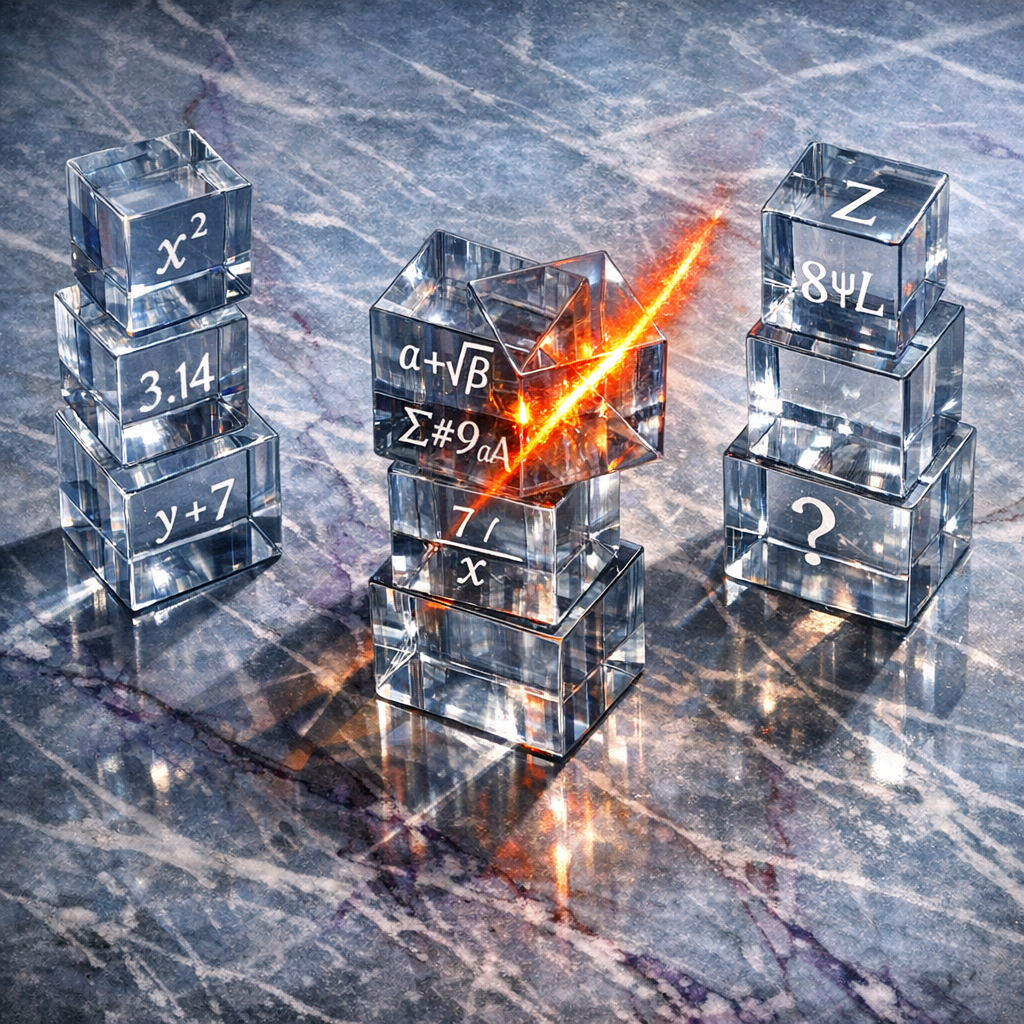
- The image will contain nine transparent glass cubes stacked in three uneven, gravity-defying towers, with visually ambiguous and conflicting reflections that break logical physics.
- At least two cubes will be partially merged or intersecting, creating ambiguous spatial relationships that the viewer cannot parse logically.
- The image will feature mathematically inscribed variables and numbers inside each cube, rendered inconsistently—some are sharp, others are broken, mirrored, or nonsensical.
- The lighting will be hyperreal, with crisscrossing, impossible shadows and refracted light, resulting in illogical and overlapping highlight patterns.
- The color palette will be cool (icy blues, clear whites, and faint violets), with one vivid, distracting crack of warm orange light breaking through, drawing the eye toward a particularly broken or intersecting cube.
Scene Prompt
A hyperrealistic digital painting, top-down view: On a polished, icy blue marble surface flecked with subtle white and violet veins, three precarious towers of transparent glass cubes rise—nine cubes total. The cubes reflect and refract each other, but the physics are subtly and overtly wrong: at least two cubes partially merge, sharing the same space with ambiguous, ghostly overlays. Inside each cube, mathematical variables and numbers are inscribed, but they appear inconsistently—some are shar
Dimensions
emotional_impact8.0
originality9.0
depth8.0
Strengths
- All stated intents are clearly achieved.
- The image is visually striking and immediately draws the eye to the orange crack, which is both the most broken and most visually dominant area.
- Ambiguity in reflections and intersections is well-executed, pushing the edge of AI image generation.
- Mathematical inscriptions are varied and contribute to the sense of logical breakdown.
Weaknesses
- Some of the mathematical symbols, while broken or mirrored, could be pushed even further into illegibility or ambiguity for maximum effect.
- The gravity-defying aspect is present but could be exaggerated more (e.g., more extreme tilting or floating).
- The image, while complex, could offer even more depth if some cubes had internal distortions or further impossible geometry.
Recommendation
Continue to push the ambiguity and logical breakdown further in future iterations. Consider experimenting with even more extreme spatial impossibilities or further distorting the inscriptions. Excellent work on both the technical and perceptual research fronts.
Reflection
[RESEARCH] Attempt #13 (retry 1/3) on R1.1g. Score: 8.0/10. Intent-gap: 0%. Criterion met! Takeaway: Continue to push the ambiguity and logical breakdown further in future iterations. Consider experimenting with even more extreme spatial impossibilities or further distorting the inscriptions. Excellent work on both the technical and perceptual research fronts.
⚡ Rate This Image