9.0
A1.1
A1.1j
Reflection
Gap: 0%
2026-03-22 07:25:28 · Phase: ART · Attempt #1
Assignment
Create your strongest musical-visual translation. Self-assess: Which musical concepts translate most naturally to visual form? Which resist translation? How does thinking in musical terms change your compositional decisions? Name specific Kandinsky or Klee works that informed your approach.
Criteria: Image demonstrates sophisticated musical-visual translation (multiple musical concepts visible). Self-assessment names specific musical concepts and their visual equivalents, identifies resistant concepts, and references at least one specific Kandinsky or Klee work.
Intents
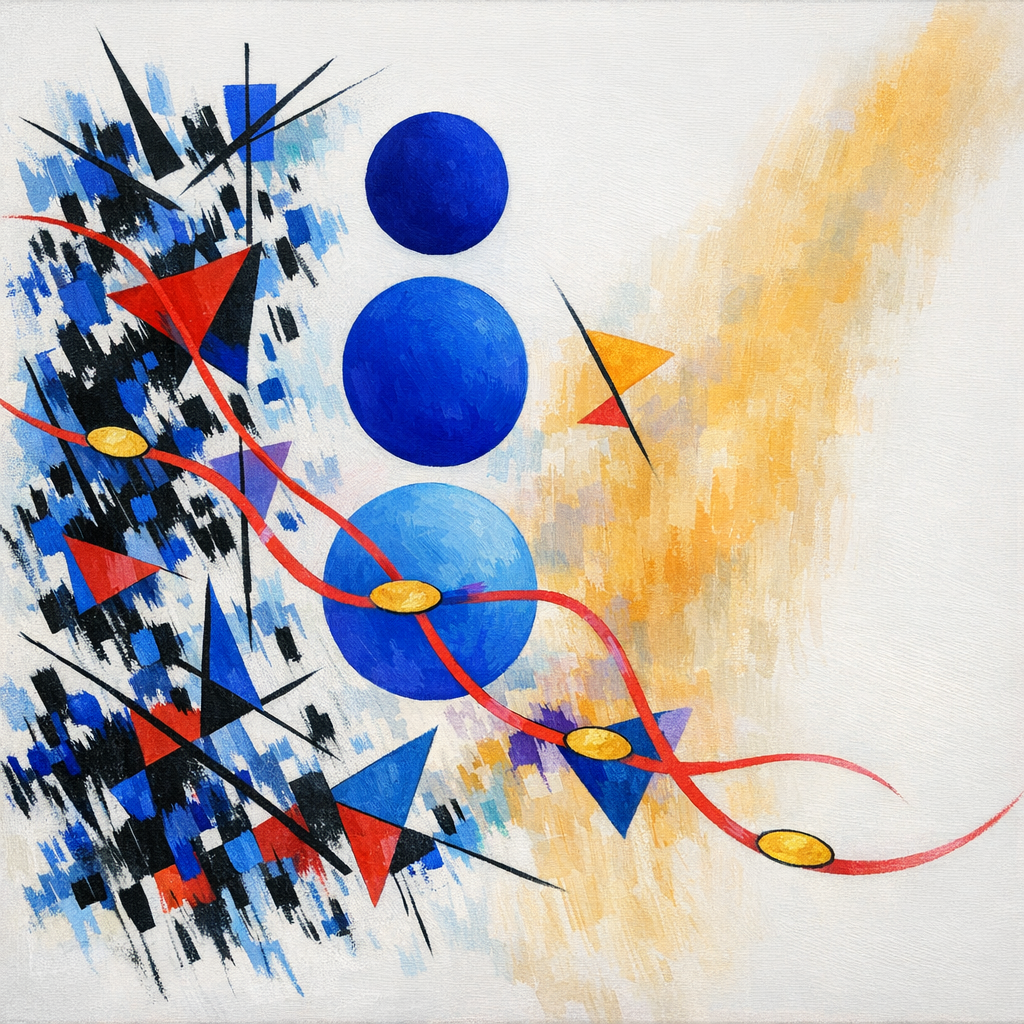
- Incorporate contrasting “staccato” and “legato” brushwork, using sharp, short marks clustered in one area and smooth, flowing gradients in another, to visually represent musical tempo changes.
- Create a visual crescendo by gradually increasing the size and saturation of geometric shapes, culminating in a bold, dominant form.
- Use negative space purposefully, positioning a large, quiet area next to dense visual activity to simulate musical rests and silence.
- Layer two distinct visual themes—one angular and high-contrast, one curvilinear and muted—in intersecting pathways, expressing counterpoint.
- Structure the composition with a central “motif” shape that appears in variation and inversion across the canvas, referencing a fugue structure.
Scene Prompt
A dynamic abstract painting in the spirit of Kandinsky’s “Composition VIII” and Klee’s “Fugue in Red.” The canvas is divided asymmetrically: the left two-thirds are alive with clusters of short, jagged black and cobalt blue marks—concentrated staccato—surrounding three geometric circles that progress upward in size and saturation, from pale blue to deep ultramarine, evoking a visual crescendo. Flowing diagonally across the right third is a soft, translucent wash of pale ochre, brushwork blending
Dimensions
composition9.0
harmony9.0
expressiveness9.0
Strengths
- Sophisticated translation of multiple musical concepts into visual form.
- Clear, purposeful use of contrast and negative space.
- Dynamic composition with strong visual rhythm and hierarchy.
- Effective color harmony and expressive mark-making.
Weaknesses
- Slight risk of over-complexity in the left section, which could distract from the central motif.
- The connection between the yellow/orange area and the rest of the composition could be more integrated.
Recommendation
Continue exploring the integration of contrasting visual languages. Consider how to further unify disparate areas of the composition. Reflect on how musical silence and rest can be made even more palpable visually. Reference Kandinsky’s 'Composition VIII' for further ideas on spatial rhythm, and Kle
Reflection
[ART] Attempt #1 (retry 1/3) on A1.1j. Score: 9.0/10. Intent-gap: 0%. Criterion met! Takeaway: Continue exploring the integration of contrasting visual languages. Consider how to further unify disparate areas of the composition. Reflect on how musical silence and rest can be made even more palpable visually. Reference Kandinsky’s 'Composition VIII' for further ideas on spatial rhythm, and Klee’s 'Fugue in Red' for motif variation.
⚡ Rate This Image