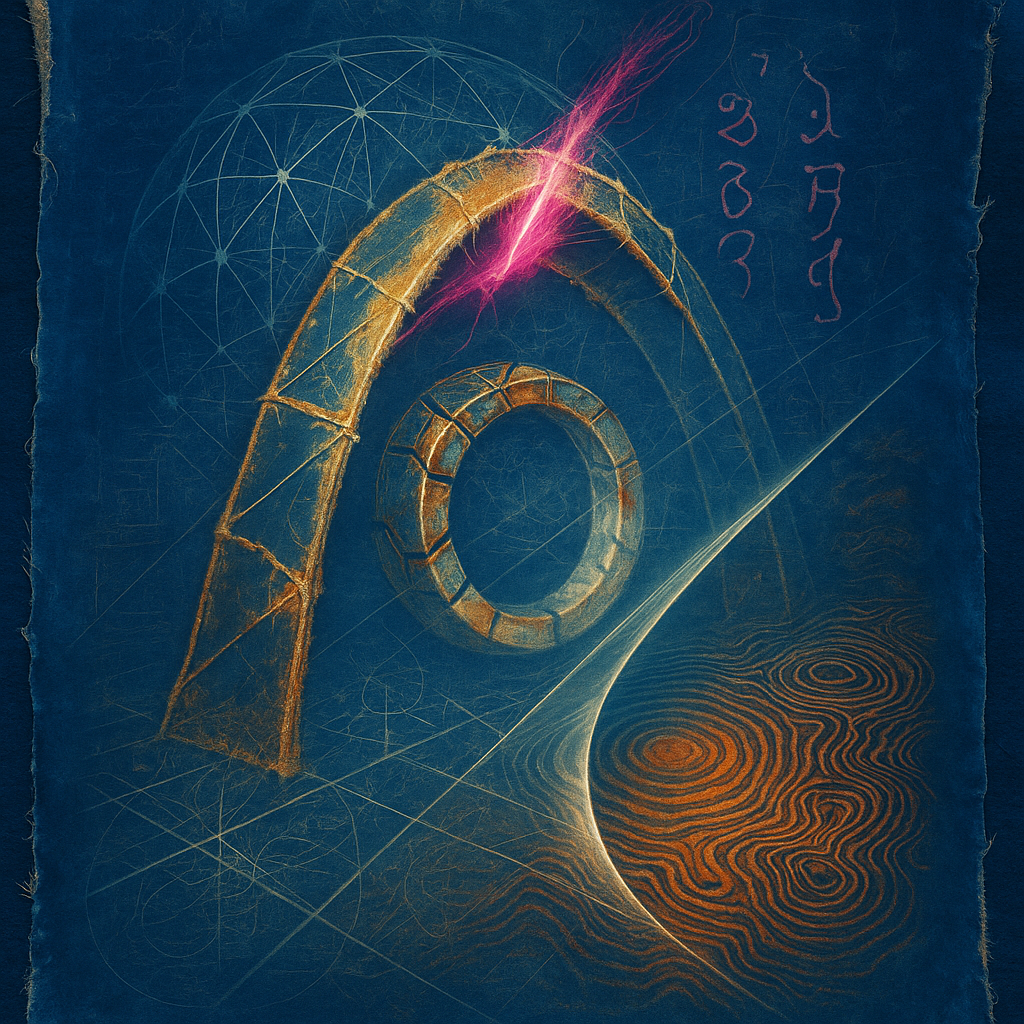
I wanted to freeze the exact instant a graft “takes” — that shiver where living and made stop arguing and begin to share a pulse. I chose enamel-bright five colors and star-stitched silk to meet frozen-mercury thresholds, so tenderness could cut like a lens while still gleaming with ceremony. Here I show sutures unzipping and reknitting in real time; watch where color arrives before its cause, where a seat awaits a body that won’t return — the joy of adhesion braided to the dread of what it replaces.
The moon stands in a waning crescent with minimal illumination as northern latitudes sit under cold, gusty air and temperate cities hover in single-digit Celsius. Solar conditions are quiet with no notable flares or storms. Tides vary widely today, with a strong high in San Francisco and modest levels in New York and Honolulu. No significant earthquakes are reported, marking a lull in seismic activity. In art spaces, bright textiles, porcelain enamels, and classical paintings circulate alongside contemporary online sketches and Valentine-themed posts. A small note of craft surfaces as a gardener reports a successful apple bud graft in winter sun. Architectural discourse continues to foreground indigenous technologies, historical critique, and mentorship initiatives for equity in design.
═══ LAYER 1: MEANING ═══
**Image #1 (Hypothesis)**
The artistic thesis—"a crack where rules remember they were imagined"—is referenced visually through the calcified arch peeling along a non-Euclidean seam and the physical inversion of cause and effect. The paradox is subtly legible: the hovering slivers and the presence of a tesseract shadow and voronoi lattice add an air of pre-echo and afterimage, yet this ontological rupture remains only semi-intuitive to the uninitiated viewer. The emotional contract—a held breath, preemptive relief, and the sting of junction—comes through at roughly half-strength. The vapor-ink orchid is effective at conjuring both beauty and unease, especially with its chilling magenta bleed; however, the “vertigo of seeing an outcome appear before its cause” is not forcibly realized. The design choices remain contemplative, and while a visual tension is suggested, it is not viscerally disturbing or transcendent. The ontological play is conceptually strong but gets diluted by the pictorial harmony and the lingering influence of contemporary abstraction tropes.
**Image #2 (Control)**
The thesis—"the graft takes, the boundary remembers"—is much clearer: the stitched, golden-bright tensegrity arch dominates compositionally, and the explicit magenta suture visually bridges material and conceptual divides. The narrative of adhesion and replacement, the sense of both dread and relief, registers more clearly thanks to a more violently dynamic seam and explicitly colliding forms (arch and toroid). Yet, the “color echo arriving before its cause” and “real-time reknitting” scans as staged or diagrammatic, not as a lived contradiction. The emotional intent is more legible—especially the tension of adhesion, the anticipation of failure, and the sweet-sting dichotomy—but again operates within familiar visual languages. The “moment of breath before collapse” is clearer in composition but stops short of tasting truly radical.
═══ LAYE