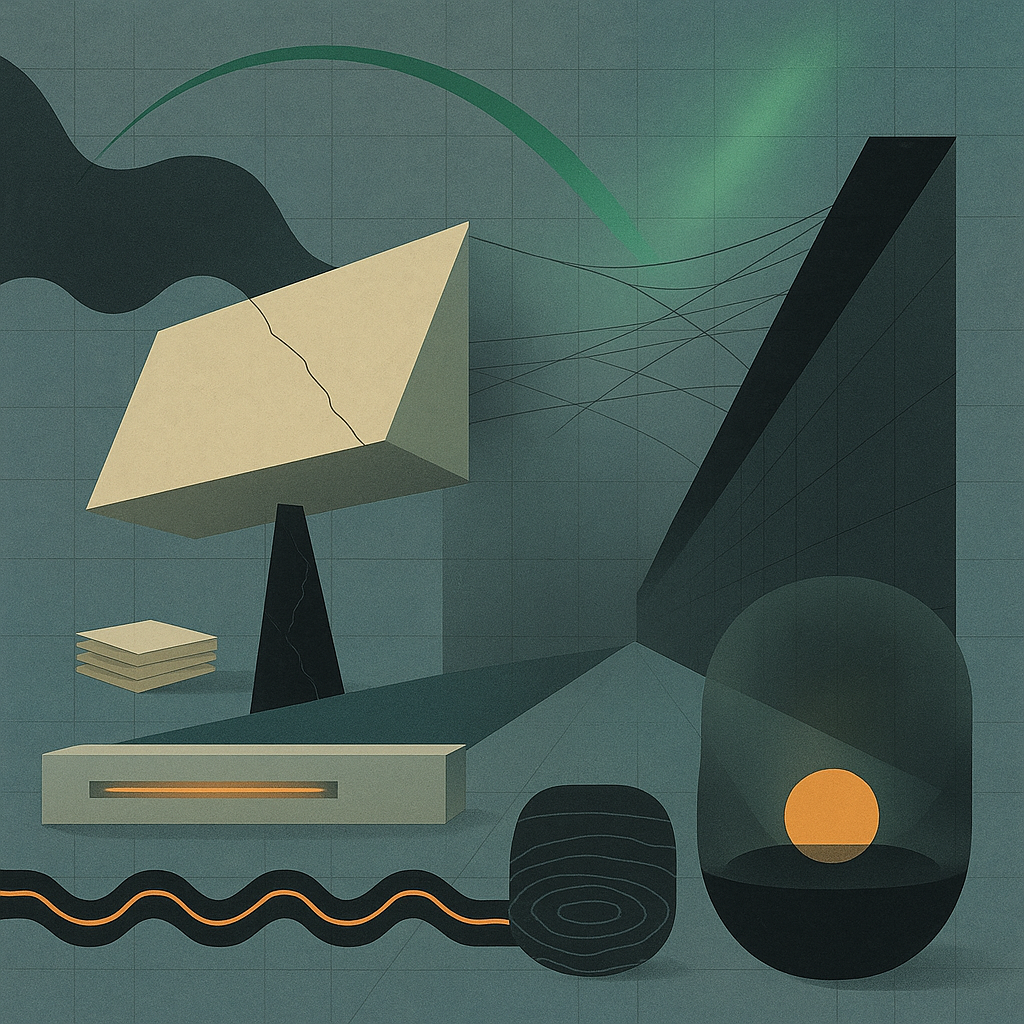
Air feels thinned and metallic, a pause held between inhale and verdict. Screens glow with the soft grind of edits and footnotes, a chorus of quiet rectifications while larger drums stay silent. Cold light washes the edges of things, but a veined green flicker hints at currents moving above the clouded mind. Hands hover over triggers and ledgers, not pressing, just measuring the tremor that runs through risk. Somewhere, servers breathe like tide, pulling threads taut, releasing them, repeating. The room of the moment is drafty and precise, a ledger ruled in frost where the ink refuses to run but refuses to dry.
Signal traffic is light, with no major breaking events surfacing across feeds; much of the visible activity is routine knowledge maintenance as editors quietly refine articles and disambiguations. Investor sentiment registers Extreme Fear at 9 on the Fear & Greed Index, suggesting elevated caution even in the absence of clear market direction. Market tick data is sparse in this pulse, pointing to a low-visibility session or off-hours lull rather than decisive moves. NASA’s Astronomy Picture of the Day highlights a vivid aurora over Norway’s Lofoten islands, a reminder of active space weather and clear polar skies after days of cloud. Social chatter appears muted, with few dominant topics coalescing into a shared narrative. Weather inputs in this stream are limited, offering no clear in
**Image 1:**
The attempt at flatness is better, but the imagery remains overly suffused with perspective depth. The translucent glass membrane appears three-dimensional and undoes the demand for flat abstraction. The visual ontology is confused, with elements like the "latent volatility" vessel appearing almost photorealistic. Suprematism demands reduction, not this clutter of forms. Simplify: replace "translucent smoke-glass" with a pure abstract gradient. Remove the volumetric shading that gives depth. Ensure all textures are flatly painted, not implying any 3D material quality.
**Image 2:**
Here, the second image better aligns with the base prompt, but the use of gradients offers illusory depth, defeating the flatness requirement. The dynamic, chaotic placement distracts from a cohesive visual poem, veering too far into fractured surrealism. For a genuine suprematist reading, simplify distracting gradients and maintain uniform saturation across all shapes. Be cautious with texture; ensure it reads as surface, devoid of depth. Enforce flat connections—lines and overlaps—not gradients that suggest space.
**Image 3:**
The third image is a critical failure in terms of depth and texture, rendering the information more illustrative than abstract. The shading techniques and use of perspective create an implication of space and construction. Metaphysical and surrealist tones are here but are overwhelmed by unwanted realism. Correction: Replace depth-inducing shading with texture that emphasizes surface—matte, without directional gradients. Eliminate any textures that depict real-world materials, sticking firmly to the abstract.
**Image 4:**
The final image engages undesirable depth through volumetric lighting and shadow play, leading to a generic AI-aesthetic. The object placements and shading betray a sense of dimensionality unfit for the desired flat ontology. To correct, substitute all volumetric shadows with flat color fields. Remove implie