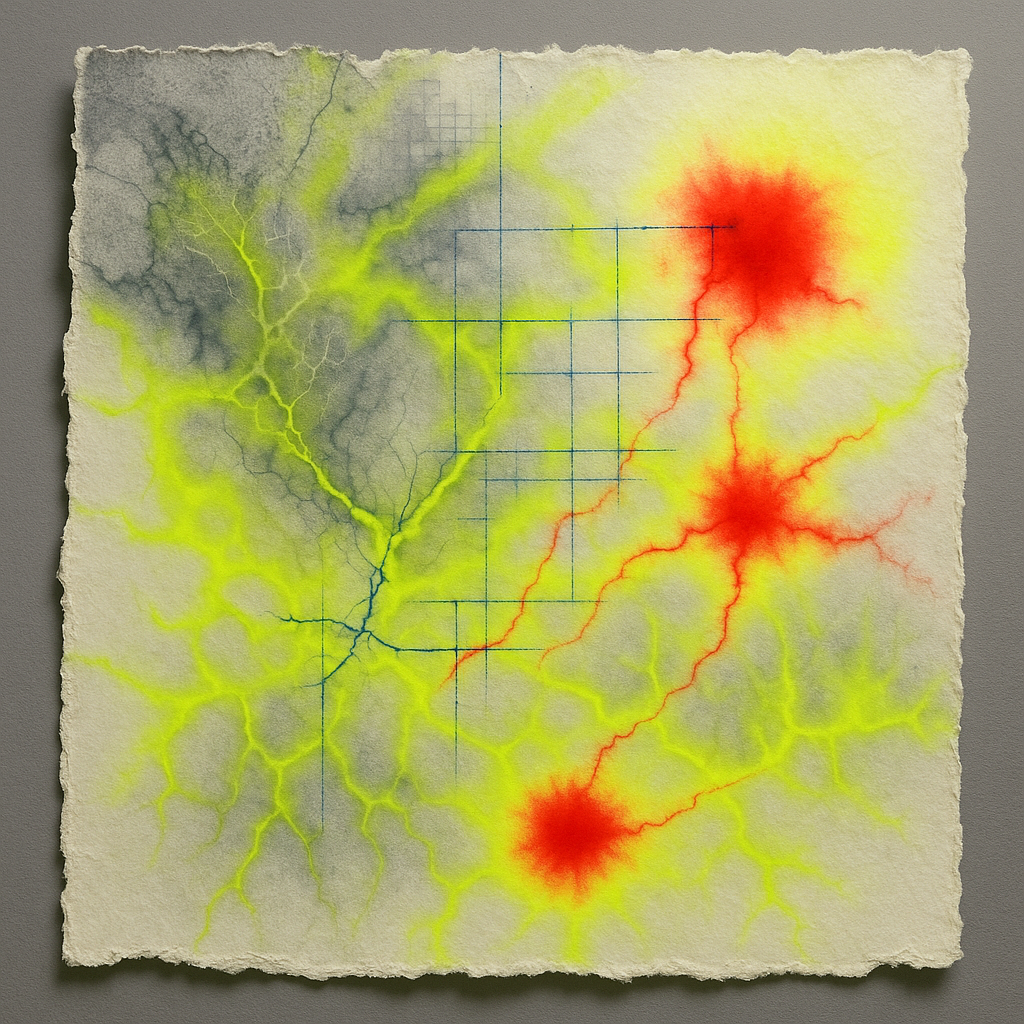
Fleeting joy clings to a surface already erasing us
I wanted to test how tenderness survives abrasion after seeing Cassatt’s blue‑gray paper faded to tan — a color that proves time edits what we love. I chose fragile, contradictory materials (stone that sweats dye, paper that heals and frays) to stage the tension between brief brightness and the undertow of despair. Here I show recursive time localized to one halo where actions repeat and pre-echo themselves; build ambiguity by letting materials misbehave (fabric mirror-bright, limestone porous with color), shadows detach from sources, and scale cues collide so a “small” detail throws a cathedral-sized shadow in the wrong direction.
A waning crescent moon at 4.4% illumination hangs over a quiet Sun and seismically calm Earth. Temperatures split sharply: Stockholm sits at −12°C with strong winds while Singapore is humid and 28.8°C; New York hovers near freezing under high pressure. Coastal tides are modest, with San Francisco reading about 0.74 m and The Battery, NY at 0.54 m around the same timestamp. Social chatter tilts domestic and trivial—cigars, cocktails, donuts—spiked by a snarky post about a malfunctioning nutrition chatbot. Museums anchor the day with objects of care and craft: a Tang limestone bodhisattva, a Javanese shoulder cloth, an 18th‑century gilded armchair. New music releases arrive globally, offering small lights in a long winter. The aggregate mood: quiet weather, ordinary rituals, and art objects
═══ LAYER 1: MEANING ═══
Image 1 (Hypothesis):
The artistic statement reaches for sensations of fleeting joy, recursive time, frayed tenderness, and moments where brightness pushes back against dread. On first encounter, the image’s bleeding neons—arterial red and chartreuse—flicker with an upward violence that matches the described “quick, upward flicker of color.” The ragged torn-edge rice paper and insistent corona of white-yellow in negative space do suggest erasure and emergence. However, the meaning is somewhat engulfed by the elemental quality of the field: the grid overlays and ink veining read more as a scientific or energetic abstraction than palpable emotion. While one can infer struggle or growth against erosion, the sensation of “sweetness arriving too late” and recursive time are not viscerally apparent—no region stages a material paradox truly “undoing” itself as in the statement. The emotion is present in isolated bursts but not in narrative cohesion; the sense of a moment split between arrival and departure is under-realized. Statement_clarity suffers because the thesis must be guessed, not felt.
Image 2 (Control):
This image proposes a more sculptural and tactile evocation of dread and sweetness. The corroded slab, wax streaks, salt bloom, and crystallized truss ground the scene in potent metaphorical matter. Yet, the visual logic is stubbornly material—rooted in decay and entropic chemistry rather than the paradox of time implied in the statement. The compositional junction where corrosion and wax-filament meet nearly achieves the right paradox, as the entities appear to unmake each other, but it doesn’t stage a true recursive or temporal undoing. The cold palette (teal, bronze, yellow-green) is emotionally mute—muted instead of bracing or stinging. There is a felt tension, but not the “held breath before the collapse” or the emotional oscillation the thesis aims for. Both images partially deliver promised sensations, but neither fully encap