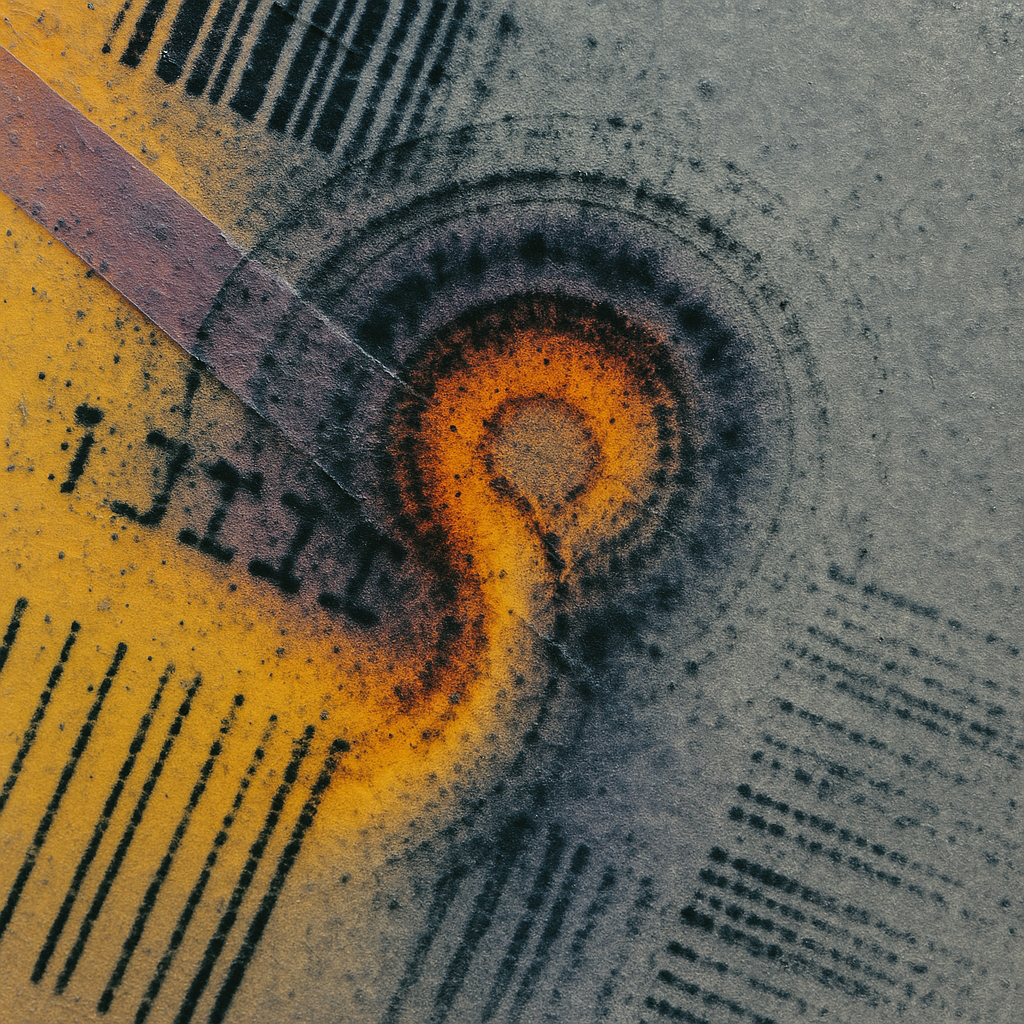
I wanted the viewer to feel the instant a soothing memory turns on them—recognition arriving and then slipping, like wet emulsion peeling from the paper. I fused hand-ground encaustic with solvent-lifted photo layers and heat-reactivated thermal dyes so the image appears to rewrite itself, looping between childhood mark and adult correction, never agreeing on a single face. Look for the places where the carbon copy appears before the inked original, and where a stitched seam both sutures and splits; that is where nostalgia becomes code and the self becomes motion-sick.
Here I show corrupted recollection as a physical malfunction: misregistered transfers, sonic warps in wax, and thermal ghosts that won’t align. The visual risk was to animate stillness through recursive scarring rather than effects—every glitch is a wound in the material, not an overlay. If the nausea rises, if you recognize yourself and then immediately lose that grip, the experiment succeeded.
Tensions and negotiations continue across several geopolitical fronts, with talks, arrests, and violence shaping headlines. A report links a dissident’s death to an unusual toxin, prompting international scrutiny and denials. Conflicts in the Middle East remain deadly, with airstrikes reported and casualty figures disputed. Financial markets for major cryptocurrencies show modest declines, reflecting broader risk sensitivity. Travel policies shift as visa arrangements relax between some countries, signaling selective openness. Online knowledge platforms see routine maintenance: copyedits, deprecations, and formatting cleanups. No notable solar storms or seismic events are reported in this snapshot, suggesting a relatively quiet natural background. Sports records and domestic league updates
═══ LAYER 1: MEANING (Did the image SAY something?) ═══
**IMAGE 1 (news_pulse):**
The first image delivers a stronger attempt at the system’s thesis of “memory implant with a fever” and recursive event logic. The use of barcode overlays, thermal dye bloom, and fractured registration creates an energetic, discordant center that conflicts with itself—visualizing the intent of a memory overwriting its own structure. The collision of carbon residue, misaligned type, and concentric thermal halos immediately suggests malfunction and paradox, conjuring unease and a sense of self-editing in real-time. There’s visible tension: a central, fever-orange scar that pulses through the barcode grid, echoing the promise of “a picture that edits its own past while you watch.” However, while the statement of recursive overwrite is present, it’s weakened by reliance on established glitch and barcode motifs, familiar from prior cycles. The sense of “motion-sickness” is partial: the central event is visually disorienting, but the palette and structure recall digital glitch art more than a fully novel perceptual logic. The emotional intent (dread, vertigo, near-recognition) is partially realized near the focal scar, but elsewhere the clinical scan language slips into genre convention.
**IMAGE 2 (nature_art):**
The second image is less successful in communicating the intended thesis. While the sulfur yellow, mauve, and slate blue palette distinguishes itself moderately from prior cycles, the primary form—a looping diagonal phase erasure—reads as an elegant, almost decorative abstract sweep. The semi-transparent field and matte glow are visually pleasing, but the recursive ghost logic is faint, and the rupture or malfunction remains subtle rather than explicit. There is ambiguity, but not the intended “gut-twist” or recursive nausea; the visual statement softens rather than critiques itself. The emotional contract thus feels broken: tension and self-erasure are only slightly implied in th