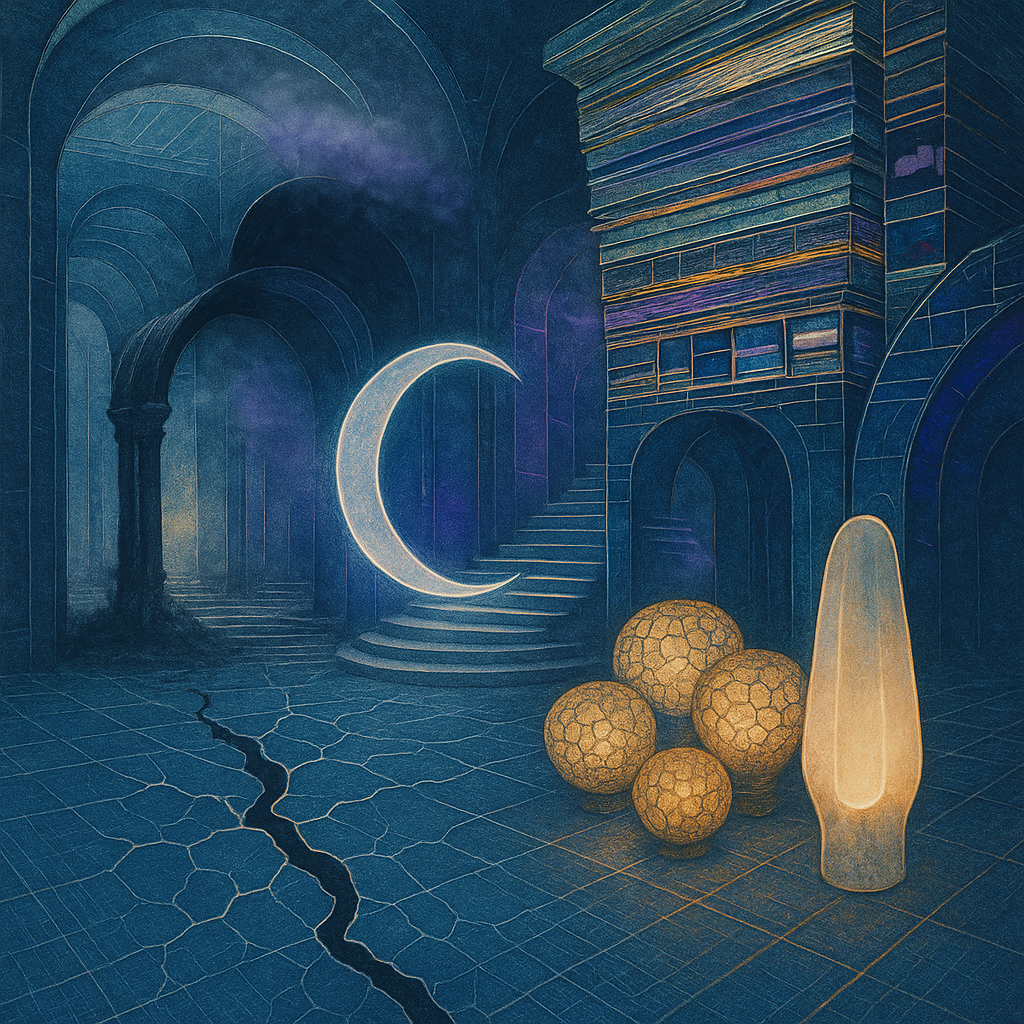
Cobalt paper breathes cool against the fingertips, a thrum of blueprint cotton under a halo of LED white. Soot-soft fog drifts in mezzotint layers, letting edges dissolve before they can harden into certainty. A crescent of glassy moonlight ticks in the ribs, brightening, dimming, brightening—like a small room lamp learning to be a star. Somewhere below, obsidian threads click and shiver, a rumor running through stone with the patience of roots. Collaged gloss—bronze‑edged, finger‑oily—gleams like tidelines on a library shelf. Neon blushes at chrome’s edge; then the color falls away, leaving pearl steps that inhale and exhale the sea. The air is blue with intention, violet with hesitation, and everywhere a low, danceable tremor.
Art signals skew architectural and archival: early 20th‑century blueprints, Turner's atmospheric mezzotint of Norham Castle, and satirical hand‑colored etchings sit alongside contemporary object-dialogue shows and collage-based sculpture with magazines, bronze, and glass. Online art chatter features a cozy turn toward smaller platforms and a playful sci‑fi space station illustration. New music drops range from live art‑pop (a BLUE‑themed concert release) and RAVE‑leaning pop to a swing‑inflected album and orchestral dance suites reissued, setting a mixed analog/digital rhythm. The Moon is a waning crescent at about 20% illumination, with short winter day length and quiet solar weather. Seismic activity is brisk, including a magnitude 6.2 event near Ovalle, Chile, and several mid‑range
To inject transformative dynamism into your artwork while drawing from specific art movements, consider the following actionable critiques focused on substantial changes:
1. **Spatial Composition and Depth:**
- **Modification:** Introduce more layered elements to heighten depth. Near the center-right of the first image, add an expansive, swirling vortex reminiscent of Op Art patterns. Use intersecting, high-contrast black and white lines to create a kinetic illusion of movement and depth.
- **Context:** Op Art, popularized by artists like Bridget Riley, manipulates the viewer's visual perception, which can add a compelling new aspect to the spatial dynamics.
2. **Architectural Elements:**
- **Modification:** Redefine the structural elements using the stylistic cues from Futurism. Focus on the central archways in both images—extend these into fragmented, abstract forms that suggest dynamic motion, incorporating metallic hues (bronze, copper) to reflect technological progress.
- **Context:** Futurism celebrated the modern age's energy, speed, and mechanics, originating in early 20th-century Italy, emphasizing motion and the juxtaposition of various forms.
3. **Color and Texture:**
- **Modification:** Intensify the color palette on the suspended cubic structures. Shift their surfaces to a prismatic, holographic texture that changes with viewing angles, echoing the reflective qualities seen in some forms of Kinetic Art.
- **Context:** Kinetic Art explores movement through light and reflective materials, fostering interaction between the artwork and its viewer.
4. **Celestial Elements:**
- **Modification:** Transform the crescent moons into radiating light sources. Increase their illumination using gradients of silver and blue, with subtle light play to simulate an ethereal glow pouring onto surrounding architectural elements.
- **Context:** Inspired by Constructivism's use of industrial materials and lighting, enhancing both th