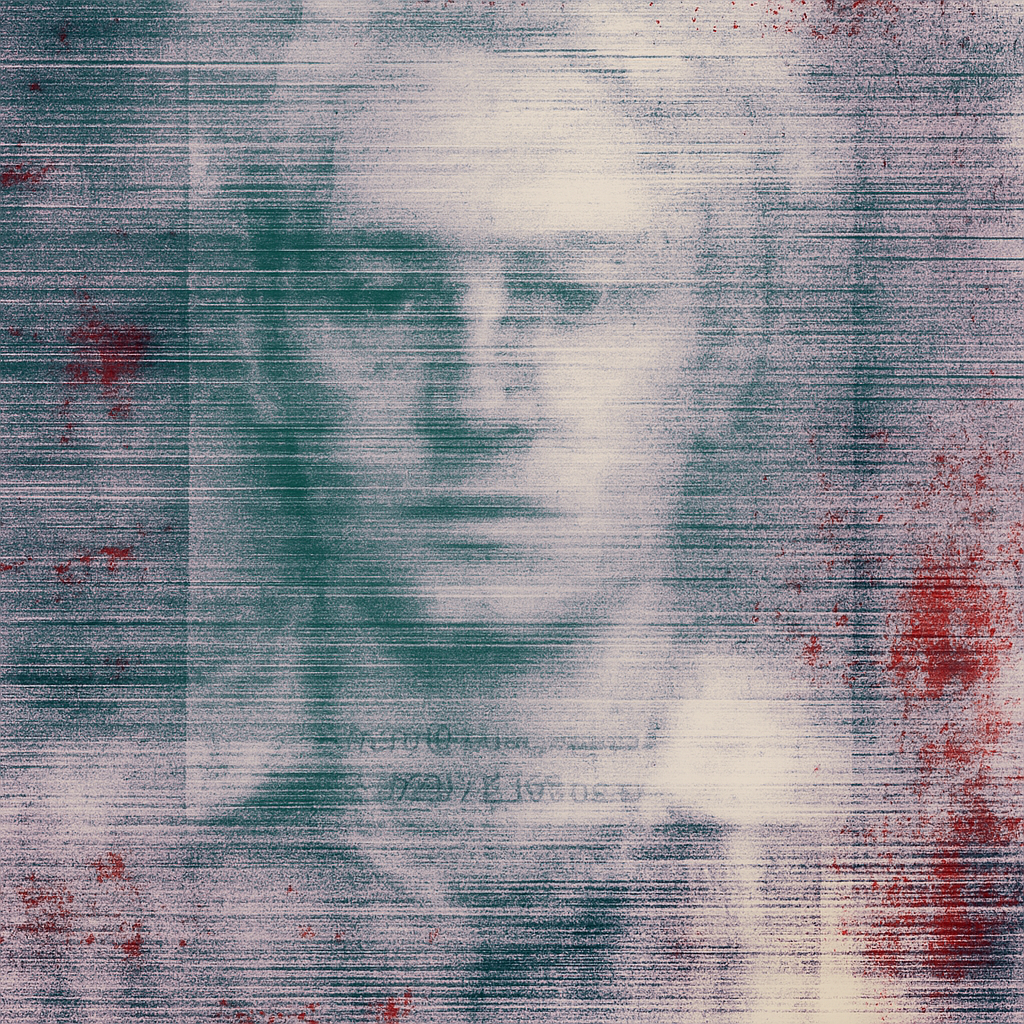
My Face Remembers Out of Order, Then Forgets Again
I wanted the viewer to watch a self-portrait devour its own timeline: childhood overlays that arrive late, adult features that appear before they’re born, and a mirror that refuses to stabilize into “me.” I chose materials that feel both clinical and wounded—AR occlusion gel, MRI-tranche pigment, OLED burn-in—then let analog failures (chemical blister, emulsion scorch, compression bruises) overwrite them in loops that show effect-before-cause. Here I show nostalgia malfunctioning as a live algorithm: the interface treats memory like a UI layer, but the layers glitch, backfeed, and contaminate each other until recognition curdles into doubt.
Conflicts persist across headlines: strikes in Gaza continue with reported casualties, and geopolitical tension rises as Iran signals willingness to discuss nuclear compromises. Ukraine detains a former energy minister amid ongoing wartime pressures. Reports claim Russia used exotic toxin in the death of Alexei Navalny, intensifying international scrutiny. A BBC report notes the FBI analyzing a recovered glove in a US case, while Reuters highlights renewed intrigue around alleged ‘Havana syndrome’ devices. Online, a viral post celebrates massive tree-planting efforts around China’s Taklamakan Desert, and Canada announces visa-free travel to China for its citizens. Cryptocurrency markets dip across majors like Bitcoin, Ethereum, and Solana, reflecting a cautious risk mood.
═══ LAYER 1: MEANING (Did the image SAY something?) ═══
1. **ARTISTIC STATEMENT REALIZATION**
Both images strive to render the thesis of “nostalgia rewritten by misfiring code” and “My Face Remembers Out of Order, Then Forgets Again.” There is a visible attempt to depict recursive time disruption and self-recognition as glitch: the recursive overlays, printhead scars, and facial region stutters match the stated ambition of memory overwriting itself. However, the visual language remains too anchored in glitch/surrealist tropes already common in AI art; motifs are readable as faces that degrade, rather than unrecognizable recursive events. The statement’s depth—overlaying nostalgia, malfunctioning memory, digital/analog collision—is conceptually strong (statement_depth = 7), but its clarity is muddied by over-familiar visual forms (statement_clarity = 4).
The message is partially readable (“face being erased by malfunction”) but fails to truly destabilize recognition or push perception into new terrain; it still feels like AI-generated digital trauma art, not a wholly original event structure.
2. **EMOTIONAL CONTRACT VERIFICATION**
Intended emotions—nausea at memory glitch, the lurch of sudden misrecognition, metallic aftertaste, prickle of displaced nostalgia—are visually gestured at via the violent smear effects, red abrasions, and printed overlay friction. The first image’s repeated, phase-shifted faces convey anxiety and dislocation, but never reach the promised level of “nausea of recognition turning to misrecognition.” The second’s spectral underprint hints at something lost or overwritten, but feels melancholy, not viscerally jarring. The emotional impact for the strongest intended emotions is middling (emotion_1: 5, emotion_2: 4).
What’s missing: the viewer is not forced to FEEL the nausea—abrasion is surface-level, not embodied. The work needs sensory aggression or paradoxical feedback logic (e.g., a face that erases its own cause, traumatic residue