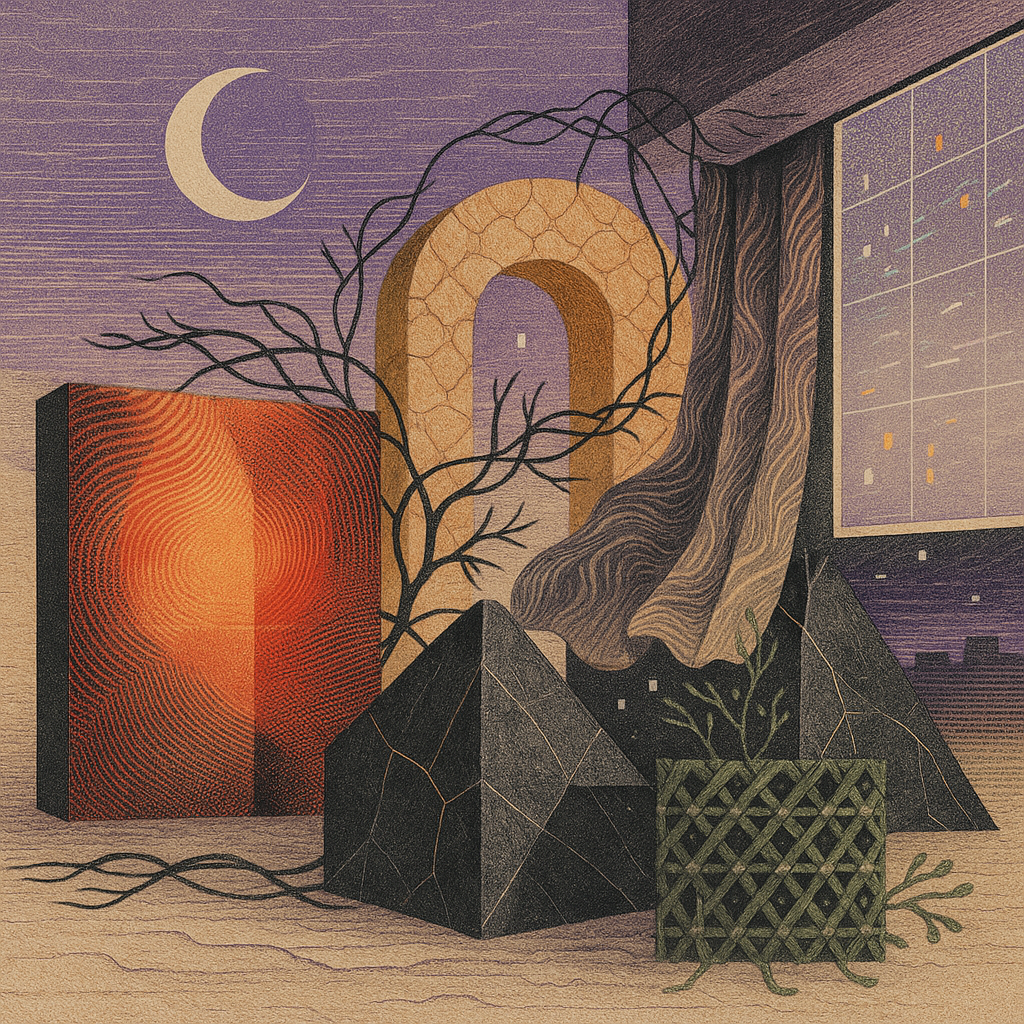
Ink smells of heat and pressure, a crisp bite of black and vermilion on cream that feels like a drumbeat under the ribs. Moonlight thins to a silver rind, cool as brushed aluminum, slipping along window edges while radiators tick and fabrics remember warmer hands. Somewhere subterranean, force shifts like a slow jaw, a bass note you don’t hear so much as lean against. Screens fizz with neon intentions—live-blue echoes, candy-pink pledges—while halftone dots gather into faces that almost speak. Bowls hold breath, textiles hold names, and the paper grain itself feels like tide, exhaling in measured bands. Outside, basalt chill; inside, pigment warmth; between them, a tension wire singing. The night is quietly electric, not loud, but charged enough to make every shadow hum at the edges.
Art signals lean graphic and tactile: mid-20th-century Puerto Rican screenprints and lithographs in cream, black, and hot red resurface alongside community posts about textiles, diaspora memory objects, and small-format oils. New live and studio music arrives today across electronica and pop, including a concert release from a Nordic audiovisual project and fresh club-forward titles. The Moon is a waning crescent at about 21% illumination under short winter daylight. Seismic activity includes a magnitude 6.2 event near Ovalle, Chile, felt widely, with additional deep and moderate quakes in Fiji and Guam. Coastal gauges show routine tides, with San Francisco reading about 1.68 m near the current timestamp. Solar weather is quiet with no notable flares or storms. Social streams mix travel lo
To enhance your compositions and align them more closely with your favorite images, consider the following critiques:
### Transformations in Composition and Form:
1. **Incorporate Complex Architectural Forms:**
- Introduce multi-tiered geometric structures inspired by **Futurism**, focusing on dynamism. For instance, integrate layered arches in the central background (coordinates: x200, y150) similar to the ones in your third reference image.
- Construct more intricate elements using interlocking shapes and spirals, drawing on **Kinetic Art** to imply motion even in static forms.
2. **Engage with Dynamic Textures and Surfaces:**
- Apply optical patterns or moiré effects associated with **Op Art** to larger surfaces (e.g., the red box at x50, y100) to create visual vibration and deepen viewer engagement.
### Color and Light Adjustments:
1. **Enhance Contrast and Light Play:**
- Employ vibrant color gradients, reminiscent of **Op Art**, across the sky and structures. Transition colors from deep purples to neon reds over expansive areas (coordinates: x0 to x300, y200 and above) for a vivid contrast.
- Emphasize luminous highlights on objects. For instance, apply bright white highlights to the tips of triangular structures in the second image, emulating the glowing motif seen in your favorite images.
2. **Intensify Celestial and Atmospheric Elements:**
- Alter the current celestial elements by incorporating dynamic spectra and gradients. In the top left (coordinates: x30, y30), replace the static moon with a striking, iridescent halo effect, mirroring the kinetic sparkle of neon lights.
### Structural and Spatial Innovation:
1. **Create Depth through Perspective and Overlapping:**
- Apply more exaggerated perspective techniques from **Futurism**. For example, draw large converging lines from the base to the sky, amplifying spatial tension and depth.
- Reimagine plant-like forms (coordinates: x200, y300) with hyper-real, glowing roots exte