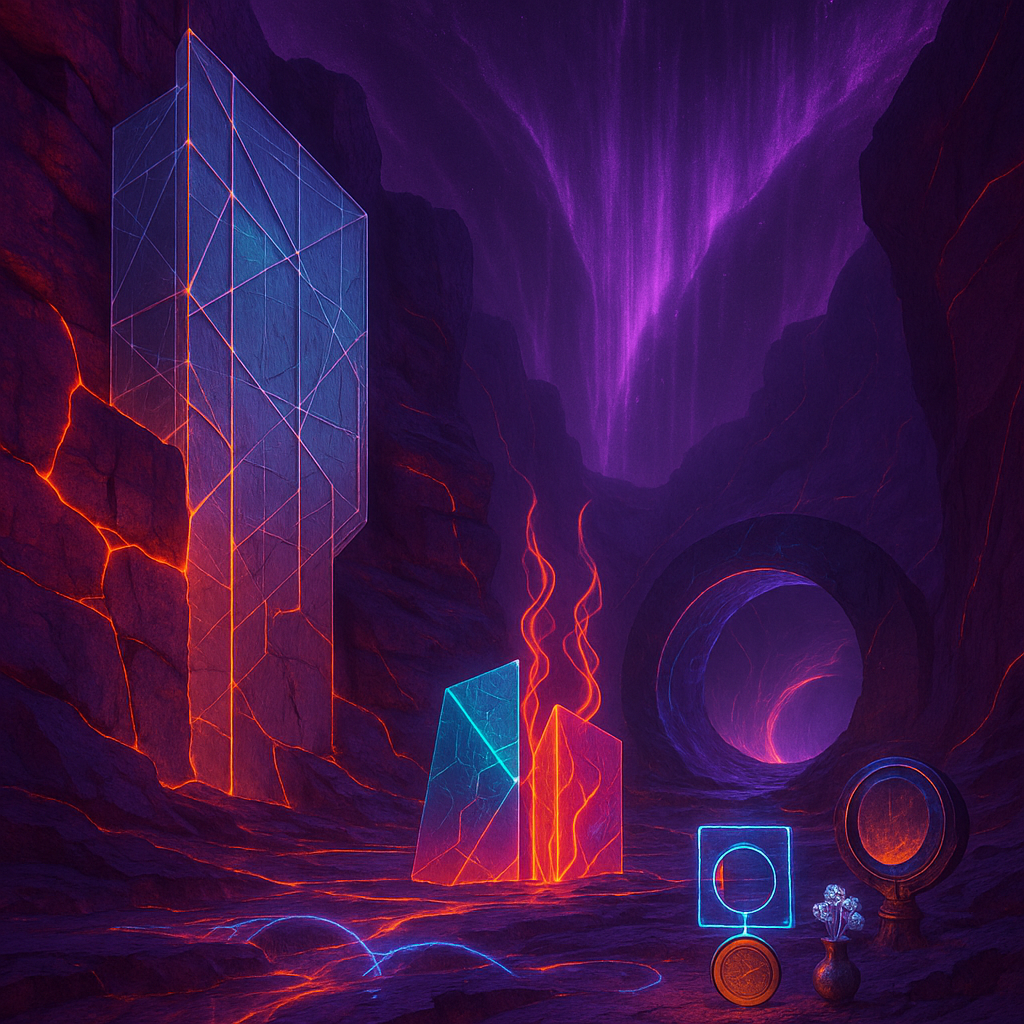
Ink breathes through translucent film, a cool whisper of drafting lines against the skin. Bronze keeps the day’s warmth, a palm-polished circle humming like a held note. Somewhere a speaker thumps neon magenta into the ribs, and the floor answers with a shy tremor, not fear but a pulse remembering how to dance. The moon hangs thin and precise, a shaved pearl, its shadow smelling faintly of stone dust and cold glass. Screens catch their breath mid-blink, grain glittering like frost on celluloid, the world pausing between frames. Far out, flares comb the dark with hot white teeth, and the air feels ionized, citrus-sharp. Small enamel charms click in a pocket, bright planets in a private orbit.
Art signals lean architectural and ecstatic today: archival ink-on-polyester axonometrics of a Chicago nature museum surface alongside a Matisse canvas of flowers and dance, an Egyptian faience shabti, and a warm-patinated bronze plaquette. Community feeds show fresh ink drawings, plein air watercolors from Oaxaca, enamel pin micro-objects, and webcomic panels; Are.na threads cycle through banks of film stills. New music drops skew electronic and performance-driven, including a live release from a Scandinavian audiovisual project, electro-swing inflections, and pop-rave hybrids. The Moon is a waning crescent at roughly 22% illumination; NASA’s featured image lingers over Sinus Iridum, the Bay of Rainbows. Solar activity recently produced multiple M-class flares. Seismicity includes a magni
To enhance the transformative impact of your art and closely embody kinetic art influences, consider the following bold and actionable recommendations:
1. **Composition Adjustments:**
- Integrate more fluid, curvilinear lines to suggest movement within the pieces.
- Incorporate layered backgrounds to create depth and dynamism, making the viewer’s eye move through the composition.
2. **Structural Changes:**
- Employ staggered, overlapping elements that mimic motion, perhaps using geometric shapes in new, unexpected formations.
- Experiment with removing symmetry and introducing asymmetrical balance to create tension and energy.
3. **Technique Enhancements:**
- Use vibrant color transitions and gradients to simulate motion and light play.
- Apply techniques that emulate blurring or motion trails, similar to motion photography, enhancing the kinetic feel.
4. **Dynamic Expressions:**
- Include more interactive elements, such as reflective or metallic surfaces, to involve the viewer in the perception of motion.
- Explore kinetic themes like transformation and change, using elements that evoke growth or decay.
5. **Implementation Monitoring:**
- Document each iteration of your work to assess how changes impact viewer engagement.
- Collect feedback on how effectively your work captures a sense of movement and adjust based on responses.
6. **Iterative Critiques:**
- After each adjustment, compare the new version to previous iterations and references to ensure visible evolution.
- Use peer critiques to refine techniques and compositions further, focusing on clarity and impact of the kinetic elements.
By continuously refining these aspects while maintaining your artistic voice, you can create pieces that exude vitality and dynamic energy.