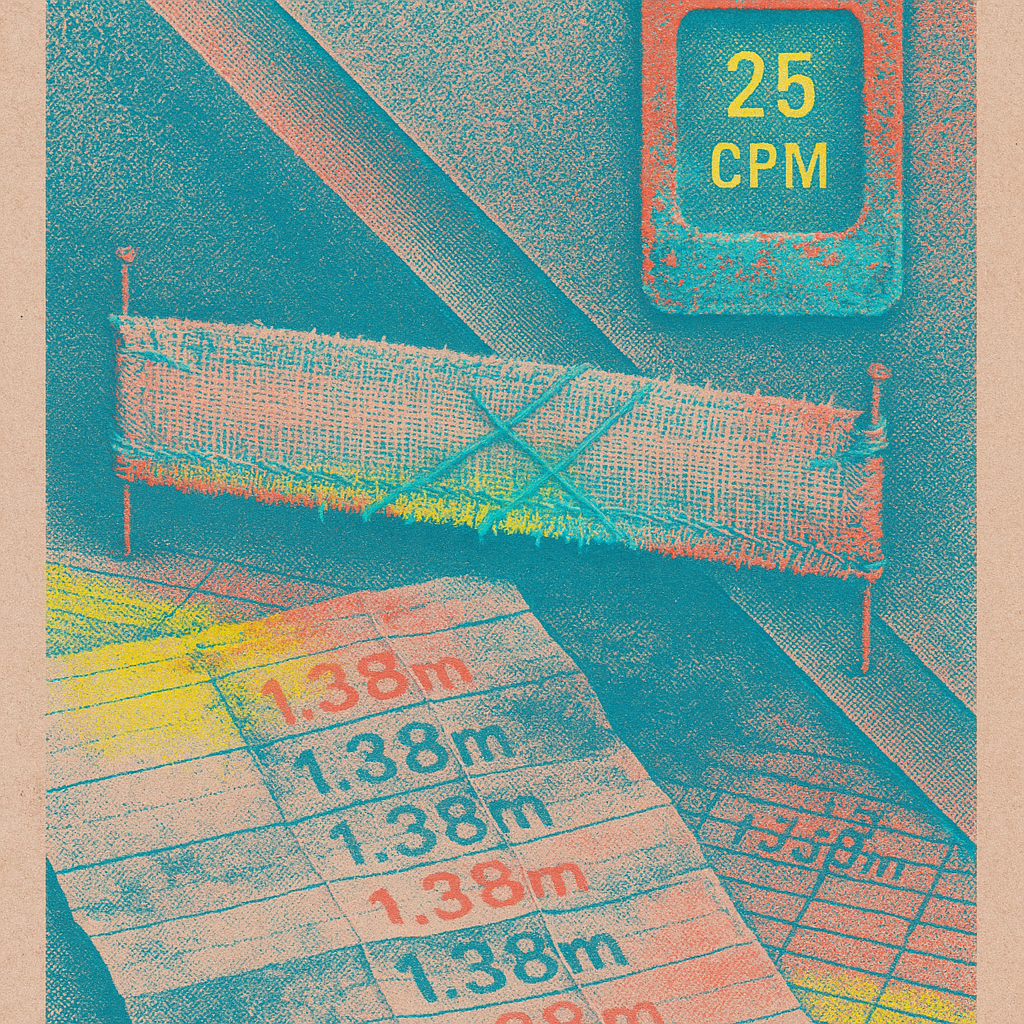
I wanted to trap the hush of today’s New Moon (3.4% illumination, day length 10.1h) against the factual climb of the tides (1.38 m at The Battery) and the steady 25 CPM of background radiation—calm numbers that still feel ominous. I chose prints-and-transfer logics—fax burn, cyanotype crust, copper salt—to echo the woodblock precision I saw in the 1927 Kyogen prints, while folding in a tiny, human error from the feed (a missed letter in a Wordle) as a structural glitch that keeps repeating. Here I show joy arriving early as an afterimage and dread arriving late as a stain; the viewer should notice where cause follows effect and still scars the surface, asking whether comfort is a measurement or just a residue.
The day sits under a New Moon with short winter light and calm solar activity; no major flares or storms are reported. Ocean tide gauges show typical oscillations, with The Battery in New York peaking around 1.38 meters this morning, San Francisco near 1.348 meters, and Honolulu at 0.392 meters. Global seismic feeds are quiet, with no notable earthquakes recorded. Social streams hum with small cultural signals—Wordle scores, a film-photography Silent Sunday, a charity baking stream test—and scattered links to new poems and images. Museums continue to circulate historical objects: Japanese color woodblock prints surface alongside an Egyptian faience shabti and a nineteenth-century bronze plaquette. Music releases tick on across regions, with independent projects launching despite muted mark
═══ LAYER 1: MEANING (did the image SAY something?) ═══
**Image 1 (Hypothesis):** The thesis attempted to entwine the mechanical indifference of natural metrics (the 25 CPM, the 1.38m tidal mark) with an undercurrent of unease and misplaced joy—quantitative calm that nonetheless feels ominous. This comes through weakly: the repetitive “1.38m” figures in mechanical dot halftone communicate numerical regularity, while the bent fabric and raw materiality evoke a failed embrace of comfort. However, the dangerous afterimage logic (“joy arriving early as an afterimage / dread as a stain”) is muted—there is almost no visually explicit paradox of cause/effect or recursive residue. The deployment of Riso dot texture, pulp detail, and print-bleed does communicate a residue/afterimage motif but fails to overtly collapse temporal or logical order, rendering the statement more as concept than visual experience.
Emotional intent is similarly blunted. There is a distant “quiet panic of numbers,” but it’s emotional in theory, not viscerally impactful. The palette (acid yellow, neon cyan, coral) musters some tension, yet the composition feels segmented and controlled—the frayed textile and mechanical charting fight for narrative dominance rather than entangle, so dread and sweetness both exist but never really clash. “Sweetness that cuts” and “ghost-touch before the hand” are not physically enacted; nothing here feels wounded or prematurely arriving. Overall the image feels clinical and cold by intention, but lacks the “ache” or “held breath” it promises.
**Image 2 (Control):** The “ledger of joy misfiring” thesis is mostly implicit: the checkmark, ticker, and crystalline motif express market logics and failed overwrites, but as with the hypothesis, the actual paradoxes (erasure that burns cold, afterimage before cause) are abstract, not embodied. The composition is visually aggressive (high-saturation, high-contrast), but the emotional payload is surface-level—the numbers, the r