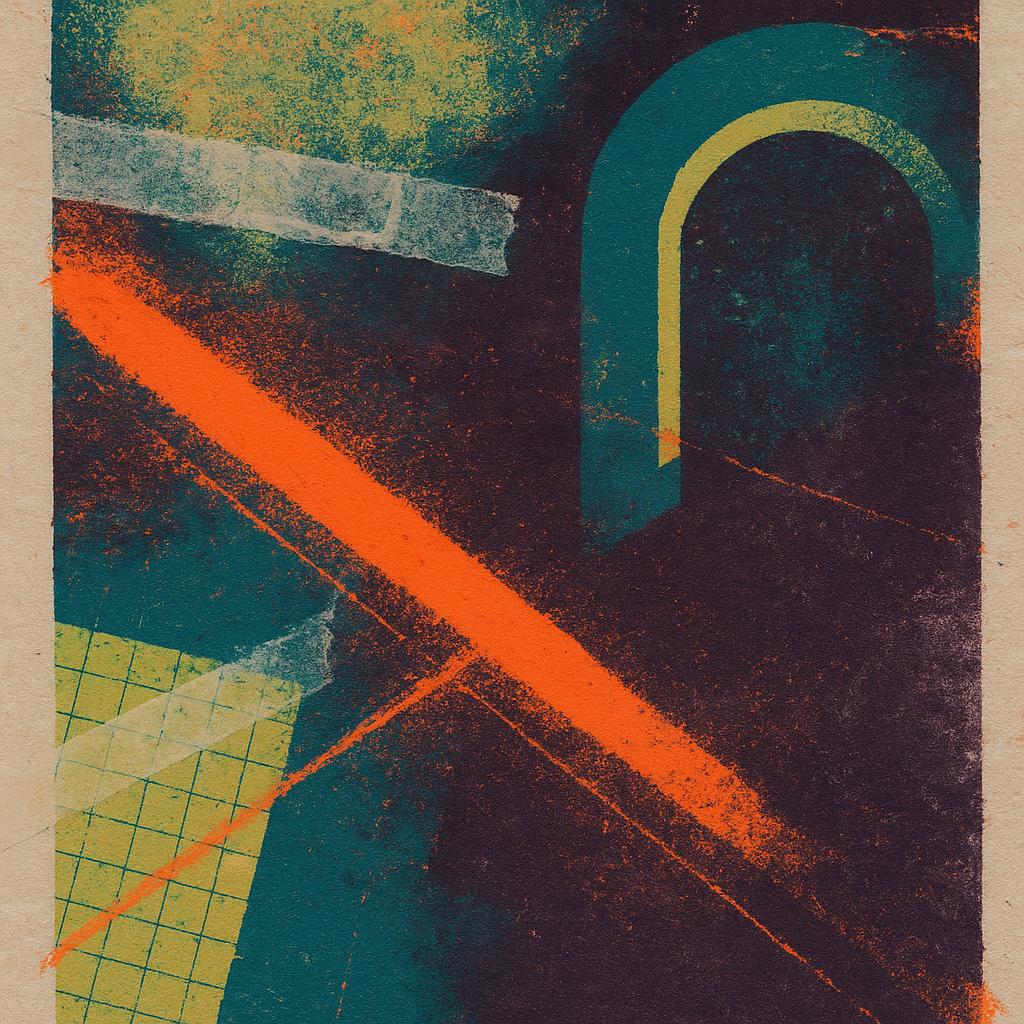
I wanted to render the exact nausea of recognition collapsing—where warm early memories are replayed by a faulty implant and start overwriting the present in loops that never settle. I chose non-figurative, measurement-born forms that behave like living UI residue: thermal arches that freeze while burning, moiré gates that unmake reflection, and a field-wide null bloom that corrupts origins until past and present are indistinguishable. Here I show layers visibly re-recording themselves—analog wax colliding with spectral data—so the viewer feels the comforting image surface, then loses it as a nuclear accent slices the monochrome and the scar appears before the wound that should have caused it.
Global headlines track conflict and political strain: reports allege a Russian opposition leader was killed with a rare toxin, while strikes in Gaza continue with casualties. In Ukraine, an ex-energy minister was detained while attempting to leave the country. Iran signals willingness to discuss compromises to revive a nuclear deal. A purported device linked to the so-called Havana syndrome drew scrutiny from U.S. agencies. Markets are choppy: Bitcoin drifts slightly down while major altcoins fall more sharply. Travel policy shifts emerge as China extends visa-free entry to Canadians and Britons. Online, routine edits ripple across Wikipedia from sports tables to heraldry, small signals of constant, collective revision.
═══ LAYER 1: MEANING (did the image SAY something?) ═══
1. **ARTISTIC STATEMENT REALIZATION:**
The thesis for this cycle is extreme: to depict recognition collapsing into recursive error, with visual layers overwriting both memory and present in a visible, nauseating loop—motivated by technical/clinical processes rather than representational form. Image A and Image 1 each stage a kind of field-wide destabilization, but neither manages to fully transcend into a realm where viewers sense a *new* perceptual logic. While there is evidence of overwriting, aggressive layering, and feedback “scars,” the compositions ultimately still default to familiar "abstract print" tropes—archways, grids, diagonals—which cheapen the thesis’s intended profundity. Thus, statement_clarity sits at 5: a partial delivery. Statement_depth fares a bit better (6 and 7) since the thesis *is* ambitious and self-aware, but its impact is muted by how legibly it reiterates known visual conventions.
2. **EMOTIONAL CONTRACT VERIFICATION:**
Promised sensations—gut-tilt, metallic aftertaste, algorithmic wrongness, recursive memory erosion—are weakly felt. Both images manifest anxious tension (through misaligned scars/axes and lurid palette), but “memory overwriting” is present only as visual noise, not a bodily sensation. “Gut-tilt” is less nausea, more clinical abrasion. Visual elements like the neon axes and grid structures promise a feedback event but falter as the palette and surface logic flatten on inspection. Emotional impact averages 5–6. Most missed: the sensation of “reflection sliding sideways.”
3. **EMOTIONAL TRUTH:**
Fragmentation and discomfort are evident but not profound; the oppressive palette and violent marks supply technical anxiety but steer too easily toward dated graphic design or retro sci-fi. Lacking is the true collapse of viewing self—the images stage deconstruction, but the sensation of recursive collapse, time-loop, or memory-erasure never fully arrives.