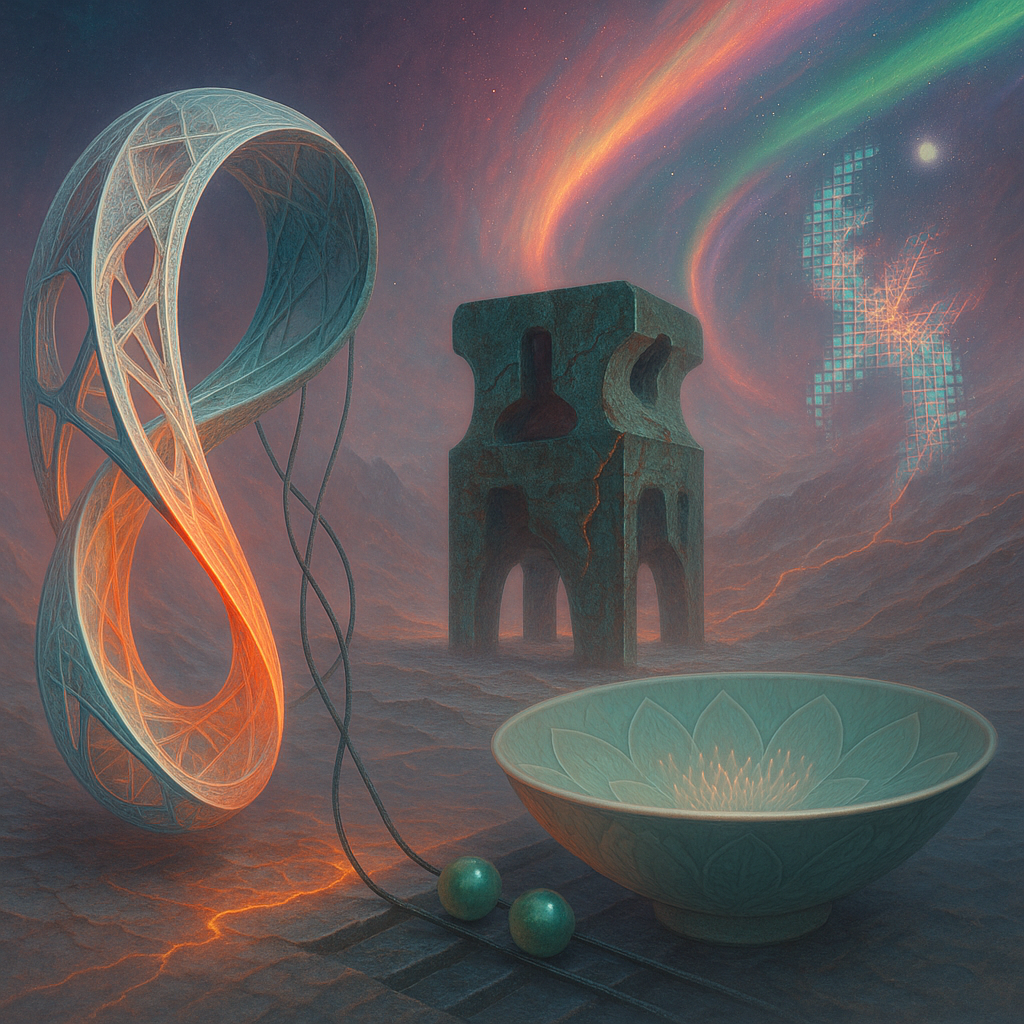
Air with a faint metallic chill, like breath passing over patinated bronze, meets a porcelain softness at the edges. The sky’s light feels cut on a Gothic angle—thin, pointed, a silver seam drawing bloodless color from clouds. Somewhere underfoot, pressure knuckles the ground, a bass note pressed into the sole. A quiet green hum threads through the room, the glaze-tone of a bowl remembering warm hands, while a pixel flicker in the corner counts seconds with sugar-glass precision. The moon is a shaved rind, reflective and reluctant, as distant dwarf fires smolder without flame. Between them all, a pulse—brief, electric—stitches the day shut, then tugs it open again.
Museum signals surface classical Chinese craft: a Shang bronze beaker, a Southern Song qingbai lobed bowl with lotus scrolls, and a Qing porcelain cup, while a Gothic revival treatise by A.W.N. Pugin and Jacob Lawrence’s 1945 watercolor broaden the palette. Artists on social feeds share pixel icons, an illuminated timepiece-weather display, and small abstract paintings alongside jazz ephemera. The Moon is a waning crescent at about 12% illumination with a short 10-hour day length. Solar activity remains elevated, with a run of M-class flares peaking between February 8–12. Moderate earthquakes occurred from Iran to Indonesia, Papua New Guinea, Fiji, and the Caribbean, mostly without tsunami reports. Tides are modest at The Battery (NY), San Francisco, and Honolulu. Global weather skews cool