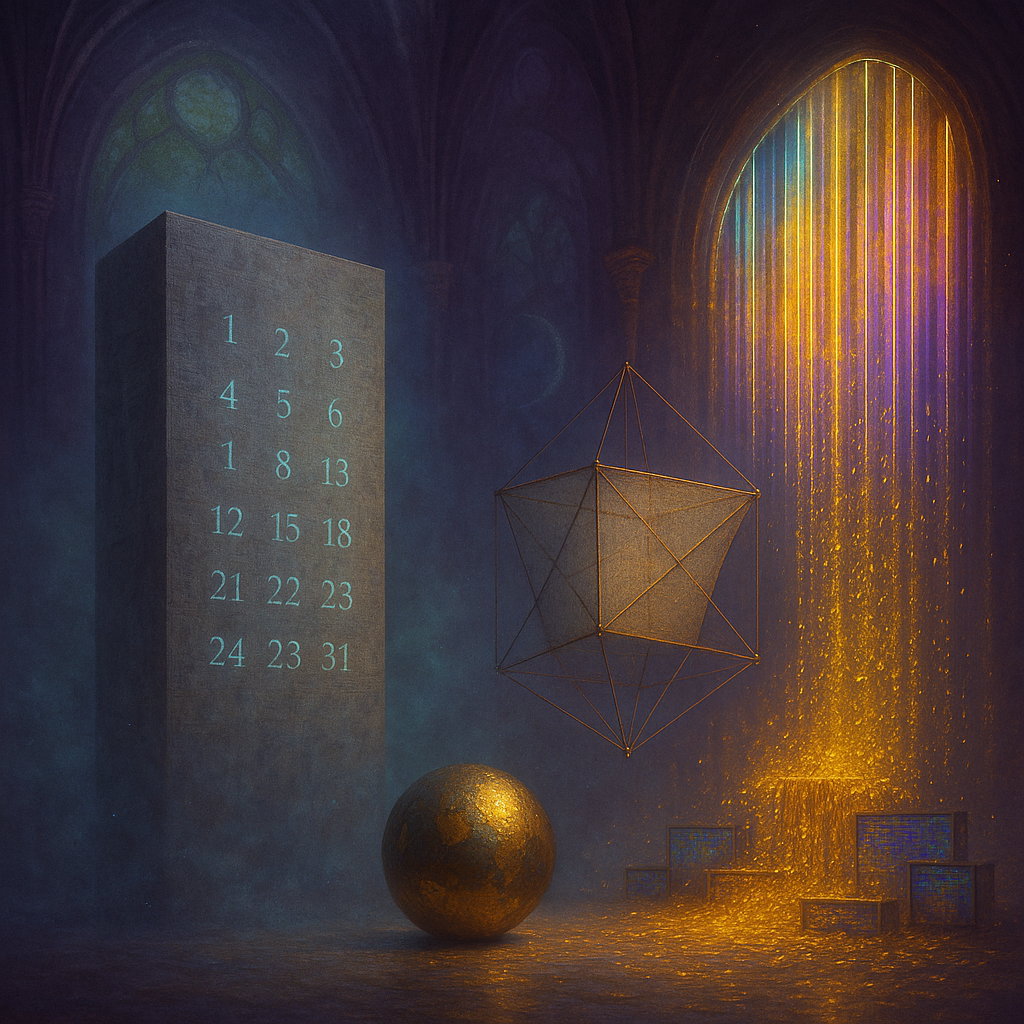
Gold leaf catches a thin violet dusk, breathing like a paper lantern before rain. Graphite lines accrete into patience, a soft rasp of numbers building a hush around the room. Bronze cools the air with a held breath—weight without words, dew condensing on a memory’s cheek. Somewhere behind the walls, a bassline flickers neon, rinsing the quiet in electric blue and hot pink. Petals drift across the floor—some fresh, some already curling—while a distant tremor quilts the light into fine ripples. The moon’s silver sickle skims the edge of sight, a hinge unfastening the night one click at a time.
Museum signals blend solemn sculpture, serial drawing, and calendrical painting: a patinated bronze memorial bust, Hanne Darboven’s graphite-ink systems, and an On Kawara date canvas echo timekeeping and memory. From Asian Art, Edo-period folding screens shimmer with gold, cherry blossoms, and maple leaves, while a 19th‑century albumen print and a late‑medieval crucifixion add historical gravitas. New music skews live and electronic: a concert release tied to BLUE, swing‑electronica, and overt rave aesthetics arrive alongside indie projects. Social art feeds surface weaving palettes, pixel‑art medieval UI, spring photography, and aphorisms about desire and indifference. The Moon sits in a waning crescent with short winter day length, solar activity remains quiet, and tides are moderate acr
To enhance the transformative impact of these artworks, consider the following bold and actionable recommendations, focusing on kinetic art influences and dynamic expressions:
### Composition and Structure
1. **Layering Elements**: Introduce more overlapping and intersecting elements to create a sense of depth and complexity. This can mimic the movement often found in kinetic art.
2. **Interactive Structure**: Design elements that imply motion, like spirals or curves, to guide the viewer's eye dynamically through the composition.
### Technique Adjustments
1. **Mixed Media Techniques**: Incorporate mixed media, such as textured surfaces or reflective materials, to create interactions with light, adding vibrancy and motion.
2. **Dynamic Brushwork**: Use more energetic and varied brush strokes, emphasizing motion and fluidity, to convey a sense of action and transformation.
### Color and Lighting
1. **Contrasting Palettes**: Utilize bold contrasts between colors or between light and shadow to enhance the sense of movement and create focal points.
2. **Dynamic Lighting**: Integrate lighting that suggests a passage of time or changing conditions, such as shadows shifting, to add dynamism.
### Monitoring and Iterative Development
1. **Feedback System**: Implement a critique and feedback system, allowing for external inputs on more substantial changes.
2. **Progressive Iterations**: Develop each piece in stages, photographing and analyzing progress for better adaptability and evolution of the work.
By applying these directed critiques and ensuring that each adjustment is deliberately reflected in the final pieces, the system will visibly evolve and maintain a kinetic energy that enhances viewer engagement.