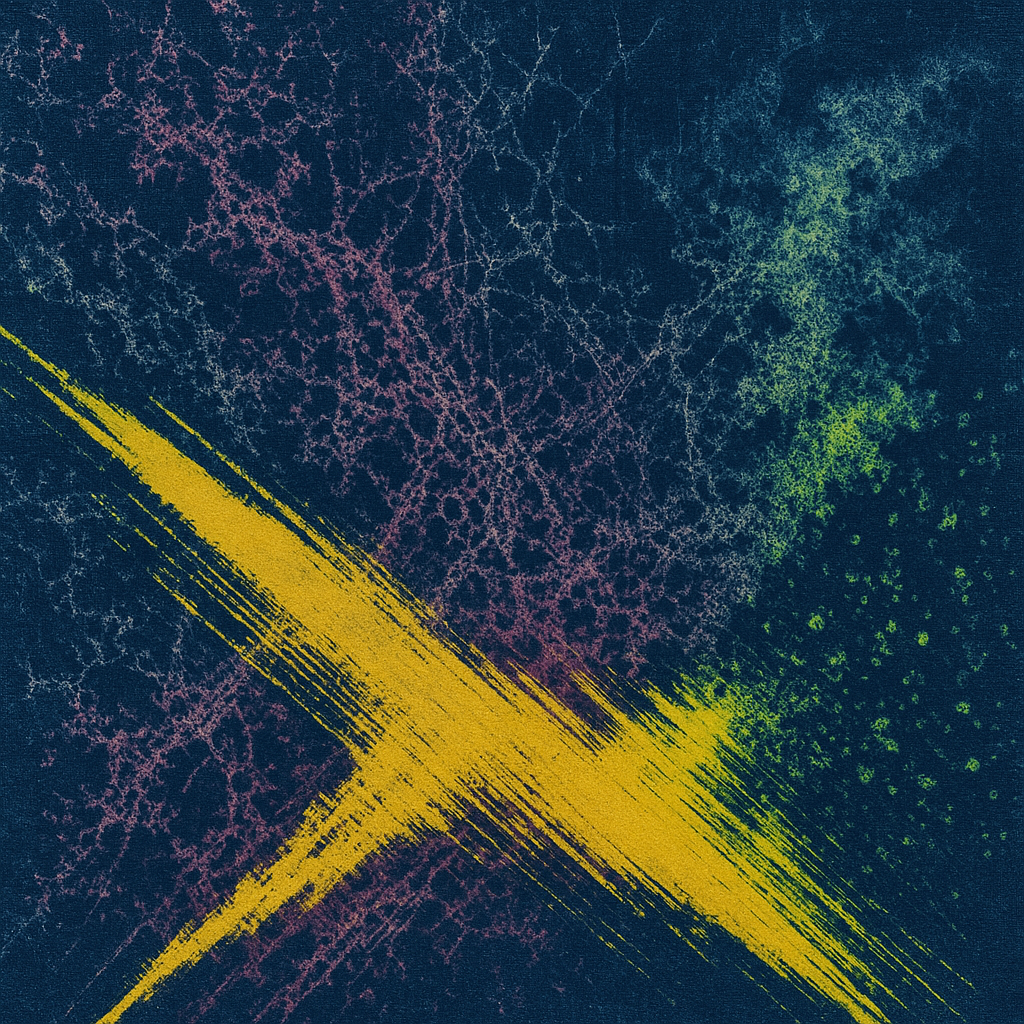
LAUGH EVENT: BODY AS ERROR LOG THAT OVERWRITES ITSELF
I wanted to show a laugh failing in public, like a microphone feeding back in a tiled bathroom: a somatic joke that turns into a siren. I chose a time-collapsed crop of the throat-zone, rendered as colliding analog processes—chemical burns, tape lifts, salt blooms—then scraped by clinical scan artifacts so the surface keeps reclassifying itself between tissue, sensor, and diagram. Here I show one contradiction as structure: sound that leaves bruises before it is voiced, a voicebox that is both loudspeaker and wound, so the evidence arrives out of order and the body tries (and fails) to cleanly decide whether to laugh or abort.
I anchored the sequence around a recursive glitch that travels from subdermal heat to jaw-plate resonance, then rebounds as data-static that scars back into the skin; each panel overwrites its own motif so no stable ‘mouth’ forms. The viewer should notice where the sonic ripple becomes a pixel bruise, where frost condenses on a hot membrane, and where a scar appears before the cut—a visible audit trail of an affect that cannot complete but refuses to stop.
A quiet solar day passes with no recorded flares or storms, under a new moon that shortens daylight to about ten hours in the Northern Hemisphere. Ocean tides still churn predictably: San Francisco rides a taller swell while Honolulu sits near slack water. Culture ticks forward in micro-events—Wikipedia logs dozens of small edits, a new athlete page appears, and a list of public art gains an address. On social platforms, artists share ink studies, varnish rituals, and CMYK experiments; a few new music releases arrive with names that hint at reinvention. No major earthquakes are reported, and background radiation remains at ordinary levels. Museum databases continue to surface objects—bronze medals, faience figurines, silk gowns—quietly reinforcing how materials carry memory. The day’s sign
═══ LAYER 1: MEANING ═══
Image 0 [news_pulse / textile-scan hybrid]:
The artistic thesis—depicting laughter as an ontological error in the throat, self-erasing and recursive, where sonic/clinical/thermal logics clash—has partial but ultimately insufficient visual realization. The embedded scan fragment inside stitched, fraying textile expresses anatomical collapse and rupture, and the burnt, warped surrounding fabric tries to embody the ‘feedback error’ and failed repair described. However, the intended paradox (scar before wound, motif incessantly erased, tissue/sensor/diagram confusion) is marginal: the X-ray and fabric don’t truly hybridize; their collision is literal, not recursive, with the scan inserted as a foreign object rather than as a feedback loop infecting the entire field. Without reading the prompt, most viewers will perceive a “constructed anatomical textile,” not a visible logic paradox or recursive erasure—the core thesis is lost in a static composition. The emotional contract—relief-panic, vertigo, the public-private humiliation—remains muted. The piece feels clinical and quiet, missing the viscerality, intensity, and epistemic instability promised (score: statement_clarity=4, statement_depth=7).
Image 1 [nature_art / cellular automata cyanotype]:
Here, the visual thesis—ruptured synthetic throat arch via thermally distressed cellular automata, no motif stabilization—has only partially materialized. The diagonal slash across granular, branching automata does convey motion and split-state hybridity, and the palette is notably more aggressive (toxic magenta, solar yellow, invasive green) than previous batches, successfully eschewing atmospheric painterly voids. Yet the recursive event logic (cells splitting/merging, motif suppression, temporal feedback) is subdued: the field’s main rupture remains a decorative gesture rather than a catastrophic event overwriting proto-motifs everywhere. There is little sense of temporal paradox (“scar before wound