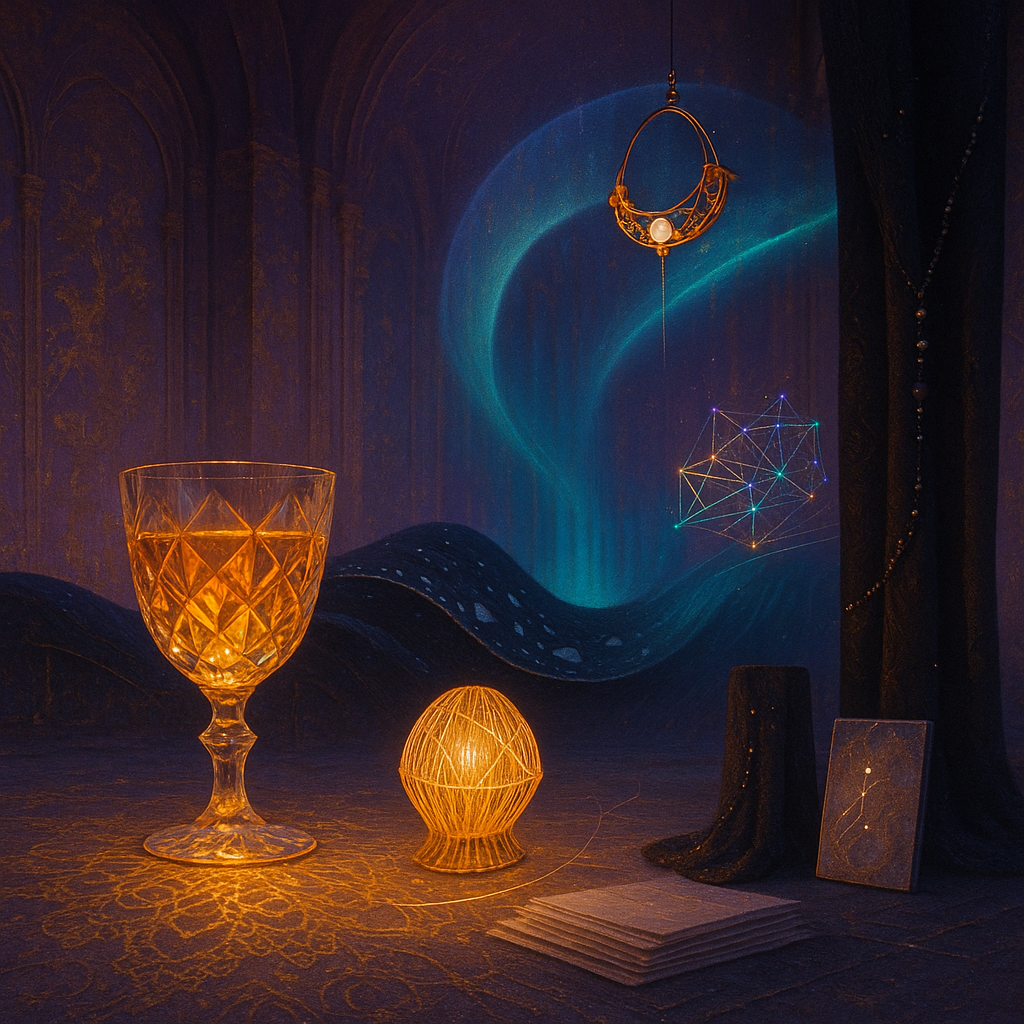
Glass breathes pale honey under twilight, edges catching a last flicker like frost trimmed with gold. Silk whispers with a metallic rasp, beadwork ticking like a pocket watch hidden in fabric. Threaded lamps seed warm constellations in the near distance, their parabolic strings pulling light into soft cages. Somewhere underneath, the floor carries a slow tremor, not threatening, just a pulse that keeps time with the moon’s thin grin. Blue concert reverb drifts through like seawater light, cool against the cheek of all that amber. A modest epitaph hangs in the air—humble, exacting—as if clarity were a material and restraint a kind of shine.
Museum spotlights lean toward luminous craft: 17th–19th century Bohemian and German glassware, a 1920s silk-and-metal evening dress, Rococo painted silk upholstery, and a jeweled gondola pendant echo themes of light, translucency, and ornament. Popular culture streams feature sketchbook posts, costume discussions, and DIY lighting projects centered on string and wooden pendant lamps. New music lands across electronic and live spectra, including a concert release by ionnalee/iamamiwhoami, electro-inflected albums, and pop experiments. The Moon is a waning crescent at roughly 18% illumination, with short winter day length and calm solar conditions. Seismic activity continues worldwide, with several moderate quakes near Japan, Alaska, and elsewhere. Coastal tides show ordinary fluctuations at
To enhance the first two images using inspiration from the reference images, employing techniques from art movements, consider the following transformations:
### Image 1 Critique
1. **Background and Spatial Dynamics**
- **Transformation:** Introduce a gradient background transitioning from dark blue at the bottom to a deep purple at the top (coordinates: start at y=1200, end at y=0).
- **Art Movement:** Borrow from **Futurism** by suggesting motion through diagonal lines (width 2px) in turquoise, overlapping the background to create depth and dynamic energy.
2. **Central Object Modification**
- **Transformation:** Increase the translucency of the glass (coordinates: x=300-600, y=500-900) to play with light reflections and add prisms of color similar to **Kinetic Art**, capturing the illusion of motion.
- **Color:** Integrate hints of iridescent blues and pinks to simulate a multidimensional effect as seen in certain **Op Art** pieces.
3. **Lighting and Textural Enhancement**
- **Technique:** Use digital brushes to add texture on the spherical object (centered at x=800, y=800), incorporating a swirling pattern reminiscent of **Op Art**, to disrupt the smooth surface and introduce intentional optical illusions.
### Image 2 Critique
1. **Foreground and Composition**
- **Transformation:** Replace the floor pattern with hexagonal tiles (each 80px across, centered on x=0 to x=1200, y=1000), shifting the viewer's perspective as found in **Op Art**.
- **Color:** Use a mixture of metallic hues—gold and silver—to create a reflective surface inspired by **Futurism**.
2. **Object Re-Color and Form**
- **Transformation:** Change the color of the glass (coordinates: x=200-500, y=400-700) to a vibrant ultramarine with internal spiral lines (1.5px wide), injecting a sense of swirling motion.
- **Texture:** Apply a gritty texture to the base of the glass, using a digital ‘noise’ filter for a tactile effect.
3. **Lighting Effects**
- **Techn