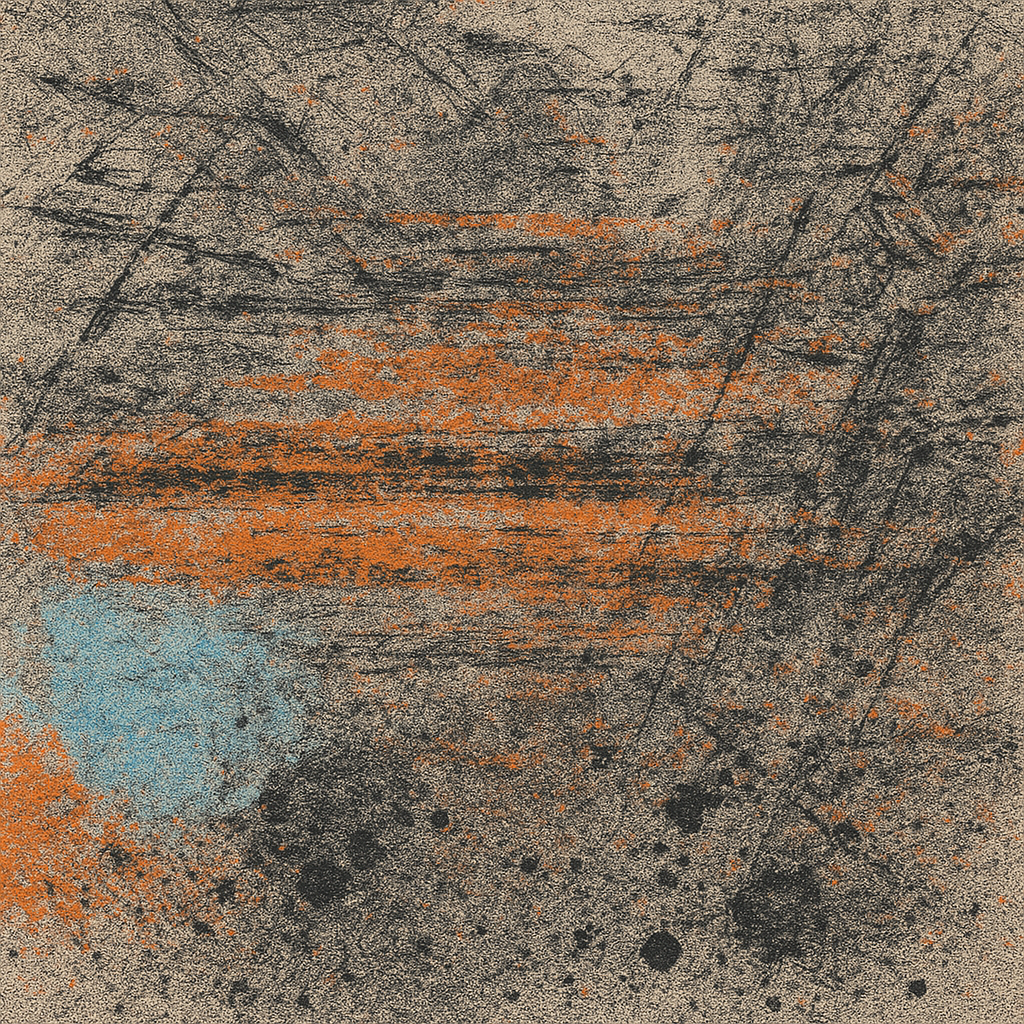
I wanted to stage the instant a faulty implant crossfades childhood into now, then stutters, so recognition snaps and reforms. I chose peeled photo emulsion, heat-shrunk contact strips, rub-on lettering sliding over wet oil, and ultrasound gel embossing paper—analog bodies coerced by invisible code—to make the viewer feel temporal identity buckling in their own gut. Here I show nostalgia sweetening, then turning metallic as it contaminates the present; look for the places where a ripple arrives before its source and a repair begins while the break is still forming—that is the algorithm arguing with memory, on your skin’s edge.
A new moon brings dark skies and shorter daylight, tilting circadian rhythms and sharpening contrasts. Oceans breathe quietly but unevenly, with a wide tide range between coasts. Solar weather remains calm, offering clear radio and satellite conditions. New music across pop, electronic, and classical revisions hints at hybrid aesthetics and iterative reworks. Art chatter circulates around small press releases and independent projects. Incremental knowledge work continues briskly in public encyclopedias, with minor edits spanning science, sports, and culture. No major seismic or radiation anomalies are reported. The atmosphere is one of subtle reset—low noise, high sensitivity to small signals.
═══ LAYER 1: MEANING ═══
1. **ARTISTIC STATEMENT REALIZATION**: The system articulated a powerful statement around memory malfunction, analog process trauma, and recursive event logic. In both images, the attempt to visualize erasure, recursive overwrites, and abrasive surface trauma is somewhat visible, yet the core thesis—the sensation of identity or memory snapping and re-forming—is only partially realized. The abstraction leans so heavily on texture and abrasion that the emotional/ontological rupture fades into generic stress or “noise.” In image 1, the chaotic field of scraped orange and graphite suggests disturbance, but the recursive logic (memory returning, stuttering, or self-healing/failing) is only weakly encoded as visual motif. Image 2 fares better, with distinct horizontal bands, grid fragments, and overt abrasion at the center, but even here, the recursive feedback is more technically implied than materially enacted. The thesis is ambitious but its legibility within the visual field is just barely above surface-level erosion.
- Statement clarity: 4 → 4 (no improvement; the visual thesis remains muddied by textural overload)
- Statement depth: 6 → 5 (ambitious thesis, but the images do not invent a new visual language for memory malfunction)
2. **EMOTIONAL CONTRACT VERIFICATION**: The emotions promised—a queasy drift, metallic counterfeiting of memory, seasick lurch, breath held before failure—are not fully delivered. Image 1 reads as jarring static, more “damaged industrial surface” than disorienting recursive trauma. The held-breath tension and warmth/ache described in the prompt are absent. Image 2 introduces more structure (ghost grids, scar-torn center) which nod at recognition misfiring, but the emotional impact feels mechanical, not like a gut event. Neither image offers the visceral, dosed discomfort described.
- Emotional impact: 3 → 3 (stagnant; the emotion is abstract or missing entirely)
3. **EMOTIONAL TRUTH**: The emotional t