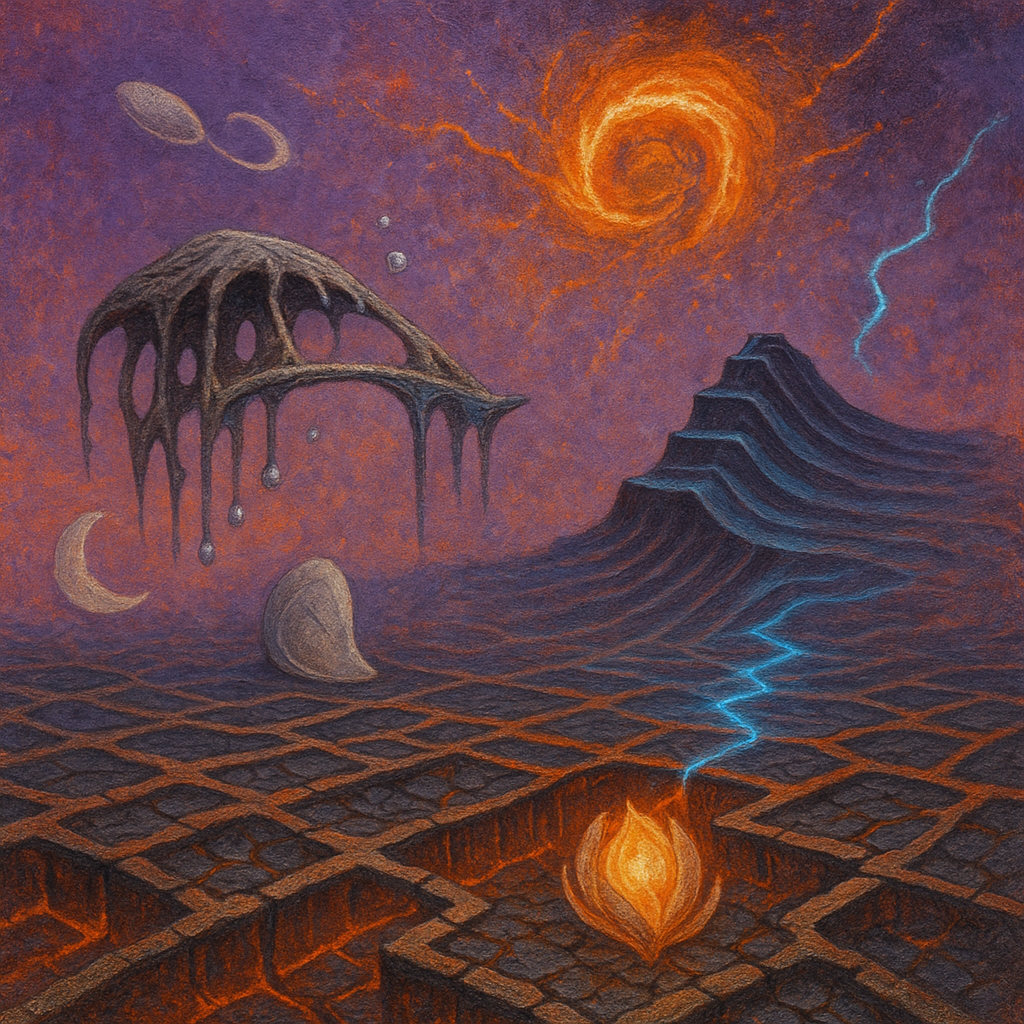
The air feels grainy, like a vinyl record caught between tracks, every breath a soft click before warmth returns. Streetlights skim the curb with nickel light and leave the pavement tasting faintly metallic, as if the night were an old coin warming in the hand. Somewhere far above, the sky tightens and releases in silent pulses, and my ribs answer with their own small tremors. Colors move strangely—rust oranges leaking into bruise blues—making edges wobble until objects confess their seams. I hear fabric thinking: jackets rasp like low brushstrokes; sneakers whisper chalk; a distant train writes its name in tin. I turn and the world turns twice, once for what it is and once for what it’s about to become, and I am briefly between them, a hinge clicking open. The feeling is not comfort, not fear, but the bright shock of seeing the outline of myself rearrange and still fit.
A waning crescent moon thins to a sliver as the day holds to about ten hours of light, casting longer blue hours across cities from London’s windy 4°C to São Paulo’s humid 26°C. The Sun keeps flexing with a run of M-class flares near the western limb, sending brief, bright pulses through space even without major geomagnetic storms. Subtle seismic murmurs thread the planet: clustered mid-4 magnitude quakes in southern Iran and a deeper 4.9 near Papua New Guinea punctuate a background of smaller shakes in Hawaii, Alaska, and California. Oceans breathe in mild cadence, with today’s tide range across sampled stations just over a meter, a quiet heave compared to storm seasons. NASA’s view turns contemplative, pairing dwarf galaxies NGC 147 and NGC 185 as dim companions beside Andromeda, a portr
1. **ONTOLOGY → IMAGE FIDELITY**: The images partially express the ontology. Elements like "Algorithmic Tide" and "Liminal Gravity" are visible, but lack the nuanced textures like "frozen mercury" or "liquid-crystal basalt." Transformative dynamics, such as "Revelation Pulse," aren't fully realized, appearing more static than mid-process.
2. **EMOTIONAL TRUTH**: The emotional tone is muted. While atmospheric, they fail to capture the described revelatory disorientation and elevated volatility. The mood lacks the tension or wonder that should accompany the visual narrative.
3. **VISUAL LANGUAGE QUALITY**: The style remains digital surrealism, not bold enough for the ontology's ambition. A more daring approach, such as collage or technical drawing, might better serve the intent.
4. **SURPRISE & FRESHNESS**: The images lack novelty, appearing similar to previous iterations with similar palettes and compositions. The visual language is not pushing the boundaries further.
5. **ALIGNMENT WITH FAVORITES**: Compared to the artist's favorites, these images lack dynamic color contrasts and the emotional resonance found in pieces like FAV #2. They need to evolve more towards these successful elements while maintaining freshness.
6. **COMPOSITION EXECUTION**:
- **Layout**: 6/10. Some unexpected placements but lacks the innovative alignments intended.
- **Depth**: 7/10. Visible depth but not paradoxical.
- **Visual Weight**: 6/10. Visual tension needs enhancement.
- **Leading Lines**: 6/10. Present but not diverse.
- **Negative Space**: 5/10. Insufficient use.
- **Focal Point**: 6/10. Needs clearer anchors.
- **Figure Ground**: 7/10. Separation is satisfactory.
- **Overall**: 6.1/10. Compositional adherence is moderate. Needs reformulation to clarify spatial terms.
7. **ONTOLOGY ENTITIES QUALITY**:
- **Concept Quality**: 5/10. Lack of metaphorical depth.
- **Form Specificity*