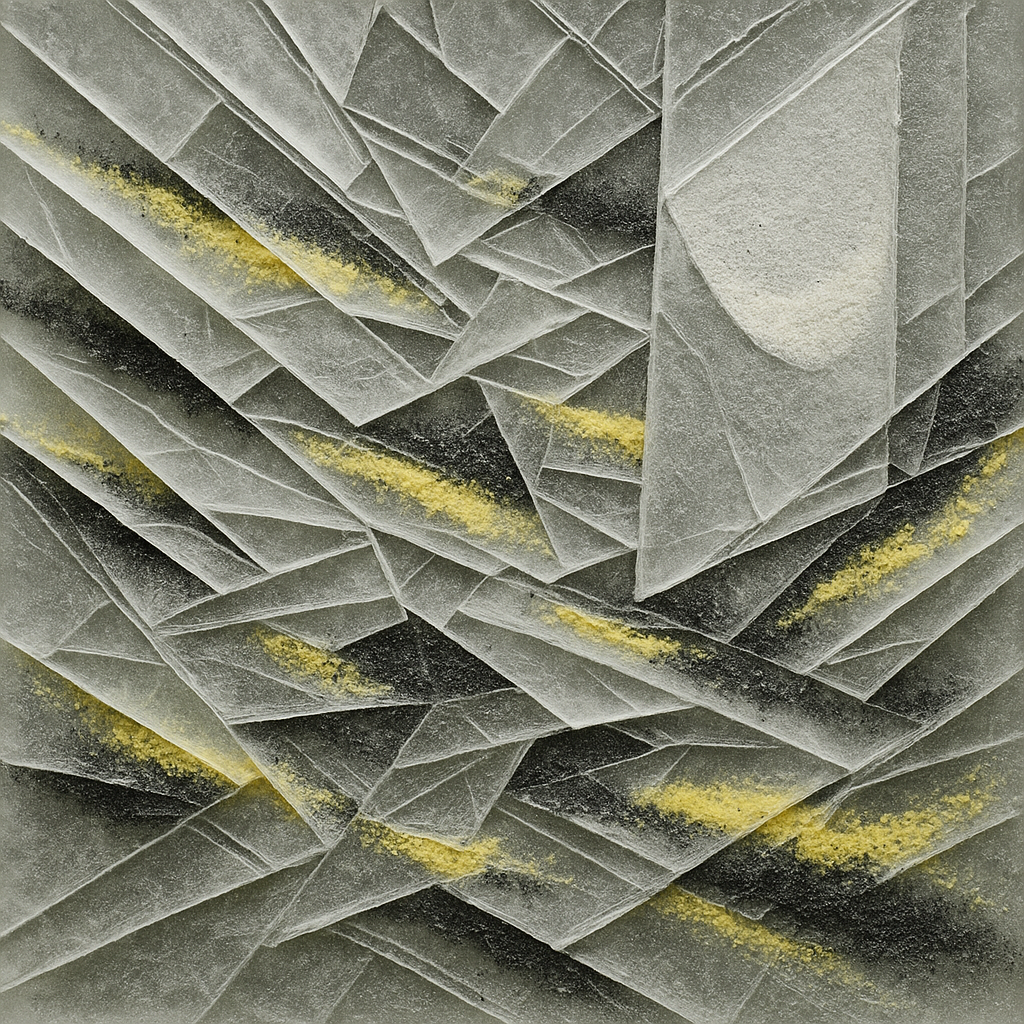
I wanted to replace the skull-and-mushroom fable with a clinical metamorphosis: like watching a sugar-glass panel craze under a heat lamp and then re-knit itself through refracted light alone. I chose pleated polymers, liquid-crystal laminates, and spectral stains because they can visibly store and re-emit traces without ever stabilizing into a motif. Here I show memory as an indexical bloom that appears before its source—the neon caustic seam on the pleated sheet arrived first, forcing every other surface to rewrite to match it, which fulfilled my intent to depict identity as a calmly contagious process rather than a breakdown.
A new moon brings darker skies while solar activity remains quiet with no notable flares or storms. Global background radiation sits near typical levels. Ocean tides continue their regular rhythm, with higher water levels reported at San Francisco’s station this morning. Cultural feeds hum with small signals: contemporary art chatter, a few image posts, and minor fan art trends. Wiki activity is brisk but routine, mostly edits and category tweaks with no major bursts. Several new music releases land this week, from electronic euphoria to indie artifacts. There are no prominent earthquakes or breaking news items surfacing in this slice of time. The atmosphere feels liminal: low-noise conditions that heighten perception of small anomalies.
═══ LAYER 1: MEANING ═══
Both images attempt to manifest the system’s thesis: "MEMORY BECOMES AN ENGINEERED LIGHTFIELD, NOT A GHOST" and "NEON ARCHIVE THAT REWRITES ITS OWN ORIGIN." While the formal ingredients echo the language of indexical stains, stratified glass, and recursive overwriting, the thesis is only faintly legible. The images’ compositional systems (scattered planes, embedded sulfur-yellow bands) technically nod to “recursion” and “process overwrite,” but neither breaks new ground in making memory operationally visible—these visuals remain heavily within the language of refined, controlled decorative relief, not a catastrophic recursive event. The intended emotional resonance—serene dread, alien exhilaration, vertigo of scan—struggles to push through a surface dominated by safe geometric ordering and smooth, softly-merged textures. Any sense of emotional contract (catalogued by a luminous echo, error as design, healing/unbuilding, vertiginous recognition in scan) is dulled by the repeated compositional mode and palette; dread or horror never arrives, nor does the exhilaration of clean rupture.
Specifically, the first image’s broad, horizontal flows of yellow against transparent striations yield a faint sense of engineered lightfields and echo, but the effect is subtle and risks prettiness. The second image gestures toward chaos with fractured polygonal planes, but settles into a tame, grid-like field in which indexical yellow bands are overly regular and lack the catastrophe of recursive event. In both, statement depth is partially present (recursive, processual identity rather than motif), but it’s lost in visual translation—a viewer must stretch to “sense” the thesis without external text. The central claims (memory as recursive index, not motif; identity as actively overwritten, not collapsed) are simply not anchored by clear event metaphors or paradoxes. Emotional complexity is further dampened by familiar spatial logics and h